In the Serra Gaúcha region, robots are becoming a constant presence, operating from hospital corridors to restaurant tables and industrial production lines. Far from being just future concepts, these machines already play crucial roles in the current scenario.
The advance of automation has provided efficiency gains for various institutions and companies, allowing for the reduction of repetitive tasks and freeing up employees to dedicate themselves to more strategic activities that require human interaction.
Robots in Caxias do Sul Hospitals
In a hospital located in Caxias do Sul, one team member is not human, but rather a technological robot. This automaton circulates through the corridors delivering medication to nursing stations. Powered by the hospital pharmacy team, it follows pre-established routes and uses sensors to detect any obstacles in its path. Upon reaching its destination, the robot notifies the sector by phone so that the medicines can be collected.
The hospital pharmacy coordination reported that the robot transports over three thousand medications monthly within the unit. For the hospital, the greatest benefit lies in offering professionals a valuable resource: more time to dedicate to patients. André Leite, president of Unimed Caxias do Sul, emphasized that there are aspects beyond machine-human interaction, citing the importance of eye contact and shared experiences.
Grostoli with Italian accent
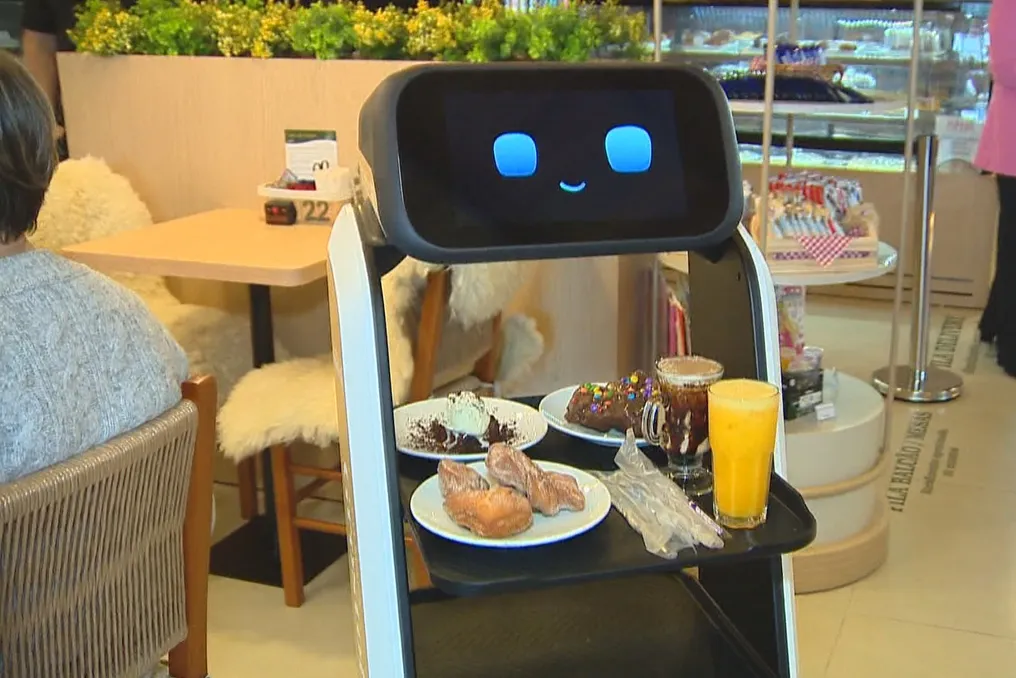
The application of machines is not limited to the healthcare sector. In gastronomic establishments, an electronic attendant interacts with customers, even speaking Italian between deliveries, saying something like: 'I hope you enjoy your dishes. The rest will be served shortly.' For the management of the place, robots primarily assist in transporting trays and heavier items. Meanwhile, traditional cooks remain responsible for preparing the famous grostolis.
Fabiano Ferrari, the restaurant manager, explained that without the robot, an employee would have to carry all that weight to the customer's table, and thus, the machine takes on the hard work, also promoting a more pleasant work environment for the employee.
Army of 600 Robots
In the factory environment, robots are already considered essential. At the Tramontina factory in Carlos Barbosa, automation has been expanded over decades with the aim of improving quality and processes. The board emphasizes that the goal is not to replace people, but rather to reduce repetitive tasks, redirecting workers to functions that add greater value.
Marcos Antônio Grespan, commercial director, stated that integration is necessary because without the human element, there would be no programming, robotics, or innovation. It is the robots that are responsible for moving stocks, supplying production lines, and performing phases of manufacturing pots and pans. In a short time, metal sheets are transformed into final products thanks to the collaboration between technology and specialists.
Rafael Vagliatti, technical manager, commented that robots support various aspects of the operation, providing high reliability, productivity, and a wide variety of uses.
Who programs the machines?
Behind every precise movement made by the machines, there is fundamental human work. In a company in Caxias do Sul focused on industrial automation solutions, programmers and technicians are responsible for instructing the robots to perform each activity. Speeds, trajectories, deviations, and minuscule movements must be configured by these professionals, who convert client demands into automated operations.
Eduardo Sachet, executive director, declared that the process consists of 'taking a client's need, making it viable, by creating the solution according to the client's product and need.' The result is a production that operates without interruptions, maintaining the same level of quality and repeatability throughout the production cycle.
For professionals in the field, the notion of worker replacement by robots is not confirmed in practice. Machines take on tasks of high precision and repetition, while programming, operation, and development of solutions remain dependent on people. Marcos Antônio Grespan, commercial director of Tramontina, reinforced that this results in quality improvement and allows the employee to be relocated to areas where their work has higher added value.