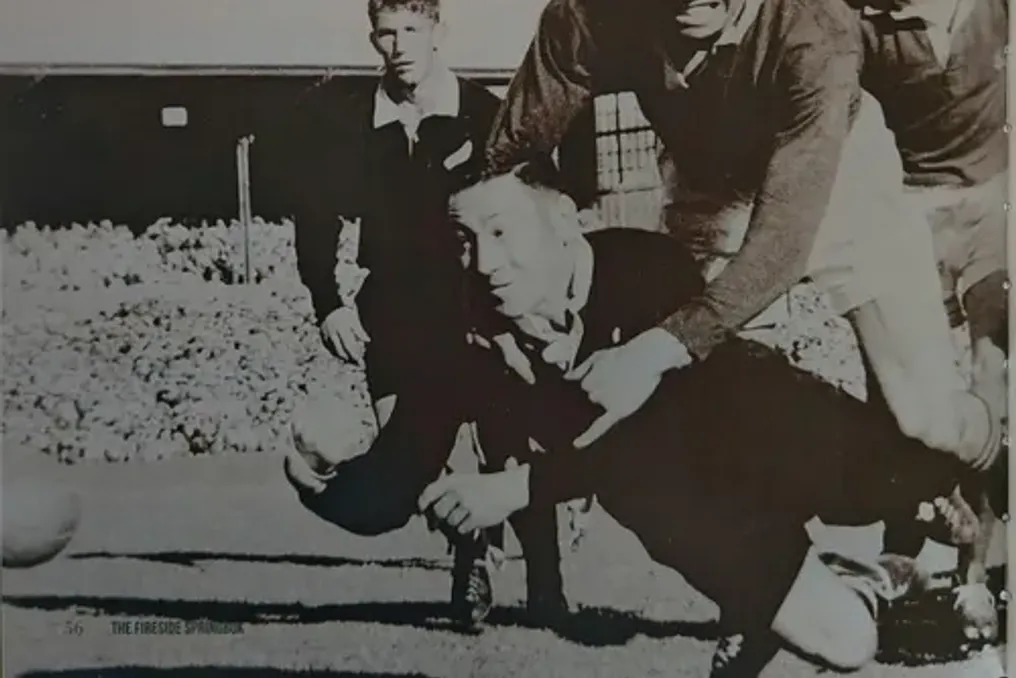
South African national team fans (Springboks) are known for their support, often associated with the idea that they have one eye, but there is a story about a team flanker who literally only had one eye.
Martin Pelser lost his left eye in an accident when he was only three years old, after driving through his father's car windshield. Despite this, he became an outstanding flanker for the Springbok team.
The only adaptation he made to the game was positioning himself closer to the right side of the scrum so that his single eye could survey the open field.
Colin Meads, whom many consider the greatest rugby player in history, highly praised Pelser. Over 15 years and 133 matches for New Zealand, the All Blacks player dominated world rugby like a colossus.
In 1974, when Meads compiled his all-time best players squad, Pelser—a humble mechanic and turner from Johannesburg—was included in his selection as one of the flankers. Meads noted: 'I think first of Martin Pelser, the one-eyed Springbok. What a player he was. He was one of the strongest and most skilled players I ever played with. Pelser was just a headache for the 1960 All Blacks (when they toured South Africa). I say this in the best possible sense. He gave huge trouble to our halfback Kevin Bricskow, and these two constantly clashed throughout the tour.'
Meads continued: 'He tolerated no nonsense from me or from another All Blacks legend, Keith Tremaine. During this tour, we watched the backline play. One would push Pelser, and the other would jump for the ball. We alternated. But when Keith pushed Pelser, Pelser hit him. And when it was my turn to watch Pelser while Keith jumped, Pelser didn't hesitate. I was diplomatically trying to hide in the developing ruck when he hit me too.'
Pelser started playing late. Before sixteen, he played football because his mother feared he would injure his single eye in rugby. However, the toughness of rugby proved too appealing, and once he started playing, he flourished for two main reasons.
Firstly, he subjected himself to an relentless fitness regime, which paved the way for the second reason for his success—he said the most useful training advice he received was never to walk on the rugby pitch. He never did and was the most active player on the field.
On Monday after New Year's, he would run for an hour every morning, and every other day he would do another hour, but the distance had to be greater than the previous day. At that time, there were no strength training sessions, and Pelser explained that his powerful physique was the result of carrying heavy equipment in work clothes.
He was so resilient that he was disappointed when the referee blew the final whistle, saying, 'But I'm just warming up.' After his debut for the Springboks against touring France in 1958, he was inevitably asked how his vision impairment affected his play. He replied: 'Would I be a better player if I had two eyes? I don't think so. It never bothered me in childhood, and it never bothered me as a player. I feel I always had perfect vision, and in any case, rugby is a simple game for me—I just like chasing the ball.'
When the All Blacks and Meads toured in 1960, the chase between halfback Bricskow and Pelser became a curious spectacle across all four matches of the series; 'Jackal' relentlessly hunted the 'hare'. After the Boks won the series 2-1, with one draw, the renowned New Zealand critic Terry McLean rated Pelser as the best Springbok player of the tournament: 'Martin Pelser was Bricskow's nemesis and undoubtedly the best free-playing forward—friend or foe—of this tour, and no one contributed more to the Boks' victory in the series than he did.'
McLean added: 'In the fourth match, Bricskow was tackled as if he had been hit by a battle axe, except the axe was a fist, and the handle was Pelser, and a South African journalist swore it was the best left hook since Joe Louis.'
Nevertheless, Pelser maintained that he never hit unless provoked. 'I wasn't a dirty player, but I felt my duty as a Springbok was to respond if I was hit first.' Reports suggest that the entire Boet Erasmus Stadium crowd in Port Elizabeth saw this tackle as clearly as they saw Pelser score the winning try in the fourth match to secure the Boks' series victory. This prompted McLean to write: 'Cheers and cheering spectators surrounded great Pelser and lifted him onto their shoulders, and it was deserved because he completely shattered New Zealand's hopes that day.'
Pelser played 11 matches from 1958 to 1961, losing only one, before his career tragically ended at the age of 27.
For some time, he was pursued by scouts from the British rugby league, and although he declined numerous offers to join professional play in England, he agreed to help organize the rugby league in South Africa. He was paid 3000 Rand for these efforts, but the venture failed completely, and the strict rules of the rugby union forced him out of amateur play. Rugby only became professional in 1996.
Pelser took a philosophical approach to the end of his career after the failure in rugby league. 'The money I got helped me buy a house, and that was a big help for a mechanic and turner.'
And like Forrest Gump, Pelser never stopped running. He switched to marathons and won many medals in his age group, running Comrades in deep old age.
Springbok legend Frik du Plessis loves to tell the story of Martin Pelser. 'Martin debuted for the Boks in a match against France in Newlands in 1958. This Frenchman constantly caused problems. In that era, rugby had no yellow or red cards, and you had to do something radical to get an exception. The referee became increasingly frustrated by this guy's constant annoying actions. Suddenly, this fresh flanker completely charged the Frenchman. When the players gathered around the downed rooster, the referee told Martin: 'Thank you, mate, you should have hit him sooner.'
Pelser died in 2018 at the age of 84.