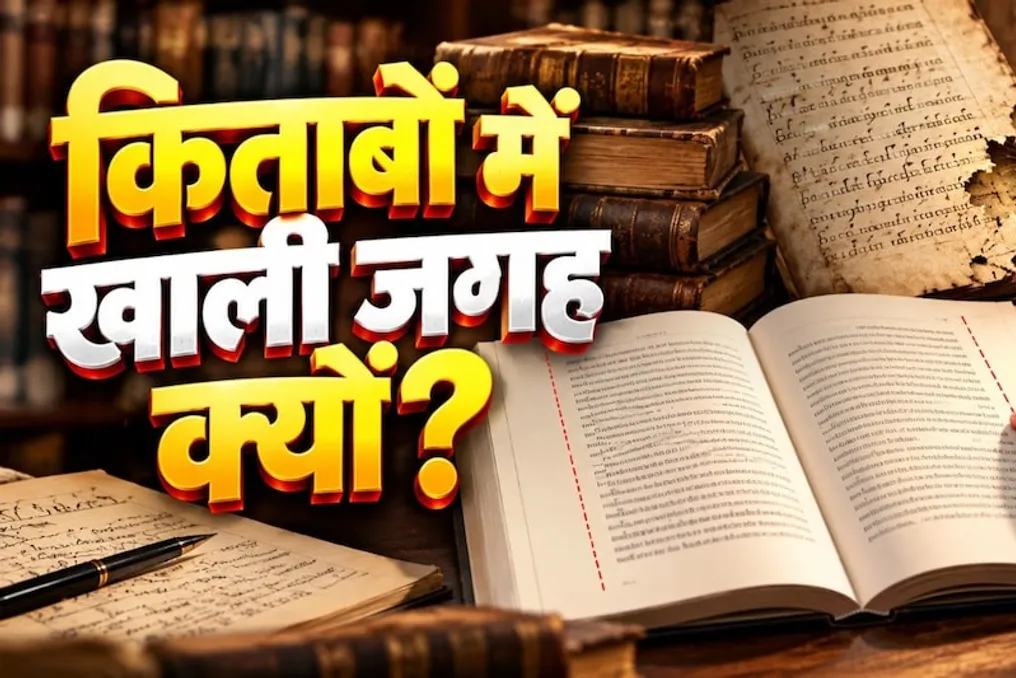
You have probably noticed the empty space around the pages of books—whether they are school textbooks, magazines, or large reference guides. The words on these pages usually do not reach the very edges. At first glance, this space might seem useless, raising the question of why it is left empty if more text could be placed there. However, the reason for this phenomenon is related not only to reading comfort.
The tradition of leaving blank margins on book pages dates back to ancient writing methods, reader habits, and book manufacturing techniques. Interestingly, this age-old practice persists in modern printed editions.
In the past, the edges of books were not simply empty. People used them to record their own thoughts, explain complex terms, and sometimes even to create drawings that are still striking today. This meant that readers were not just consuming the author's words but were also leaving their own stories on the pages.
Today, if we like an idea in a book, we record it on our phone or underline it with a pencil. But in old times, people did not have mobile devices or the ability to make digital notes. Therefore, the edges of books served as a kind of notebook for them. Information about the tradition of marginalia is presented at the exhibition 'Manuscript and Printed Book' at the University of Toronto's Centre for Renaissance and Reformational Studies. In antiquity, readers would write down the meanings of difficult words, clarify important lines, or record emerging questions.
These notes and comments in English are called marginalia. They help modern historians understand how people read and interpreted the content of books centuries ago. Imagine finding a book hundreds of years old and discovering a comment from an unknown reader—that entry could connect you to the thinking of a person from that era whom you know nothing about.
On the margins of old books, one finds not only words but often hand-drawn figures resembling fingers. These figures point to a specific line or sentence. It gives the impression that the reader is advising us to pay attention to that part of the book. Such signs are called maniculae. In ancient times, they were used to draw attention to specific information. Today, we put asterisks next to important data, highlight lines with a marker, or take screenshots on our phones; whereas then, such handwritten signs performed a similar function, only done by hand on paper.
The University of Toronto exhibition explains that these notes and signs in the margins relate to the traditions of reading ancient books.
Today, font size, page length, and margin placement can be adjusted on a computer. But in the past, book production was a very laborious process. Inscriptions were made by hand, and creating each copy took time. Under such conditions, it was important not only to write the words but also to consider where the writing should begin and end, as well as how much space would be left on the edges of the page.
In old manuscripts, margins were also used for readers' notes and drawings. Even after printing spread in Europe, the influence of many manuscript traditions was visible in early printed editions. Thus, the empty space visible in modern books cannot be seen merely as part of modern design; it is also connected to the ancient form of books and their reading methods.
There is another interesting question about margins: are they related to protecting paper from mice in ancient times? Indeed, there are examples of old documents damaged by mice. A digital archive of Leiden University mentions a historical manuscript related to Hugo Grotius, on whose pages traces of gnawing are visible along the lower edges.
This indicates that manuscripts were attacked by rodents in the past. However, the mere fact of finding damage on the edge of a document does not prove that margins were originally left blank to protect against mice or termites. The Leiden University example only provides information about signs of damage, not the reason for the initial layout of the margins.
The question remains open: why is empty space left in books today, when books are created using machines and computers?