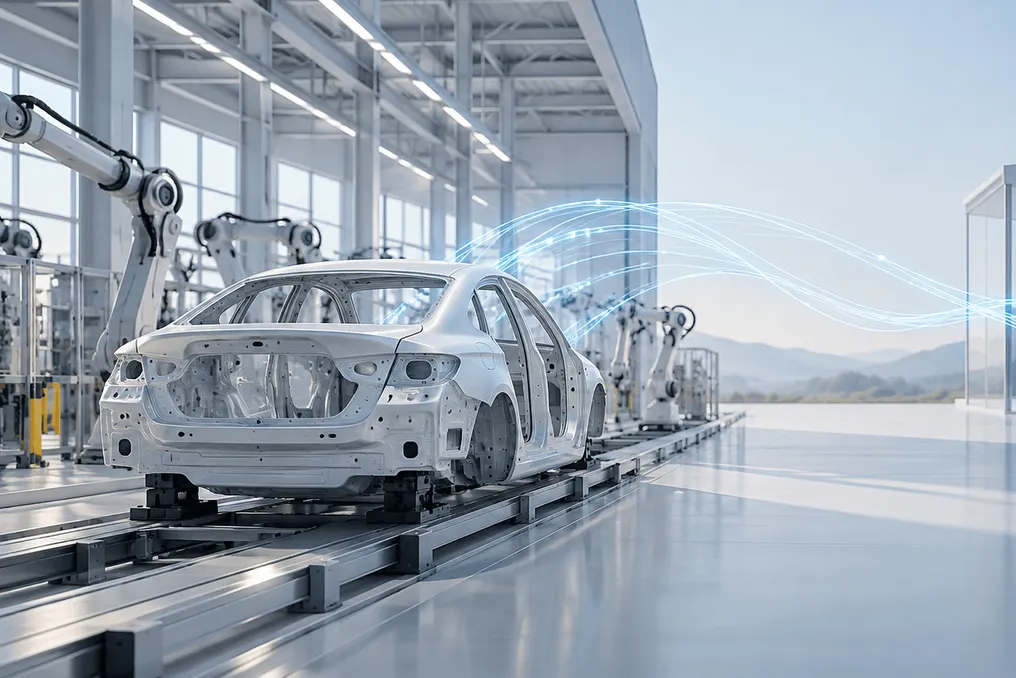
China Mobile has introduced the first industry-wide general AI platform for the automotive industry. This platform is a suite of services that includes computing power, data, and models that car manufacturers can utilize without needing to build their own artificial intelligence infrastructure.
The platform was unveiled at the Intelligent Connected Vehicles Conference 2026 in Beijing. It was developed by the National Basic Platform for Pilot Application of AI in the Automotive Sector, which operates under China Mobile's guidance. According to reports from Science and Technology Daily and Sina Tech, this base positions itself as neutral because it does not manufacture cars, and its capabilities are open to the entire industry.
Executives from companies such as FAW, Dongfeng, Changan, BAIC, Li Auto, as well as representatives from Tsinghua University and the Beijing Economic-Technological Development Area, attended the event. The creation of the platform took one year, and it is now available for shared use since its launch.
In terms of computational resources, the platform supports 112.7 EFLOPS, which manufacturers can request elastically instead of building their own data centers. Regarding data, the base ensures that manufacturers retain full control over their core data; this data is only transferred between partners within an established compliance system. Concerning models, a set of tools is offered covering the stages of development, validation, and deployment.
The platform covers four key areas: research and development, manufacturing, intelligent driving, and testing. It incorporates six specialized agents: vehicle body design, process planning, visual quality inspection, intelligent maintenance, driving data generation, and driving model training. It is reported that these agents are already being used by more than ten state-owned automakers.
The base presented several examples based on its own metrics. In Shanghai, a design agent that generates blueprints from sketches was able to create one design set three times faster. A process planning agent reduced the time to produce vehicle technical maps from five days to four hours. In Jilin, an inspection agent increased defect detection above 99.5% and reduced line adaptation time from four weeks to one, while the data generation agent lowered R&D costs in driving by 10%. In Chongqing, a maintenance agent can recognize over 20 types of malfunctions and reduce downtime by 30%. In Beijing, a training agent doubled the speed of driving policy learning.
A representative from China Mobile stated that the next phase involves opening up additional key capabilities, linking them to specific manufacturer use cases, and creating a set of reference implementations that other companies can copy. This launch marks an expansion of China Mobile's efforts from providing raw computing power to offering comprehensively packaged, industry-specific agents, giving smaller automakers the ability to test AI tools without the initial cost of building their own stack.