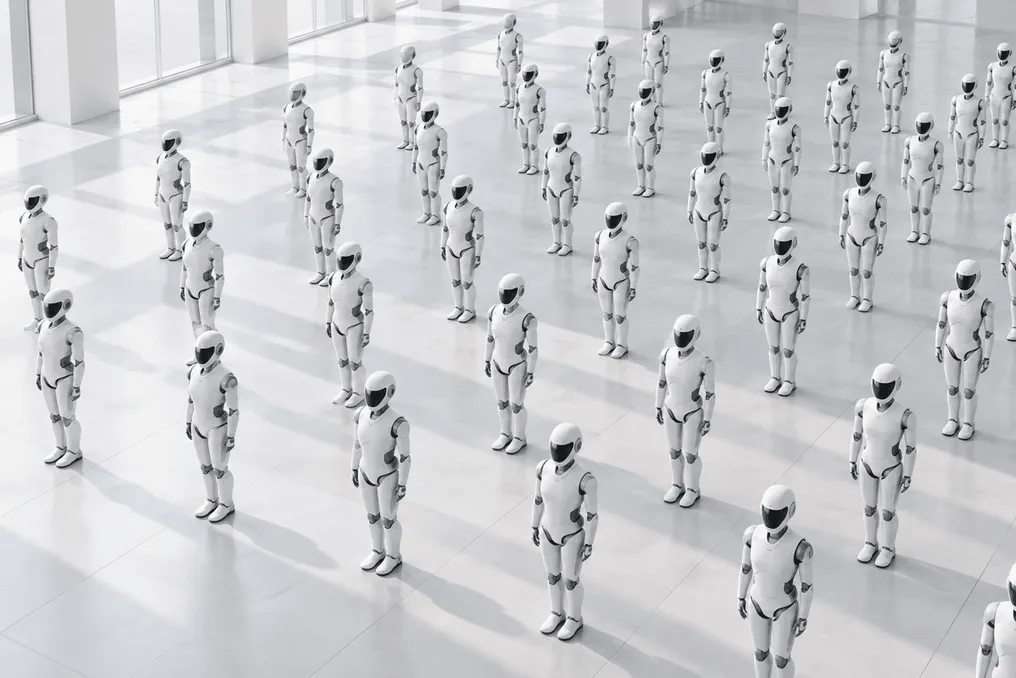
AgiBot has set a Guinness World Record for the highest number of simultaneously dancing humanoid robots, demonstrating a synchronized routine featuring 110 full-sized Expedition A3 model robots. This event took place on October 24th at the Yellow River International Exhibition and Conference Center in Jinan city.
The Guinness judge confirmed the count of 110 units at the venue, according to reports from IT Home and Science and Technology Daily. Furthermore, according to Science and Technology Daily, the key criterion for setting the record was not the quality of the dance, but the fleet's ability to complete the performance without any errors.
The robots executed several sets of complex movements over a period of 5 minutes and 43 seconds, alternating between synchronized movement and formation changes. AgiBot specified that all 110 participating robots are standard production units.
Technical Aspects of Coordination
Wan Chuan, AgiBot partner and Senior Vice President, noted that controlling a hundred robots goes beyond simply copying movements; it requires a full planning stack that includes real-time positioning determination, distributed decision-making, and dynamic obstacle avoidance. The robots independently exited their transport crates, calibrated their positions, and performed the program without manual control by engineers via remote operation.
Coordination was managed using LinkBots—AgiBot's internal multi-robot planning system. Wan described three key capabilities of this system. Firstly, formation changes are calculated based on the current state of each robot, rather than being reproduced from pre-saved movements. Secondly, the ultra-wideband positioning system provides accuracy of less than 10 centimeters, allowing the robots to coordinate walking and running while tracking mutual positions. Thirdly, individual groups can receive different instructions, and the orchestration is designed to prevent robots from interfering with each other. IT Home reported that the system is capable of locally compensating for the failure of one unit.
According to Wan, the successful implementation of these three points represents a technical boundary separating humanoid robots used as display exhibits from those that can function as productive tools.
AgiBot reports that the robots are already beginning to be used in real-world applications. Currently, they are undergoing trials at Jinan subway stations, including the Olympic Sports Center and Zhuangshan West Road, where they provide directions, assist in managing crowd flow, conduct security patrols, and offer cultural accompaniment. The company plans to utilize the robots that participated in the record attempt in tourist performances, public services, exhibition halls, and education.