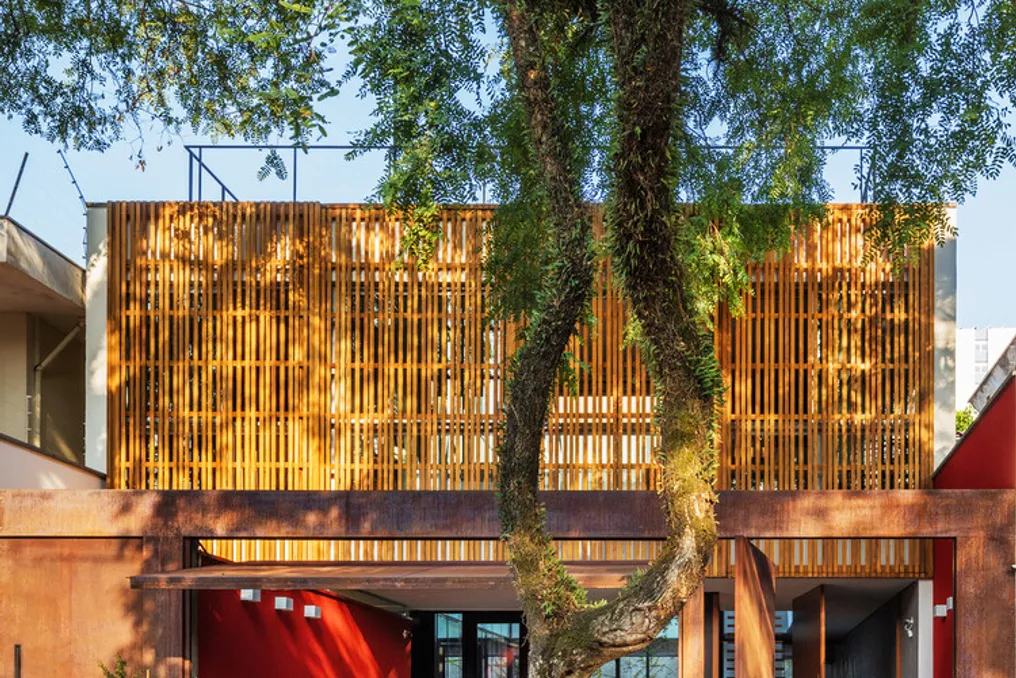
The concept of 'eyes on the street' is widely recognized in architectural and urban planning literature as a crucial factor for urban safety. Jane Jacobs uses this expression to describe individuals who, intentionally or not, monitor public spaces or observe them from their residences, thereby promoting natural surveillance. This phenomenon is stimulated both by the existence of high-quality public areas and by the strong connection established between the public and private environment through building facade design.
Jacobs advocates for a method of city and architectural construction that criticizes excessive verticalization, especially when it is marked by isolated, single-use structures that ignore contact with the public way.
Historical Application of the Concept
Introduced in the early 1960s, the concept has undergone discussions and implementations at various scales and purposes. A notable example of how it evolved and influenced architectural design occurred in Vienna during the 1990s. Housing complexes named Frauen-Werk-Stadt I, II, and III were conceived with a gender perspective, applying the principle of 'social eyes' for a very specific purpose.
In these projects, the facades were characterized by windows facing the central courtyards, especially those dedicated to children's recreation areas. Internally, apartment windows were strategically positioned in the kitchen, allowing mothers to supervise their children while performing household chores. The implementation of this concept in the housing complexes demonstrated its positive impact on improving the quality of life for the residents, highlighting the breadth of the topic even decades after its original conception.
The Relevance of the Concept in the Brazilian Context
Jacobs' idea remains relevant and is the subject of extensive debate. Curious parallels can be observed in some Brazilian cities, particularly in single-family residential neighborhoods, where a 'shared surveillance network' emerges based on signs and images reminiscent of 'eyes on the street' and neighborhood monitoring of public space. However, this practice, although using the term, differs from Jacobs' original concept because this 'union against insecurity' tends to increase resident isolation and strengthen empathy only among themselves, while simultaneously denouncing any 'suspicious movement' from external people.
In this sense, it is essential to emphasize that Jacobs' concept maintains that urban safety can be achieved not only through surveillance but also through the vitality and diversity inherent in a healthy city. Although the topic generates discussions, ranging from the effectiveness of a well-planned interface with public space to excessive neighborly surveillance, the central lesson lies in understanding the role of architectural cladding in relation to public spaces, valuing this rich interaction between openings and the street.
Jacobs' principles indicate that no design choice is isolated or singular, and that any architectural decision can affect the social and urban life of the inhabitants. This perception requires us to remain attentive to the way we design our buildings and define their relationship with the city.
Examples of Residential Architecture in Brazil
By focusing specifically on Brazilian residential constructions, several issues can be analyzed through the lens of Jacobs' concept. Some cases will be presented where the architectural envelope becomes essential for a healthy interaction between the interior and the exterior.
The SEHAB Heliópolis project, located in São Paulo, was completed in 2014 and integrated into the city's largest favela. Unlike the standard of isolated towers, the project establishes a quadra and an internal courtyard accessible to residents and the general community, echoing the previously mentioned Austrian models. SEHAB not only connects to the central courtyards and gardens through windows but also offers the street a large permeable envelope that encourages circulation and exchange between the public and the private.
On a smaller scale and with horizontal implementation, but maintaining the multi-family typology, the Casas Populares Paudalho project demonstrates an interesting configuration. In this case, visual transparency towards the street is facilitated by the living room door and window—and no longer by the kitchen, as happened in Frauen-Werk-Stadt—which was possible due to careful consideration of the low wall height. Additionally, the project creates an open covered communal area under the front porch, functioning as a powerful link between the public and private domains, something traditionally present not only in Brazilian culture but in other nations as well.
To conclude, examples of single-family homes presenting architectural solutions relevant to the 'eyes on the street' concept have been selected. Casa 711H, in Brasília, stands out, utilizing a system of retractable perforated panels on the front facade, which allows for complete integration between the private garden and the public area. Casa 4x30, located in São Paulo, also deserves mention. In strong contrast to neighboring residences, its structure is open to the street, without walls or fences separating the public from the private. Although the ground floor boundary is marked by a closed facade isolated from the street, the absence of walls promotes a more intimate and interesting proximity, favoring the approach of the upper window to the city.
Regrettably, when analyzing contemporary residential architectures in Brazil, the vast majority of examples maintain configurations isolated from public space. In the case of single-family homes, when they are not in gated communities, there is a considerable distance from the street—often determined by the Master Plan itself—reinforced by the construction of high walls or fences. This is a complex situation that generates debates, such as those addressed in this text. Nevertheless, in the clash between security, privacy, and urban life, some projects manage to stand out by striving to create certain relationships between architecture and the street. Regardless of the structural and social dimension of the issue, reviewing Jane Jacobs' precepts is always beneficial for understanding how we are designing our buildings and establishing their important connection with the city.