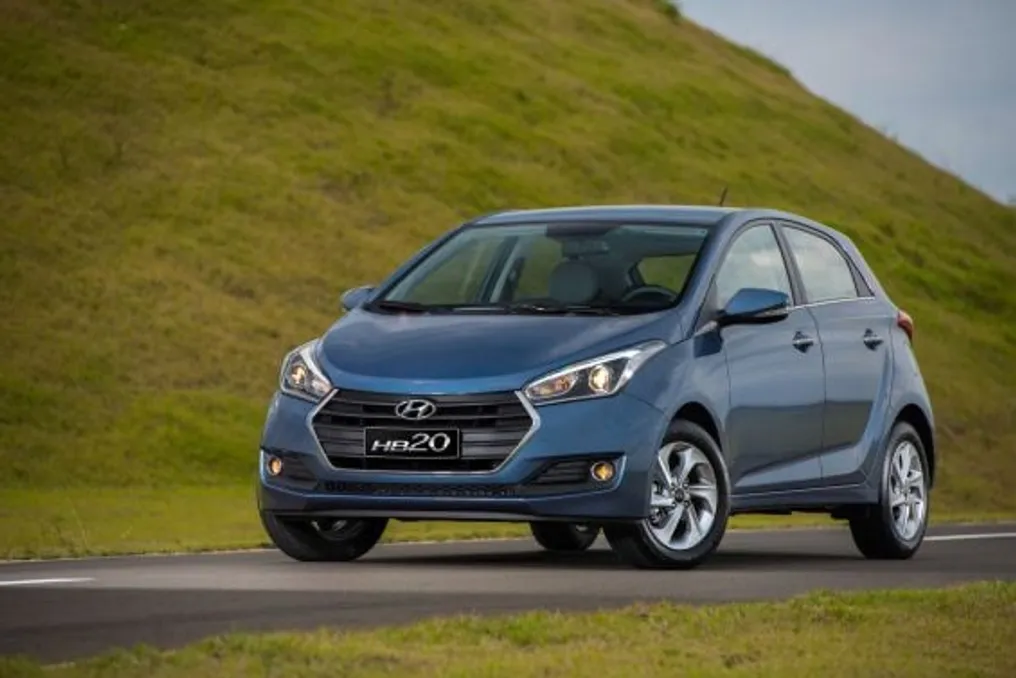
Hyundai began celebrating the 15th anniversary of the HB20, a compact hatchback that has built a history of success in the Brazilian market. Thanks to its strong acceptance, wide range of versions, good reputation for after-sales support, modern (though sometimes controversial) design, drivability, and balanced maintenance costs, the HB20 is among the most valued vehicles in its category.
This article details ten crucial points for anyone wishing to understand the Hyundai HB20, focusing specifically on the first generation and the 2015 model to aid in assessing used purchases.
The launch of the HB20 occurred in October 2012, with the goal of increasing Hyundai's presence in the national market and competing directly with the leaders of compact hatchbacks of the time, such as the VW Gol and the Fiat Palio. From the start, the vehicle attracted attention for its bolder design compared to the category average and a slightly superior finish. It offered a five-year warranty and a modern mechanical package, available in the 1.0 12V and 1.6 16V engine options.
During its first generation, the model received several updates and various special editions. In 2015, the Hyundai HB20 underwent a restyling, gained the Premium version, and started incorporating a six-speed manual transmission in the 1.6 versions. In the 2017 line, a significant innovation was the inclusion of the turbo engine, also coupled with the six-speed manual gearbox. In 2019, there were modifications to the front grille of the hatchback.
In September 2019, Hyundai introduced a second generation of the HB20, which was deeply reformulated while maintaining the original architecture. After this change, the 1.6 engine was discontinued, being replaced by a new, more powerful turbo engine in the higher-end options of the compact. In 2023, the first restyling of this new phase of the hatchback took place. Recently, Hyundai launched the i20, which serves as a natural replacement for the HB20, but the veteran model maintains its strength in the market and sales.
Although it uses the platform of the old European i20, the HB20 was designed for the Brazilian market, receiving specific design and finishing touches. This model also marked the inauguration of the Hyundai Motor Brazil factory in Piracicaba, in the interior of São Paulo, quickly becoming a pillar of the South Korean automaker's Brazilian operation.
Few compact cars managed to offer as many combinations of engine, transmission, and trim as this hatchback. In 2015, for example, consumers had nine versions available, able to choose between the naturally aspirated 1.0 and 1.6 engines. Options included five or six-speed manual transmissions, as well as a four-speed automatic gearbox, not counting the HB20X, an adventurous variant that expanded the family's possibilities.
In 2015, the HB20 also featured unique versions. The adventurous HB20X option, launched in 2013, stood out with differentiated bumpers and fog lights, darkened headlight lenses, and chrome details. The HB20X generally followed the aesthetic standard of pseudo-off-road models, featuring wheel arch moldings, darkened elements, raised suspension, and all-terrain tires. However, the adventurous HB20 had four trim configurations, always with the 1.6 16V engine.
In the following year, with the restyling of the first generation, the Hyundai HB20 launched a sporty version. This version, named HB20 R-Spec, had only bolder visual applications, without mechanical changes. It was inspired by the concept car of the same name displayed at the São Paulo Auto Show in 2012. Its features included a hexagonal grille, 15-inch diamond-cut wheels, black mirror caps, and a rear bumper with simulated air extractors, keeping the 1.6 engine.
The 2015 HB20 could be equipped with three distinct mechanical setups. The version with the naturally aspirated Kappa 1.0 engine used three cylinders, dual overhead camshafts, and variable intake cam. Despite the smaller displacement and power of 80 hp (ethanol) and 75 hp (gasoline), it delivered adequate performance for the urban category, with positive accelerations, although the 0 to 100 km/h time was close to 15 seconds.
For those seeking more agility, the naturally aspirated Gamma 1.6 engine was an interesting alternative, generating 128/122 hp and 16.5/16 kgfm of torque at 5,000 rpm. This setup provided quicker responses in the city, reaching 0-100 km/h in 9.3 seconds, with good performance at medium speeds and greater maneuverability on highways. However, this engine exhibited some roughness compared to competitors.
With the automatic transmission, performance remained interesting, registering 0-100 km/h in 11 seconds; however, the four-speed gearbox showed imprecision and slowness when shifting gears during acceleration, between 2,500 and 3,000 rpm.
The introduction of the 1.0 turbo engine in the HB20 line occurred in 2016, marking a significant advance. Hyundai adapted the naturally aspirated Kappa engine, integrating a low-inertia turbocharger with electronic management. Although it delivered less power (105/98 hp), this setup provided more low-end torque, with 15/13.8 kgfm appearing early, at 1,500 rpm, which improved response in urban traffic.
Nevertheless, the overall performance of this engine did not reach the level of some contemporary turbocharged rivals, especially those compacts equipped with direct injection.
The Hyundai HB20 2015 is recommended in the Premium version, the most complete, equipped with the 1.6 16V engine and four-speed automatic transmission. Its main attraction is the blueNav multimedia center, which features a 7-inch touchscreen, integrated GPS, digital TV, Bluetooth, iPod/iPhone compatibility, MP3 player, image and video player, USB connections, and steering wheel controls. In terms of safety, it includes the mandatory ABS and EBD systems, dual airbags, rear parking sensor, and Isofix. Additionally, it has air conditioning, electric window controls with touch control on all windows, dusk sensor, split rear seat, and height and depth adjustments for the steering wheel. Aesthetically, it features fog lights, 15-inch alloy wheels, external door handles, chrome trim, a two-tone dashboard, and a leather-wrapped steering wheel.
Consulting KBB Brazil (October 2026), the average prices for the 2015 Hyundai HB20 in the Premium 1.6 AT version can be checked. Regarding special editions, 10 editions were released in total: eight in the first generation and two in the second. The Spicy series, launched in 2015, stands out due to its aerodynamic kit with side skirts and a black rear diffuser, in addition to a glossy black hexagonal grille. This special edition came with S-wing graphite alloy wheels, glossy black mirror caps, matte black detailing on the door moldings, and darkened headlight lenses. The interior of the 2015 Hyundai HB20 Spicy featured a darkened finish, chrome door handles, gray painted molded air vents, and perforated leather seats with visible stitching, available in the 1.0 and 1.6 engine options and including the blueNav center with digital TV receiver.
The HB20 does not have a reputation for having complex maintenance. It is possible to check parts prices for models with the 1.6 16V engine, as well as the most frequent complaints from first-generation owners on forums, discussion groups, and the Reclame Aqui website.