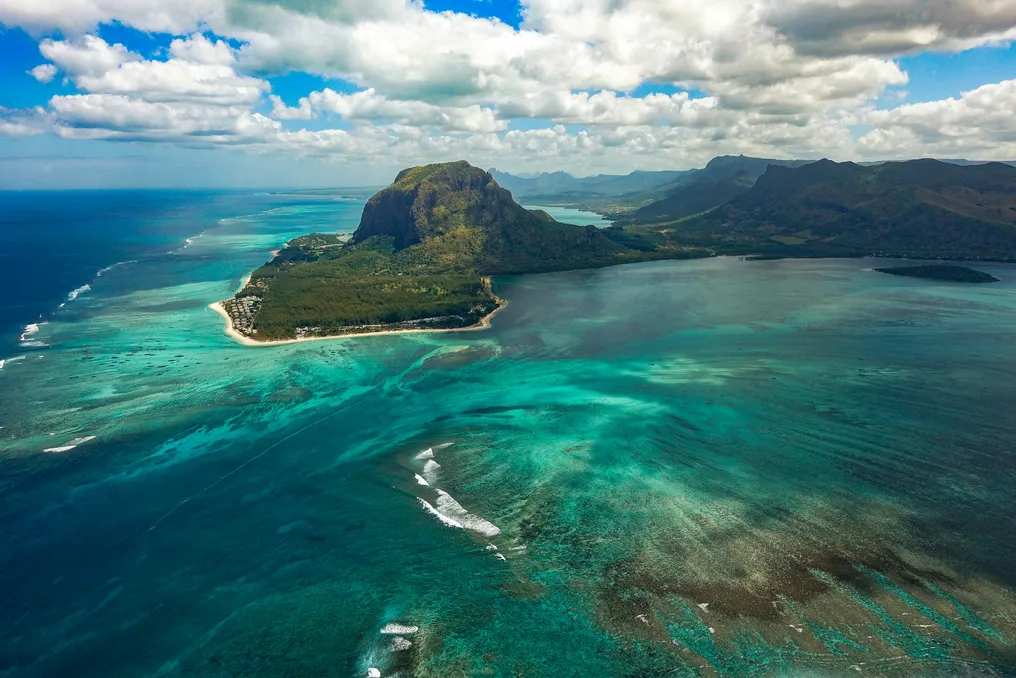
Located east of Madagascar, on the eastern coast of Africa, the Republic of Mauritius, also known as Mauritius Islands, is globally recognized for its remarkable beauty. This archipelago, composed of almost 70 islands, offers a variety of paradise landscapes, including soft white sand beaches, vibrant coral reefs, turquoise blue lagoons, as well as a mountainous interior with tropical forests and picturesque waterfalls.
The country's name derives from Dutch colonization. In 1598, the Dutch admiral Wybrand Van Warwyck arrived at the island and named it 'Mauritius' in honor of Prince Maurice of Nassau. The latter also has a record in Brazilian history for having been governor-general of the Dutch Brazil between 1637 and 1644, a period during which he established the City of Mauritius, now Recife.
Due to its history of migrations and colonizations, the destination presents a rich cultural fusion. The population of the Mauritius Islands is composed of descendants of Indians, Creoles (an ethnic group formed by descendants of French people with enslaved populations from continental Africa), Europeans, and Chinese, among other groups. This diversity is also manifested in the cuisine, where traditional Mauritian gastronomy incorporates influences from these multiple cultures.
Among the essential attractions to visit is the Seven Coloured Earths Geopark, located in the mountainous village of Chamarel, in the southwest of the island. This natural reserve is famous for its dunes, which display stripes of seven distinct colors: red, brown, violet, green, blue, purple, and yellow. This chromatic phenomenon results from the decomposition of volcanic basaltic rocks into iron and aluminum oxides, whose chemical properties generate the colored layers.
Visitors can admire the dunes from a safe distance, delimited by wooden fences, or walk around them on boardwalks. The geopark also hosts Aldabra giant tortoises, a species native to the Seychelles archipelago, which can reach up to 1.40 meters in length, and features a cafe serving locally grown and roasted coffee.
In the extreme southwest of the archipelago is Le Morne Brabant, an imposing basalt mountain adjacent to a peninsula with white sand beaches, preserved vegetation, and crystal-clear lagoons. Classified as a World Heritage Site by UNESCO, climbing to the summit takes about three to four hours (round trip) and requires good physical condition; accompanying a certified guide is recommended due to the steep and rocky sections.
From the top, one can admire a magnificent view of the vast and colorful coral barrier and the Le Morne beach. The area also hosts endemic plant species, such as Ruizia boutoniana, the national flower of the Republic of Mauritius, popularly known as 'Boucle d’Oreille', which means 'earring' in French, referring to the bell shape of the flower. Historically, the mountain served as a refuge and sanctuary for escaped slaves, known as 'maroons', during the 17th and 19th centuries.
Near the coast of the Le Morne Peninsula, an impressive waterfall is observed. However, this is not a submerged waterfall, but rather an optical illusion caused by the continuous flow of sand sediments. This effect occurs when strong ocean currents carry light sand down the slopes of the plateau towards an oceanic abyss of approximately 4,000 meters deep, aided by the variation in bluish and greenish tones of the water.
To see the so-called Submerged Waterfall, it is necessary to observe it from above, either by seaplane or helicopter, both of which usually depart from La Prairie beach. The capital, Port Louis, located on the northwest coast, also deserves to be visited to observe the coexistence of diverse cultures. The city is accessible on foot, allowing strolls both by the seaside and through the historic center.
The Central Market of Port Louis is a vibrant point of interest, where vendors offer a wide variety of products, from exotic fruits, vegetables, and spices to teas and local culinary items. The restaurants in the area are numerous, and typical dishes include well-seasoned curries, fish and seafood preparations, palm heart salad with smoked marlin, and street food such as 'dholl puri' (stuffed yellow pea dough) and farata, a flat, flaky bread of Indian origin.
To travel to the Mauritius Islands from Brazil, the most common route is to fly from São Paulo with South African Airways, with a stopover in Johannesburg, South Africa. Tour packages frequently include stops in Johannesburg and Cape Town. Flight alternatives are also available through Dubai (Emirates) and Addis Ababa (Ethiopian Airlines).