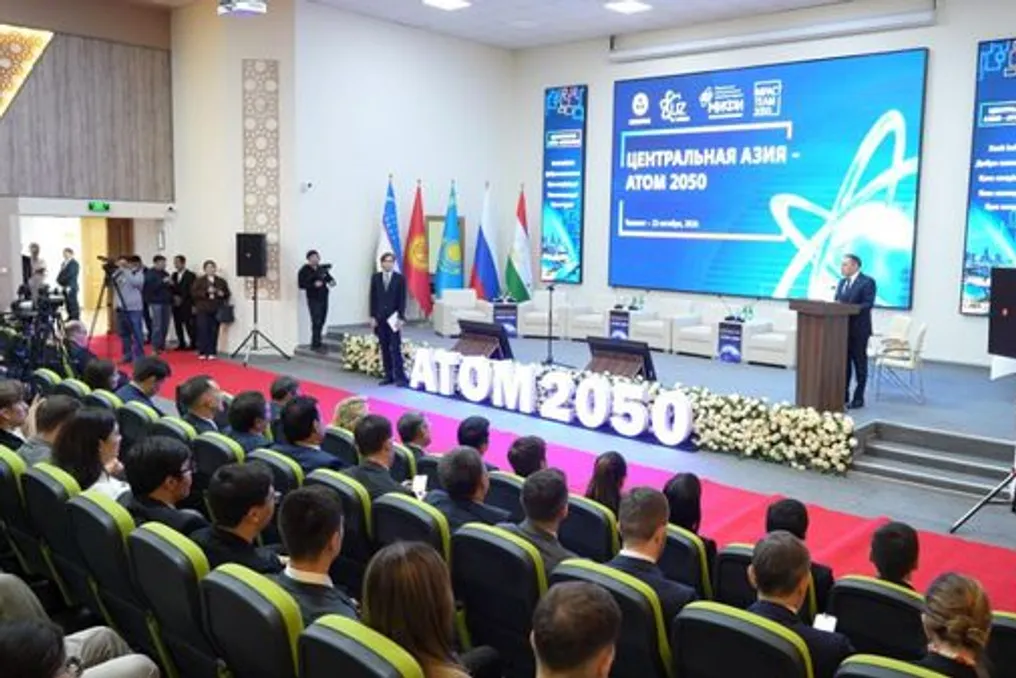
During a meeting as part of the 'Atom-2050' event at the MIFI branch in Tashkent, Rosatom head Alexey Likhachyov addressed the youth. The event gathered about 500 leading specialists from the Central Asian nuclear industry and young participants.
Likhachyov emphasized that the key support for the development of the nuclear industry and nuclear technologies is precisely the young people—the future specialists. He stated that all their devices, equipment, and technical solutions are merely an accumulation of metal, plastic, and wires.
He noted that simply getting an education is not enough; it is necessary to master practical skills by undergoing internships either on simulators or on operating reactors. Young people must become like-minded individuals capable of seeing and understanding both the current and future of nuclear technologies. Likhachyov called for great attention to the development of science, knowledge, and related technologies, expressing a desire to hear the opinions and plans of the youth for the coming decade.
Since current major programs are formed taking into account youth interests, he added that in 20–30 years, it will be they who work at the facilities, participating in their development. It is necessary that they come not just as ready specialists, but as leaders, the driving force for the development of the atomic sphere and knowledge within their company.
Alexey Likhachyov also announced that during the meeting, young specialists would be able to undergo internships on relevant reactors operating in the Russian Federation. He specified that for those who go to a construction site, a station, or in front of control panels, it is not enough to be well-prepared. They need both basic knowledge and practical skills. Therefore, internships on Russian reactors and classes in simulator halls, as well as special training in technical academies, will be organized, after which each person will be individually licensed.
Likhachyov mentioned that Rosatom is currently establishing effective cooperation with Tajikistan, Kyrgyzstan, Kazakhstan, and Uzbekistan. In Tajikistan and Kyrgyzstan, large environmental projects are being implemented, preparations are underway for cooperation in the field of nuclear energy, and work is being carried out in areas of nuclear technology application outside of energy, including nuclear medicine and scientific research.
In Uzbekistan, one of the most technically unique projects is being implemented with the support and personal guidance of the country's President Shavkat Mirziyoyev—the construction of a combined integrated nuclear power plant. Likhachyov stressed that such projects are not planned in other countries because there is no experience in placing both a large gigawatt reactor and a compact 55-megawatt reactor capable of changing power on one site. This project stands out not only for its advanced technical solutions but also for its comprehensive approach.
The meeting was also attended by Azim Akhmedkhadzhayev, director of the Uzatom agency; Timur Zhantikin, Deputy Chairman of the Agency of the Republic of Kazakhstan for Atomic Energy; Mirlan Parkhanov, Deputy Minister of Energy and Water Resources of Kyrgyzstan; and Abdulvakil Rasulov, General Director of TAUZ Hydro JSC under the Ministry of Energy and Water Resources and Energy of Tajikistan, who listened to the youth's opinions.
Timur Zhantikin shared his opinion, noting that physicists will not be left without work. According to him, students are very determined in pursuing this profession, and the task of companies is to ensure their comfortable adaptation to production activities, which requires creating a solid educational foundation. He also noted that atomic energy is a much broader concept than just peaceful atom and energy, and students look at life broadly. Based on his many years of experience, Zhantikin believes that physicists usually find work because they possess strong knowledge and understand that nature cannot be deceived, which gives young people the opportunity to work not only in energy but also in other fields where peaceful atom and atomic energy are applied.
At the end of the meeting, the leaders of the atomic industry characterized the discussion with the concepts of 'Peaceful Atom, Progress, Prosperity, and Friendship.'