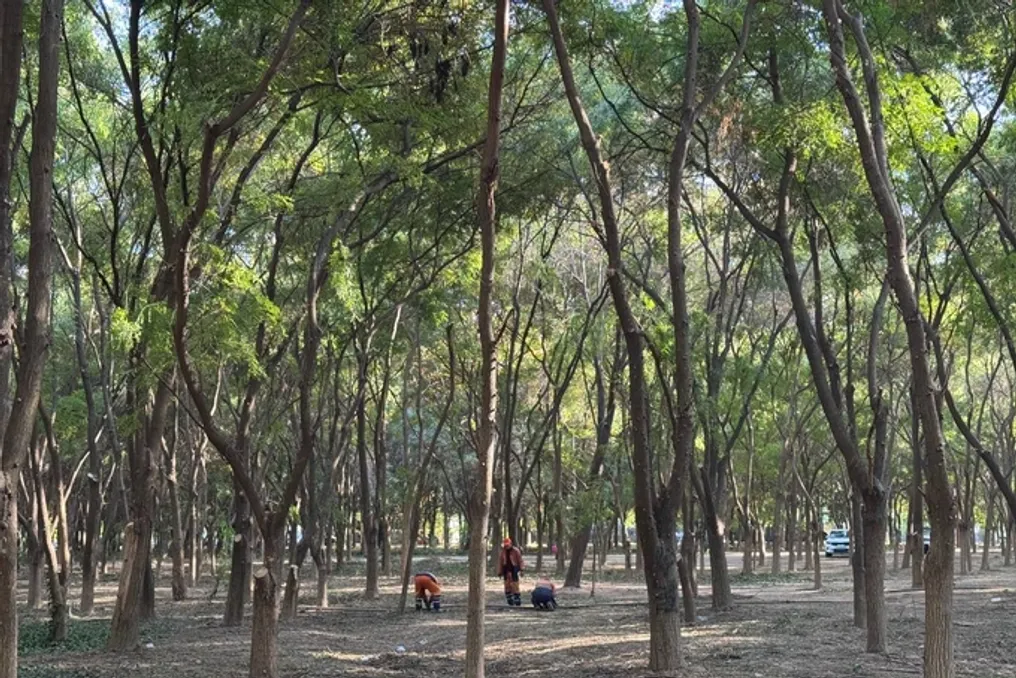
Elbek Park, covering an area of 11.74 hectares in Tashkent, will undergo a complete reconstruction, part of which will be the Uzbek-Turkish Friendship Square. The project discussion took place on Saturday in the format of a public hearing, where residents of neighboring houses presented their suggestions, which the city administration promised to take into account.
This extensive green space, located almost in the center of the capital, had been in a neglected state for a long time. Despite the lack of proper lighting and conditions, the park was regularly used by residents for walks, sports, picnics, and photo shoots; violets bloomed there in spring and early summer. Although a group of volunteers periodically cleaned up trash, maintaining cleanliness and order by local residents was impossible.
In the summer of 2023, President Shavkat Mirziyoyev visited the park, who, according to his press service, 'gave instructions on preserving this park and expanding recreation conditions for the population,' although no work was being carried out at that time.
This year, it became known that part of the park was named after Mustafa Kemal Atatürk, the first president of Turkey. Previously, in the summer, the president signed a decree renaming part of Abdullah Kadiri Street, located in front of the park, to Atatürk Street.
This week, work began in the park to dismantle the old irrigation system and prune trees using specialized equipment, which caused concern among citizens. Representatives of the hokimiyat assured during the Saturday hearing that the result would be an improvement of the park in terms of safety and convenience.
Azizxon Shavkatov, Deputy Hokim of Tashkent for Tourism, Culture, Cultural Heritage, and Mass Communications, reported that the hokimiyat had cooperated with the Turkish embassy over the past year to develop a concept for updating the park, which was created by a Turkish architectural bureau.
The main goal was to preserve the park as a quiet green zone while creating functional areas suitable for different ages and interests of the population. According to the presented concept, the main entrance from Atatürk Street (formerly Abdullah Kadiri) will be equipped with a small square, a crescent-shaped arch, an Atatürk monument, and a small body of water stylized after the Marmara Sea.
Initially, it was planned to make the crescent 80 meters wide, but the decision was made to reduce it by almost two and a half times—to 38 meters and move it to an area with lower tree density. An inventory of all trees was conducted: out of thousands, about 160 were found to be dry, and 450–500 were diseased (this number may increase). Dendrologists' conclusions are expected to determine whether these trees can be treated or if they need to be replaced.
Additionally, the transplantation of another 67 trees growing in the location of the future square is planned. A positive conclusion from dendrologists has been received, as the maximum trunk thickness of these trees is 25 centimeters. Instead of dead and diseased trees, about 500 new perennial plants from the nursery will be planted; if there is a large number of conifers in the park, priority will be given to deciduous species. It is also planned to plant 1250 shrubs and nearly 14 thousand seasonal flowers.
Azizxon Shavkatov specified that all construction work will be monitored by ecologists, and the morning remarks of Aziz Abdukhakimov, Chairman of the Ecology Committee, were taken into account.
On the section that previously served as a road crossing the park, where residents usually exercised, a pedestrian alley of 510 meters will be laid. New trees for shade, shrubs, lamps, benches, surveillance cameras, and emergency buttons will be placed along this alley. The width of this path will be reduced from 16 to 10 meters, which will allow for an increase in the park's total green area by 3000 square meters.
A curved running track with rubber surfacing, 1250 meters long, will run through the park, whose route was designed taking into account the preservation of existing trees, according to the deputy hokim. A bicycle path is not provided in the park.
Additional connecting paths will be created for movement between different zones and within the park. Azizxon Shavkatov also noted that the authorities expect people to use convenient worn-down routes and plan to monitor these paths over the year before paving them. This is considered a new approach to improvement in Tashkent that aligns with global practices.
Functionally, the park will be divided into several zones: children's, active recreation zones (workout, gymnastics), quiet relaxation zones, picnic areas with appropriate tables and benches, and dog walking areas. Instead of water bodies requiring high water consumption, a drip irrigation system will be implemented.
The park will have three main entrances, but access will be open from all sides. At the intersection of Atatürk Street and the Small Ring Road, a small parking lot will be preserved, and additional parking spaces may be created along the MKA.
During the question and answer session, residents initially expressed dissatisfaction that the public hearings took place after the start of work in the park, rather than before, which could cause rumors and discontent. Azizxon Shavkatov replied that the residents were invited precisely to answer questions and alleviate concerns.
One elderly citizen suggested installing drinking fountains for visitors, which was supported and promised to be implemented. Another resident pointed out the presence of three places where adults and children played badminton and asked to establish at least two such courts; this suggestion was also approved. A female resident also wished to preserve the violet fields, which the deputy hokim promised to try.
Among other proposals was the demand to plant trees adapted to the local climate, which has already been taken into account in the project. In response to the question about funding, Azizxon Shavkatov stated that the funds are allocated from the budget of the capital's hokimiyat, and the completion of all work is scheduled for the end of November. The deputy hokim expressed readiness to meet with residents again so they can assess the final result.