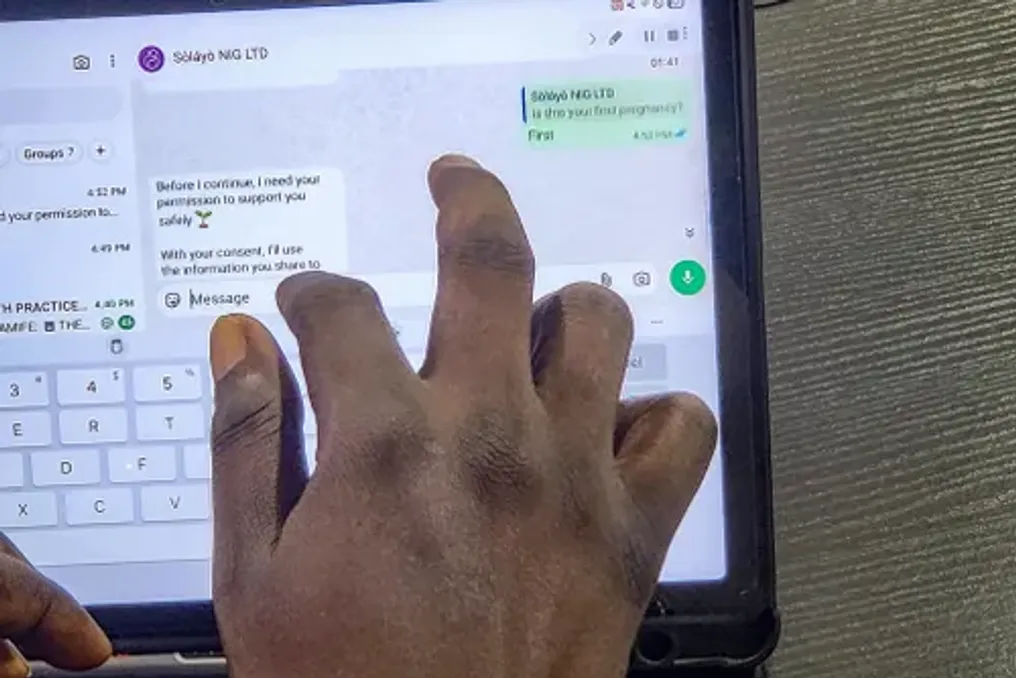
During her pregnancy, Rukaiyat Yunusa began to worry about various changes in her body, such as urine color, cravings for certain foods, sleeping positions, and leg swelling. This woman, who was expecting her first child in Lagos, wanted to know what she should eat and what she shouldn't, but some questions were difficult to discuss during consultations.
Yunusa found a convenient place to ask questions through Sòláyò AI—a maternal health support service available on WhatsApp. She noted that the service answers questions she hesitates to ask her doctor because they seem trivial.
Four months ago, Yunusa learned about this service when a team representing the WhatsApp platform visited the main medical center in Meyran, located along the Lagos-Abeokuta highway. As part of a community outreach program, they spoke with women about maternal health and demonstrated the artificial intelligence-based tool.
After returning home, she tested it on her husband's phone and has been using it ever since. Sòláyò AI was created in 2025 by co-founders Theresa Omowunmi Oyewole, her Chief Operating Officer, and Damilola Oladipo.
The service is designed to assist women who are pregnant, trying to conceive, or have recently given birth. The application includes automated solutions for maternal health issues, professional consultations, and a dedicated forum for women to exchange experiences. The founders are also working on multilingual functionality to reach women who prefer to communicate in their native language.
The demand for adequate maternal health care is reflected in general health statistics. According to UNICEF and other UN agency estimates for April 2025, Sub-Saharan Africa accounted for about 70% of global maternal deaths in 2023, totaling 454 deaths per 100,000 live births.
Pregnancy can be stressful and challenging
According to a WHO report, Nigeria had the highest number of maternal deaths and accounted for over a quarter (28.7%) of all estimated global maternal deaths in 2023, amounting to approximately 75,000 cases. Many of these deaths could have been prevented with timely and quality medical care.
Oyewole's interest in maternal health arose after she sold baby products at the Idumota market before transitioning into healthcare business development. She shared that this was her first experience with motherhood. She realized how stressful and difficult this process can be and what support women need before, during, and after pregnancy.
Over seven or eight years in this industry, she encountered women struggling with conception, first-time mothers needing support, and women experiencing postpartum issues. Their questions and concerns made her realize the importance of help that went beyond the products she sold. Discussions with Oladipo about maternity products reminded him of his childhood, as Oladipo's mother was an obstetrician at a teaching hospital and managed a maternity center.
He recounted that he used to go with her to collect bags for mothers as a child. He later worked in branding, marketing, and communications for technology companies in the transport, events, and healthcare sectors. When he and Oyewole first discussed starting a joint venture, they envisioned a platform where women could purchase necessary items for pregnancy from their phones. The initial strategy combined commerce, education, and community support, connecting sellers with buyers. However, the company did not achieve the desired results, prompting them to rethink their approach.
Safe Birth
Further research shifted their focus from product supply to addressing women's concerns. Oyewole added that they realized women needed information between doctor visits and outside regular healthcare system hours, when they might doubt symptoms or the need for medical attention. She emphasized: 'We allow women to receive vital health information exactly when they need it.'
Oladipo explains that the name means 'safe birth' in Yoruba. They chose WhatsApp because women already used this messaging network and did not need to download an additional application. He noted that it is a 'conversational platform' where the user simply sends a 'Hello' message.
The system requests user identification and permission before determining if the user is pregnant, trying to conceive, or a new mother. Pregnant users specify their expected due date to help personalize responses according to the stage of pregnancy. After this, they can ask questions and receive answers via chat.
The service evolved in response to user requests for more than just automated answers. Initially, direct consultations with professionals were not included in the automated process. However, user feedback showed that women felt significantly more confident knowing that a real human professional was available.
Users can schedule consultations through the platform. According to Oladipo, the company also supports a separate WhatsApp community involving over 20 medical specialists. Mothers can use this community to ask general questions and share their experiences. The founders are developing multilingual functionality to serve women with different levels of formal education, as well as those who prefer to communicate in their native language. This feature is not yet available, so language accessibility remains an area the organization must address.
Tips for Seeking Professional Help
Sòláyò faces a more fundamental challenge: ensuring women understand the limitations of AI-generated information. An answer suitable for a general query may be insufficient if a symptom requires immediate professional assessment. Oladipo refers to the platform as an informational companion, not a diagnostic tool. He asserts that medical professionals help update the system, and specific phrases related to high-risk conditions prompt users to seek professional assistance.
He explained: 'When a user enters terms indicating symptoms of anxiety or high-risk conditions, the system automatically suggests contacting a qualified medical specialist directly.'
Sòláyò AI is one of several digital developments aimed at improving maternal health in Africa. In Kenya, in 2025, a pilot version of the PROMPTS for Maternal Health messaging platform, involving 6,139 pregnant women, revealed a moderate improvement in maternal health awareness, readiness for childbirth, and newborn care practices, demonstrating how digital tools can complement professional treatment.
In the Mwana AI pilot study conducted with postpartum women in Lagos in 2025, 57% of respondents rated its usefulness at the highest level. Omolara Owodujuigebe, a health education specialist in Agbado-Okeodo in the local government of Alimosho, met with the founders during a community outreach program at the Meyran Center. She reported that the program included assessments, medication assistance, and discussions about the company's products and AI. She said she took time to study the service and saw that it would be very useful for women in general. However, Owodujuigebe stressed that women with health problems requiring clinical attention should consult a medical center or hospital.
Oladipo stated that Sòláyò has reached over 15,000 women through education, community groups, and outreach programs. This figure includes women participating in activities not directly related to the AI service. Yunusa noted that while running her business at home, she saw the utility of the program as a resource to turn to when problems arose between consultations, especially those she found difficult to ask a doctor. She concluded: 'Since then, it has become my companion.'