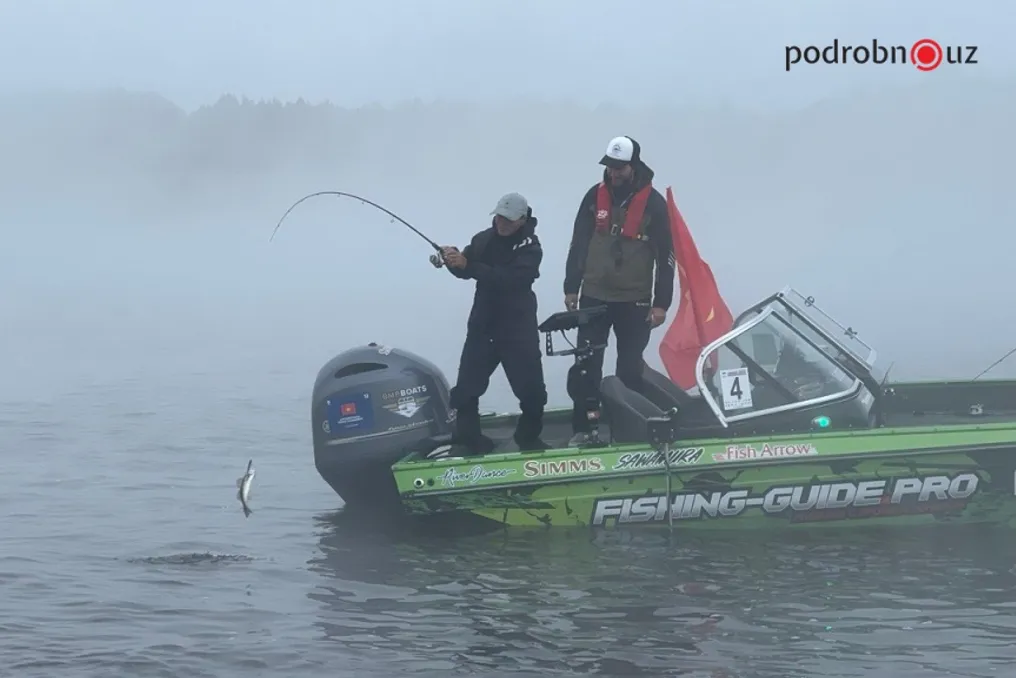
The international fishing tournament, organized by Rosatom, took place on Udomel Lake in the Tver region of Russia. The event began with tests from nature itself, as in late September, the lake was often shrouded in thick fog that obscured the shoreline and the cooling towers of the Kaliningrad NPP.
The white veil made it difficult to see the familiar outlines of the landscape, and the scenery could disappear entirely for several hours. The fog only lifted closer to noon when the sun rose high, allowing the competition participants to see their surroundings again.
The tournament attracted participants from various countries, for whom fishing is either a long-standing hobby or a way to test themselves in a sporting discipline. Despite the outward slowness, the process involves careful calculation and intense struggle, where every detail matters.
The event also served as an opportunity to draw attention to the city of Udomlya, whose life is closely linked to the Kaliningrad Nuclear Power Plant. Here, natural landscape and large-scale industrial infrastructure coexist, and the lake serves as a meeting place for local residents, fishing enthusiasts, and foreign guests.
Rosatom Attracts Anglers from Around the World
In the framework of this 'atomic' tournament on Udomel Lake, 22 amateur athletes, as well as 28 journalists and experts, participated. Participants came from 11 partner countries of Rosatom that work on or plan projects in nuclear energy. These countries include Bangladesh, Belarus, Hungary, Vietnam, Egypt, India, Indonesia, Malaysia, Turkey, Uzbekistan, and South Africa. Additionally, employees of the environmental protection and radiation control service of the Kaliningrad NPP were present at the event.
This international fishing tournament is being held for the fourth time and has transformed into an educational project of Rosatom. Previously, two tournaments were held near the Leningrad NPP, and in 2025, participants visited the Turkish province of Mersin, located near the Akkuyu NPP construction site. This year, the choice fell on Udomlya, a city closely associated with the Kaliningrad Nuclear Power Plant.
The goal of participating in the project goes beyond simply competing for the largest catch; it is also an opportunity to familiarize oneself with the area around the nuclear power plant, its nature, and the enterprise's activities. Alexander Yustus, Deputy General Director for Communications of the private entity Rosatom International Network, emphasized that the tournament has become one of Rosatom's flagship educational events, demonstrating the ecological friendliness of nuclear energy.
According to her, foreign guests can personally verify that the NPP does not harm the environment but contributes to regional development. Such events also help strengthen trusting relationships with the populations of countries beginning to implement their own nuclear projects.
The choice of Udomlya was driven by the organizers' desire to present the environmental protection activities of the Kaliningrad NPP to foreign guests and show the measures taken by the plant to preserve aquatic resources. In 2025, the enterprise carried out four artificial stocking campaigns in the Pesvo and Udomlya lakes, which are used in the NPP's cooling system. According to available data, the fish volume in these bodies of water reaches approximately 740 tons.
In the same year, the Kaliningrad NPP received first place among Rosatom enterprises in the 'Ecologically Exemplary Organization of the Atomic Industry' competition. Environmental monitoring showed that the plant's impact on atmospheric air, soils, surface and groundwater, as well as on the radiation background, is minimal.
The Chief Engineer of the Kaliningrad NPP, Ruslan Alyev, noted the high honor and responsibility of the plant for hosting such an event, as representatives from many countries came to study the NPP's operations, confirm the safety of the technologies, and learn about the enterprise's environmental protection work.
The idea for the tournament arose after an incident related to the construction of the Kudankulam NPP in India. During high-level agreements between the two countries, it was not possible to establish full contact with local residents, particularly fishermen. Since fishing was the main source of income for coastal communities, people feared that the construction of the NPP would lead to a decrease in fish stocks and a decline in catch quality, which provoked protests.
To dispel these fears, representatives of fishing communities were invited to the operational nuclear power plant in China. There, they were able to communicate with local fishermen and learn how living near an NPP affected their lives. Chinese colleagues reported that the fish population had not decreased, and the city's development linked to the plant's operation opened up new opportunities for local residents, including the appearance of cafes and restaurants, as well as expanded sales channels for the catch.
The personal experience of people who faced a similar situation played a decisive role. Communication with local fishermen, which was easier to trust than official representatives, helped Indian guests change their perception of the prospects for building the plant. Thus, the concept of an international fishing tournament near an NPP was born. Participants—journalists, experts, and fishermen from countries where nuclear projects are being implemented or planned—get a chance to see the life of territories near the NPP, interact with local residents, and form their own opinion on the impact of nuclear energy on nature and society.
There is a possibility in the future of holding a similar tournament in Uzbekistan, given that the country is also actively developing nuclear energy and building its own NPP.
Details of the 'Atomic' Fishing
The first day of the tournament on Udomel Lake was dedicated to training. Participants went out early in the morning in boats to study the lake, assess the fishing conditions, and select suitable bait and lures for different types of fish.
The organizers ensured the comfort of the participants by setting up a tent on the shore where they could warm up with hot tea or coffee and receive hot meals. A generator was provided to allow for equipment charging.
Local fishing guides piloted the sports boats, taking teams to places well known to them. According to the tournament rules, only four types of fish counted: catfish, pike, perch, and zander. During the training, foreign participants were required to familiarize themselves with these species and the specifics of catching them.
When the boats went out into open waters, they gradually disappeared into the dense fog. On the shore, journalists waited for the judges' signal to follow the anglers onto the lake. The weather was cool, which was especially noticeable to guests from warmer regions. However, the organizers provided professional gear for all participants.
After receiving the signal, journalists rushed to find their teams, but the fog made navigation difficult, and even navigational instruments did not always help orient quickly. Poor visibility created difficulties not only for the press but also for the fishermen themselves. Furthermore, participants noted that the fishing conditions on Udomel Lake differ significantly from the conditions they are accustomed to back home.
A representative from Uzbekistan shared that fishing in Udomlya is very different from the practice in Bukhara and Samarkand. This body of water hosts fish species not found in their home regions, such as pike, and the behavior of familiar species has changed. He noted that zander bites differently here, complicating the process. He added that if he could fish here for a week, he would better understand the behavior of the local fish, since his predatory fish are usually active after sunset, whereas here, as he was told, fish are caught both during the day and closer to evening.
A participant from Indonesia, Nurjan Suleiman, also shared his impressions. Both the local climate and the fishing format are unfamiliar to him, as he is used to fishing in the sea in his home country, and this was his first time fishing in a lake. He emphasized that the main difference is that Russia has freshwater, while Indonesia has marine waters.