In December 2025, the game Clair Obscur: Expedition 33 received two negative awards at the Indie Game Awards due to the use of Artificial Intelligence (AI)-generated textures in the final version. In contrast, corporations like Nvidia employ AI to design their own GPUs, which are used in various games, without facing calls for boycotts.
This scenario raises the question of the gaming community's prejudice against AI. The distinction lies between what is considered acceptable and what is not, requiring analysis not only of data but also of examples where the technology was well-received and of internal practices within the hardware industry.
A survey conducted by GDC 2026, based on responses from over 2,300 industry professionals, assessed opinions on the use of generative AI. The results indicated a worse scenario compared to the previous year, especially regarding the use of generative AI.
Among the interviewed professionals, 52% believe that generative AI harms the industry, a significant increase from the 30% recorded the previous year and 18% two years prior.
The numbers are even more critical when looking at the gaming public. A survey conducted by Quantic Foundry, which collected data from 1,799 players, revealed that about 85% of them expressed an unfavorable opinion towards the use of generative AI, with approximately 63% holding a very negative view.
The Quantic Foundry study points out that the gaming public's motivation is a relevant factor. They demonstrated greater negativity when AI is applied to the creation of art, music, sound effects, narrative, and dialogues.
For comparison, the use of AI to adjust difficulty was viewed negatively by 27% of the public, while its use in visual arts reached 83% aversion. This public resistance was also high in other creative areas, with 77% against music and sound effects, and 70% against narrative and dialogues. This suggests that public objection tends to decrease as the use of AI moves away from strictly creative processes.
An example of AI application that found some public acceptance is DLSS and related technologies. These systems use AI to increase frame rate (FPS), reduce latency, and enhance visual quality. Users welcomed these features due to the remarkable quality and performance achieved.
However, problems began to arise during the evolution of DLSS. Features initially focused on performance turned into dependencies for game development, causing new titles to require these tools, often presenting performance flaws even on powerful computers.
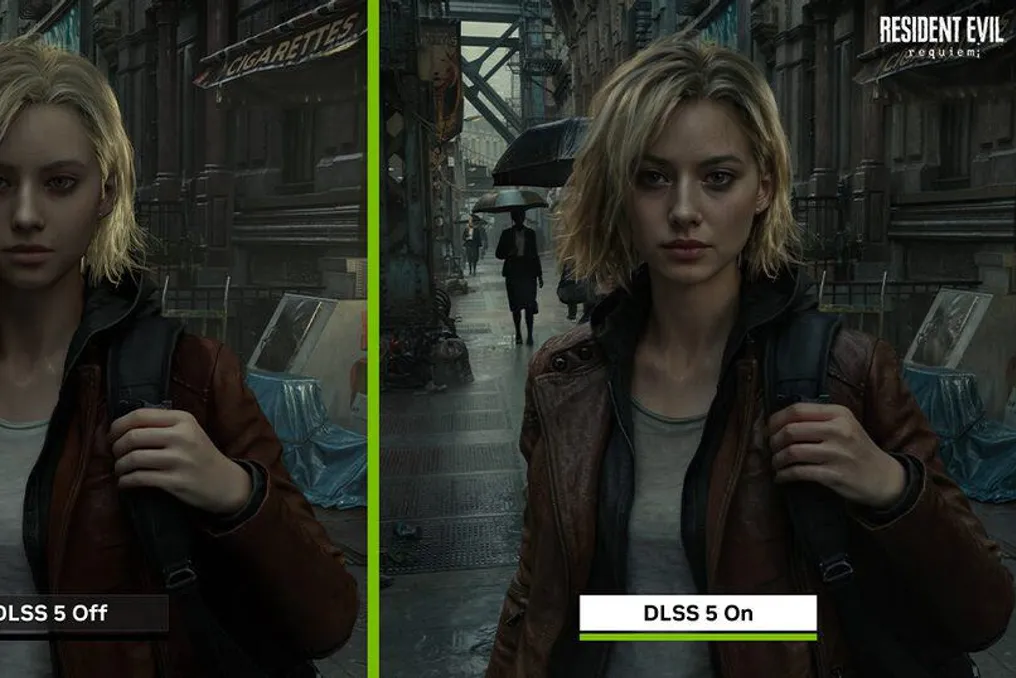
The situation worsened with the presentation of DLSS 5. This tool, which incorporates real-time neural rendering to reconstruct pixels with photorealistic lighting and materials, showed difficulties in maintaining visual coherence between scenes, resulting in the distortion of the original work and artificial and generic characteristics. Such problems were received extremely negatively by the gaming community.
Companies like Nvidia apply AI in their chip designs, covering everything from component layout to final project validation. A notable result was the development of a 64-bit adder—a circuit responsible for summing binary values—that occupies about 25% less chip area when created using PrefixRL, as reported by Jeff Dean of Google and Bill Dally of Nvidia.
At the 2026 DAC (Automation and Design Conference), companies such as Synopsys, Cadence, and Siemens displayed AI-assisted automation projects. Synopsys' long-duration design verification agent demonstrated a process 50 times faster, according to the company itself. Simultaneously, Siemens' project, in collaboration with Nvidia, presented agents capable of characterizing libraries more than ten times faster.
Although these are only two examples, they share one common point: the partial replacement of human work by AI did not generate revolt, protests, or boycotts from the public.