There is an old story about an armed robbery of a mansion in Chandni Chowk. Four or five robbers entered with weapons, committed the robbery, but the police received news and arrived. By that time, the robbers were already fleeing. One of the policemen opened fire, wounding one of the criminals, after which they disappeared. An investigation began to find out their origin and identity, but there was no evidence. When the police recreated the scene, they remembered that the wounded robber shouted: 'Are Khan, you shot!' The police assumed that 'Khan' was a word used in Bhopal, and the idea arose that they might be from Bhopal. After this, the investigation was conducted in Bhopal, and six months later, the robber was found and arrested by the police specifically in Bhopal.
It is unknown whether this story is true or fictional, but many people pass it on, associating it with Bhopal. Undoubtedly, it is about the fact that the Bhopal dialect is very melodious, but if you listen closely, you can notice that it is a language of storytelling, a language of exaggeration. That is, it is a language that uses excessive generalization to bring pleasure to the listener.
This dialect has developed in such a way that it allows a story to be told in a way that interests the listener. For example, if someone asks: 'What happened, Khan, why did you come so fast? Did you avoid traffic jams?' The answer might sound like this: 'Once my brother Sahu... It happened that the Nawab's helicopter broke down. It was a brand new machine. Many mechanics were called, engineers came, but nothing worked. Then the Nawab called us and said: 'Come and see what the problem is. The Nawab valued us greatly. We started looking: look, the helicopter engine starts, but when you try to engage the gear, it remains motionless.'
I also told the Nawab: 'Nawab, we sat under the sun for a long time thinking about it. We ourselves have managed large helicopters and made them old. We brought our wrenches, disassembled the parts, but... the matter is unclear. We looked for a long time, then he hit his palm on the hood, and the hood... And we immediately understood that the fan belt had broken.' The Nawab was pleased and said: 'Mian, you surpassed great engineers.' He asked: 'What is your fee?' I replied: 'Nawab, do not humiliate me. The fee is taken from outsiders.' He said: 'We will not let you leave empty-handed. Alright, take this. Here is fuel for our helicopter; there were two barrels. Take it.' I swear, I took both these containers of helicopter fuel home and poured it into my motorcycle. Now my motorcycle is running two feet above road traffic for three days, so I arrived quickly.
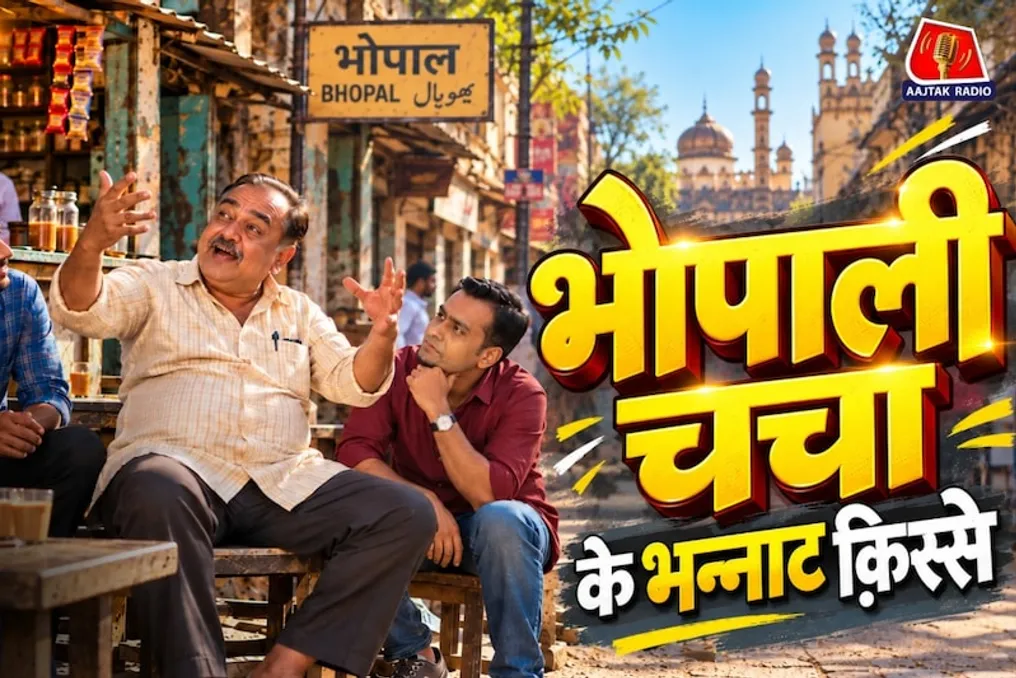
This story is called 'patiyabazi'—it is a feature of the Bhopal dialect and its amusing stories. Today in Storybox, I will talk about the Bhopal language and some famous stories told in it.
Every city has its own culture. For example, if you go to Lucknow, you will find food lovers and refined Urdu culture. In Banaras, the culture is different—a spiritual atmosphere. Similarly, Hyderabad has its own culture. What about Bhopal? Here, the 'patiyabazi' culture means that 'paties' (sitting places) are set up on the streets, intersections, and tea stalls where people gather and tell stories. The interesting thing is that both the storyteller and the listener know that the story is fictional, but it brings them pleasure. They will tell you a story so exaggerated that you will like it, and lie so skillfully that you will believe it as truth, even knowing it. As Sher Vasim said, he lied very skillfully. If I didn't trust, what would I do?
This is a fading art of the people of Bhopal, but today there are still people who support this 'batolebazi' art. The idea to talk about this in Storybox came after meeting one of such storytellers two days ago. We talked about the weather, and he said that it would soon get cold, and this time it would be cold. He said: 'Mian Jamshed Bhai, it is getting cold now. In our time, it was so cold that both the big pond and the small pond froze. The situation was such that we could play cricket on the pond, bro, and the fours and sixes we hit flew to Areera Colony. And one shot flew to Saket Nagar. One ball fell three kilometers from Indore.'
I laughed and asked: 'When you throw like that, why do you throw the ball three kilometers from Indore? Why not throw it right in Indore?' He answered: 'Okay, can we lie three kilometers now?'
Another story told by our friend Salim Nasheedi, an addict. In Bhopal lived a gentleman named Salim Nasheedi, who lay in his room all day using drugs. He had no connection to work or affairs and never cared about hygiene. One day some 'jamatis' came to him—men with beards who guide lost people and explain to them that they need to work, build something in life, take care of cleanliness, and observe prayers and fasting.'