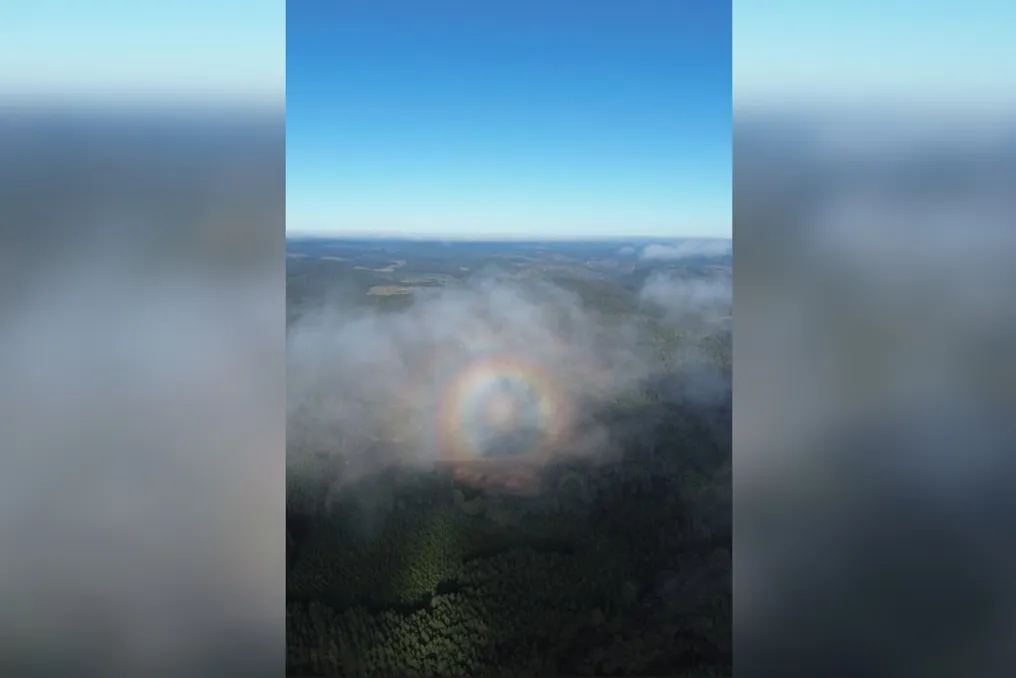
The landscape of the municipality of Bom Sucesso de Itararé is characterized by valleys, canyons, and various rock formations. Due to its elevation, the city ranks as the eighth highest in the state of São Paulo relative to sea level. Regional climatic conditions are also notable, featuring average temperatures close to 16°C and frost records throughout the year.
Geologist Victoria Gomes explained to g1 that the combination of these geographical features with local atmospheric conditions facilitates the visualization of natural phenomena in the area. She pointed out that this scenario is unique to southwestern São Paulo, where the canyon and valley relief acts as a channelizer for humidity and winds, promoting a regional microclimate that combines with ice clouds, specifically cirrostratus, which are the highest in the atmosphere.
The specialist clarified that the solar halo requires precise atmospheric circumstances: it appears when sunlight interacts with ice crystals present in high clouds, creating a luminous arc around the sun. Generally, this event occurs in the early morning, when solar rays strike the ice crystals contained in these cirrostratus clouds.
Influence of relief on observation
According to Victoria, the altitude and topographical configuration of the region are fundamental for atmospheric phenomena to be observed with such clarity in Bom Sucesso de Itararé. The city is located in a transition zone between higher areas and valleys, exhibiting marked topographical changes, such as steep slopes and landscapes enveloped in rock formations.
The geologist detailed that this geographical arrangement favors the perception of atmospheric events, especially when the observer is in a high point or above any layer of fog. She emphasized that the steep relief, rocky cliffs, valleys, crevices, and canyon, with its rugged topography and sharp gradient, function as an 'amphitheater' for appreciating these optical phenomena, while simultaneously channeling winds and retaining masses of humidity.
Victoria noted that such conditions are not limited to Bom Sucesso de Itararé; neighboring municipalities can also offer suitable scenarios for observing similar phenomena. She highlighted that the observer's perspective above the fog is a unique differential of the region, allowing for the visualization of the solar halo.
Fogs are also common in the region
In addition to the solar halo, fog is a recurring atmospheric phenomenon in southwestern São Paulo. The geologist attributes this to the fact that the relief influences air circulation and humidity distribution, where air cooling can cause water vapor condensation, generating small suspended droplets that form the fog.
Both the appearance of the solar halo and the presence of fog depend on the interaction between local characteristics and atmospheric conditions.
Millions of years of history
The Pirituba Canyon is one of the most notable in the area, located approximately 40 km from the urban area of Itapeva, on the border with Bom Sucesso de Itararé. Bom Sucesso de Itararé has 3,6 thousand inhabitants and is 471 km from the capital of São Paulo, bordering São Paulo and Paraná.
The landscapes of Bom Sucesso de Itararé also tell the geological story of the region, as sandstone formations, valleys, and rocky cliffs were shaped over millions of years by natural processes. According to Victoria, the rocks reveal different past environments, including ancient river systems and shallow seas, with water and wind acting as sculpting agents over time.
These geological processes gave rise to tourist spots, such as Pedra da Galinha, in the Valley of Giants, which provides a comprehensive view of the local relief. Victoria mentioned that this easily accessible location allows one to observe the interaction between relief and climate at up to a 360-degree angle.
She advised that the best time to observe the phenomenon is in the early morning, during cold periods, typically between winter and spring, or before winter, when the sun is still warm but the weather is cold.
How to observe safely
Despite the fascination the phenomenon holds, Victoria warned about the risk of looking directly at the Sun when trying to spot the halo, recommending the use of a hat and glasses due to the inherent danger.
Since 2021, the Paulista Canyons Association has been carrying out initiatives aimed at preserving and valuing this natural and historical heritage. As a member of the entity, Victoria Gomes emphasized the growing need to protect the natural beauties of the Itapeva region, which attracts visitors, working on disseminating information about these places.