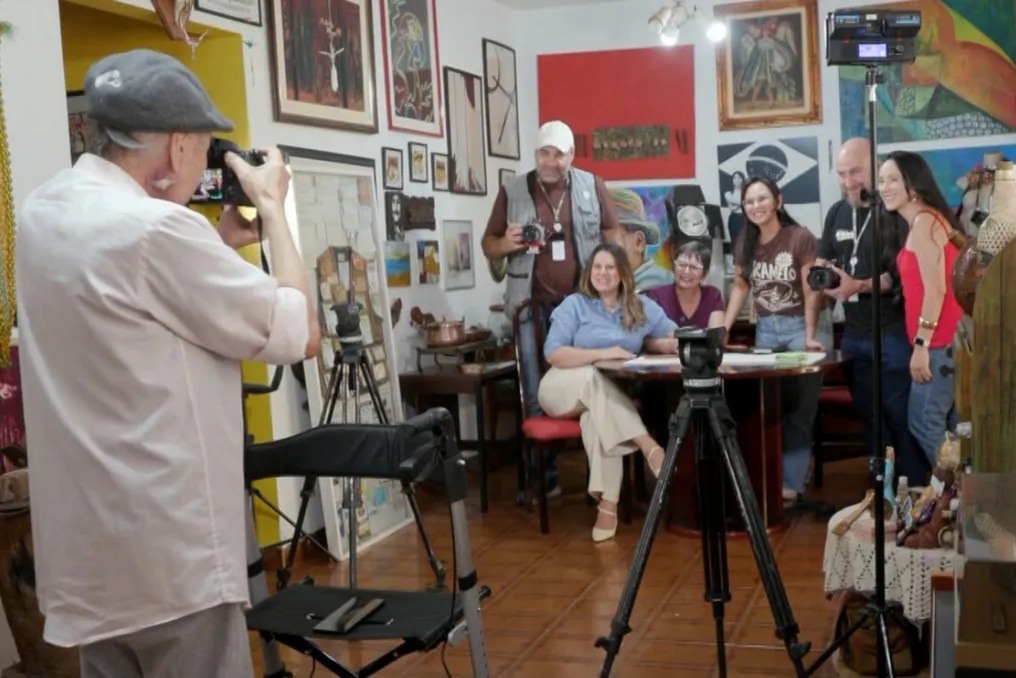
Roberto Higa, a prominent figure in the photojournalism of Mato Grosso do Sul, shared in an interview with TV Morena an overview of his life, including decades of historical records of Campo Grande and the recent challenge posed by cancer.
At the photographer's residence, the garage houses the family vehicle alongside portraits of notable personalities, while the interior of the house functions as a private gallery, filled with photos and paintings that narrate the history of Higa, son of Japanese immigrants and a reference in state photojournalism.
Back in the 1960s, he began documenting significant events using the photographic equipment of the time. Higa reported being the professional who photographed presidents the most during their visits to the state, citing names such as Medici and Geisel. Despite current physical limitations, the photographer stated that he continues to work with the camera daily.
Higa's trajectory is also linked to that of Sandra, his wife. Their relationship began at the pedal boats of the State University of Mato Grosso, which is now the Federal University of Mato Grosso do Sul (UFMS), in Campo Grande, before the state's separation. It was there that he took his first picture of Sandra, near the Olympic pool.
The couple's memories are preserved, including the wedding invitation, civil ceremony photos, religious ceremony photos, and the party held at the former residence. In the 80s, the camera captured the birth of their first child, resulting in a maternity album, a format that would only become popular much later. Furthermore, during one of their children's births, he covered the hospital with flags of Operário, the team he supports.
From street interactions to political records
Higa also dedicated his lens to recording youth festivals and gatherings in Campo Grande. He followed the movement of Avenida da Paquera, located on Avenida Afonso Pena, an area that is now part of the city center. At that time, the location was a meeting point for young people and had loudspeaker systems to aid romantic encounters.
He recalled how the young women paraded on the asphalt, and there were loudspeakers on every corner announcing, for example: 'Attention attention, you girl in the pleated skirt, white blouse, maria-chiquinha in your hair, so-and-so is waiting for you on Maracaju Street.' Higa mentioned that circulation needed to be restricted to ensure the holding of inaugurations.
His records extended to political events. He documented the changes to a monument, from its initial configuration and removal to location modifications and the installation of the current model. The arrival of the first escalator in a department store in downtown Campo Grande was also captured, showing the public's reaction to the novelty.
Throughout his career, the photographer covered rallies and crucial events for the formation of the state, such as the State Constituent Assembly of 1979, responsible for creating the Constitution of Mato Grosso do Sul after the division of the former Mato Grosso. Records from this period are also part of his archive.
On one occasion, during a visit by then-President Emílio Garrastazu Médici to Campo Grande, a rainy day was marked. Higa recounted having photographed Medici smoking, something unusual, since the president should not enter smoking, but it was his habit.
At that time, Higa possessed an ID badge that gave him access to covering presidents and candidates for President of the Republic. Many of his professional cards are displayed in a frame in his home. The history of the Matogrossense Communication Network (RMC) and the Zahran family's communication group is also documented at the residence, with Sandra responsible for organizing and preserving some of this material. She informed that the images are organized in notebooks and envelopes, each with its negatives, totaling more than 8,700 envelopes recorded in a single notebook.
The archive of life and the challenge of treatment
This year, Higa's journey took the form of a documentary and a film. While his career receives new records, the photographer faces one of the most difficult moments of his life. Diagnosed with laryngeal cancer, he received treatment in Campo Grande, at a hospital he had been following since its founding. During this journey, he and his family documented the various phases of the process.
After completing a cycle of treatment, Higa rang the bell at Alfredo Abrão Hospital, an act that symbolized the end of a phase. Months later, a video recorded in his living room brought news of a recurrence of the disease. Currently, he is receiving palliative care and relying on family support. When asked about his perception of everything he has achieved in his life, Higa replied: 'I have, and I am satisfied.'