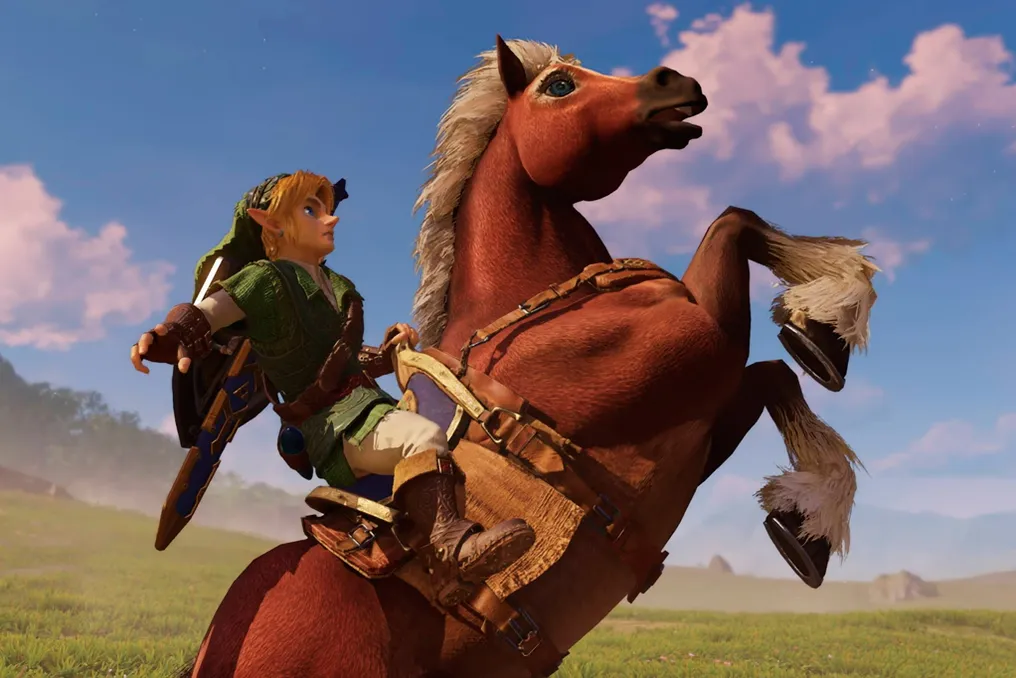
The gaming industry uses nostalgia to create great anticipation around new releases. Among remakes and remasters, revisiting an adventure can be an opportunity to recover old memories.
The game The Legend of Zelda: Ocarina of Time will receive a new version for the Nintendo Switch 2 on November 5th. For those who experienced Hyrule in childhood, this return raises the question: what is expected to be found in that world after all the changes that have occurred in our lives?
In Ocarina of Time, this inquiry connects with a narrative that addresses themes of growth and return. Originally released in 1998 for the Nintendo 64, the title follows Link on a mission to protect the kingdom of Hyrule against the threat of Ganondorf. The protagonist must explore forests, villages, and temples, solving challenges to advance.
At a crucial point, by removing the Master Sword from its pedestal, Link advances seven years and awakens older, allowing him to travel between the two eras. While the character in the game travels through time, the player perceives the time passed outside of it, although the ability to return to the game's initial state is considerably more difficult.
Growing up and finding the transformed world
Upon waking up seven years later, Link discovers that Hyrule has been altered by Ganondorf's dominion. Familiar locations present new conditions of existence, and this familiarity intensifies the perception of change. The player can make comparisons, which is possible due to environmental recognition. If everything were completely unknown, it would just be discovery; but since part remains, there is a chance to notice a loss.
The game's manual emphasizes the metamorphosis of Hyrule during this period and the consequences of childhood actions in adulthood. This can be interpreted as a metaphor for the experience of maturing. A childhood setting still exists, but its physical presence does not guarantee that it can be inhabited as before. People evolve, relationships change shape, and the visitor themselves develops unprecedented concerns.
In the game, this alteration is presented drastically. In real life, this often becomes evident upon returning: the comparison reveals the transformations accumulated over the years. The option to switch between ages generates a philosophical tension. Link returns to a previous moment, retaining, for the player, the knowledge acquired later. Although the action may restore a configuration of the world, the player's experience already incorporates what happened in the other era. Furthermore, when replaying, we discover paths that previously required exploration, and this knowledge alters the nature of the journey. A known route may bring comfort, but loses the original surprise; the return gains meaning in this difference.
The uniqueness of a first time
Remembering how a game works differs from evoking the moments lived during gameplay. When resuming Ocarina of Time, one can identify commands, predict solutions to puzzles, or traverse paths easily. However, one can also recall a specific occasion in that setting, who was present, or how one felt upon discovering something after a playthrough. Familiarity with the game and the memory of its presence in our lives may approach each other, but one does not necessarily imply the other.
This distinction helps in understanding why repeating a playthrough can generate unexpected feelings. We know the path, but we miss the person who walked it with us. We recognize the music and remember a time with different concerns. The setting remains accessible, but the circumstances that gave the first experience its special character have changed. Even reproducing every movement, the encounter occurs at a different moment in our history.
The years passed also alter what we can grasp from the work. A scene once seen as a mere stage of the adventure can gain new weight after experiences of separation or major changes. By following Link in a modified world, someone returning to the game in adulthood may recognize issues ignored in childhood. Prior experience influences this reading, along with everything lived after it.
From this point arises a paradox of return: the more we recognize a passage, the greater we perceive the distance separating us from the first time. Nostalgia can emerge from this closeness to something dear and the awareness that its original conditions remain in the past. Returning to the game allows us to revisit a valued experience and observe how our relationship with it has transformed. Hyrule remains available, and the reunion with its landscapes can aid in understanding the course of our own lives.
What science shows
A meta-analysis study, published in 2026 by Evan Weingarten of the University of Southern California, USA, analyzing over 400 experiments on the triggers and benefits of nostalgia, indicated that psychological threat situations can provoke nostalgia, and that this emotion can contribute to well-being.
The explanation presented in the article is that recalling personally significant events provides resources to cope with current challenges. In scenarios of loneliness or loss of purpose, for example, memories of shared experiences can restore feelings of connection and belonging to one's own story. The individual finds again, in memory, bonds and experiences that remain valuable to them. This process helps understand why a difficult situation in the present can evoke longing for past moments. However, the benefits vary according to individual characteristics and the way nostalgia is evoked.
Also in 2026, Michael Mask of the University of British Columbia, Canada, released two experiments demonstrating that remembering a nostalgic experience can increase the perception of the psychological richness of one's own life. The results indicate that people who write about a nostalgic memory tend to evaluate their trajectory as richer in interesting and diverse experiences capable of changing their worldview, compared to those who wrote about an everyday event.
The main factor highlighted in the findings was the atypical nature of the recalled episodes: nostalgic memories drew attention to events that differed from routine. By recovering them, participants evoked experiences that made their story more varied and meaningful, favoring a new appreciation of what has already been lived, including its emotional complexity.
Returning with the life that continued
These results suggest that the value of a memory can encompass the complexity of what it makes us perceive. In the context of Ocarina of Time, the satisfaction of recognizing a setting can coexist with the awareness of time passed. The memory of playing with someone can be both affectionate and painful. The same game allows these nuances to coexist, without requiring the past to be portrayed as an entirely happy period.
By navigating the eras, Ocarina of Time allows us to experience the nostalgia of a fiction about transformation, where knowing a place implies perceiving what happened to it. Upon encountering the game again after years, this perception can be applied to one's own life trajectory. The distance between play sessions becomes part of the work's experience.