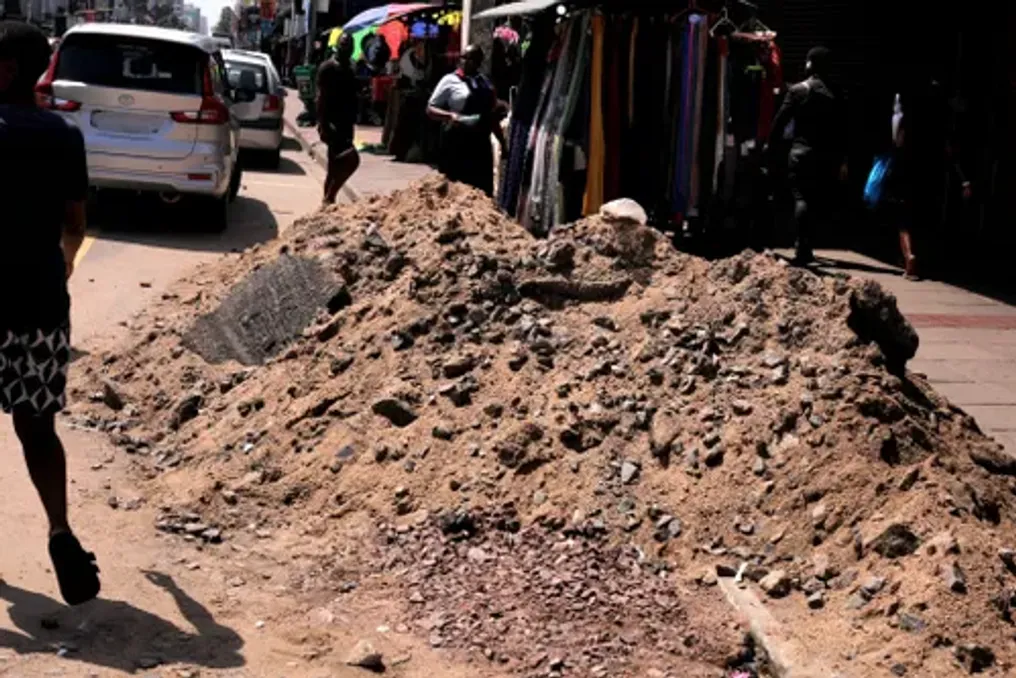
Residents, traders, and commuters note that the situation in parts of Durban's Central Business District (CBD) is worsening due to sewage overflows, overflowing garbage, broken roads, and a lack of functional public toilets.
An inspection of several locations in Durban's CBD by sundaytribune.co.za revealed potholes, abandoned stormwater drainage systems, waste accumulation, and constant sewage leaks, negatively impacting traffic flow, public spaces, and sanitary conditions.
On University Avenue in the market area, potholes disrupted traffic, while damaged and neglected storm drains along Julius Nyerere Street, Dr Packley Kaseme Street, and Anton Lembede Street contributed to sudden flooding during heavy rains.
Around the market bridge, in the open space near the YMCA, and under the bridge near Inanda Taxi Rank, there is a strong smell of rot and human excrement. Ongoing raw sewage leaks at the corner of Ungene Road and New Market Street are exacerbating a growing sanitary crisis.
Broken and aging pipes on key routes, including Margaret Mncadi Avenue (Esplanade), have repeatedly burst, allowing sewage water to enter storm drains.
Historical landmarks such as Victoria Street Market, as well as areas around the Early Morning Market, frequently suffer from disorder, illegal dumping of waste, and strong odors of human waste. Regular users of this area complain about discarded plastic waste on pavements at the corner of Dr A B Ksuma Street and Dr Yusuf Dadu Street, where some traders live directly on the streets.
The State of Durban's Central Area
Durban's central area is home to many residents, business owners, and visitors who are deeply concerned about the condition of the area.
Shadrak Ngwenya, a business owner in Durban's CBD, accused the municipality of always reacting to problems rather than preventing them. He questioned, 'The city has a large repair crew. Why don't they maintain the old infrastructure? Why wait until pumps fail and then address them late?'
Ngwenya also stated that the municipality has a large environmental department with several highly paid environmental officers. He questioned their activities, asking, 'Are they active in their duties or resting in offices? Do they visit communities and schools to educate the public about environmental issues? What do they do with the mountains of garbage dumped on the streets around the CBD?'
Ish Praladh, president of the eThekwini Taxpayers and Residents Association, claimed that municipal workers leave water, sewage, and electrical infrastructure exposed after completing repairs, which is dangerous. He noted, 'Infrastructure repairs take days, weeks, and sometimes months. Residents have to buy bottled water or install Jojo tanks in their homes due to water outages in eThekwini.'
Praladh added that the lack of municipal service provision has led to significant losses for local businesses. He emphasized, 'Schools have to send students home due to water shortages and power cuts. This shows that education is suffering. Communities are suffering from the lack of services.'
He also mentioned that many eThekwini residents face unfair billing systems and inflated water and electricity tariffs. Praladh called for not increasing municipal staff salaries to compensate for losses and unnecessary expenses. He noted that fixing infrastructure faults takes too long in many parts of the city. Although it is quick to get a reference number for any fault, the repair takes a long time.
Praladh suggested involving taxpayers' associations in the city, as they are the 'ears and eyes' on the ground.
Residents also expressed concern about taxi drivers and passengers urinating in buckets due to the lack of toilets near the taxi rank on Monty Naicker Street. Concerned resident Aubrey Govender reported that the smell of urine near this rank is unbearable. He stated, 'I don't know how people use or pass through this rank every day. The smell is awful, and it has been going on for over 6 months. I decided to use Joe Slovo Street or other alternative routes.'
Govender demanded that the eThekwini Municipality urgently resolve the issue of toilet shortages in Durban's CBD. He added, 'The lack of sanitation facilities in the CBD forces people to urinate on building walls. If you walk around the city, the only smell you will notice is the smell of urine, garbage, and sewage.'
The situation has been aggravated by protests against illegal immigration and clashes. Protesters burned and damaged more than a dozen vehicles and commercial buildings along Dr Packley Kaseme Street. The resulting garbage and ash remain on the streets.
A pothole on the pavement at the corner of Denis Hurley Street and Joe Slovo Street forces residents and customers to move cautiously. Water seeping from the ground near the Muslim cemetery on Dr Packley Kaseme Street, as well as at the corner of Dr Packley Kaseme Street and Dr Yusuf Dadu Street near the Pazi shop, contributes to municipal water loss.
Nkosikona Dladla, a driver from the Chesterville Taxi Rank in the Market, reported that toilets in the CBD are unserviced. He said, 'The smell from these toilets is unbearable. Sometimes you find out that the toilets are closed at 4 PM without warning.'
Dladla noted that the poor condition of toilets in the CBD forces people to relieve themselves everywhere. He added, 'I no longer use these toilets at taxi ranks because of their unbearable smell. If I need to use a toilet, I go to the nearest garage.'
Colonel Boisi Zungu, a representative of the Durban Metro Police, condemned public urination and other behaviors that endanger the cleanliness, dignity, and safety of public places. He explained that public urination is prohibited under Section 5(2)(c) of the eThekwini Municipality Bylaws: 'Nuisances and behaviour in public places', 2015. Zungu stated, 'Infringers may be fined R500 via a guilty plea notification in accordance with the Criminal Procedure Act. Durban Metro Police urges the public to comply with municipal bylaws to avoid enforcement measures.'
When asked how actively officers patrol the CBD to deter such behavior, Zungu replied that the Metro police conduct regular patrols and compliance operations throughout the CBD. He specified, 'Public urination is one of the offences addressed during routine patrols and compliance operations. Officers also respond to complaints received from members of the public. Information on recurring hotspots helps in targeted deployment and planning of operations.'
Zungu reported that consolidated statistics specifically regarding public urination offences in the CBD are currently unavailable. He pointed out the difficulties officers face in enforcing bylaws: 'One of the problems officers encounter when trying to enforce bylaws is that public urination often occurs in secluded spots, especially behind buildings, along walkways, and in areas with limited visibility. Another problem is the high volume of pedestrian traffic in the CBD.'
Zungu acknowledged that the lack of and accessibility of sanitation facilities, especially at night, hinders police officers' work in preventing offenses. However, he assured, 'Despite these challenges, we strive to enforce municipal bylaws and address public concerns. The Durban Metro Police is part of the eThekwini Municipality and supports an integrated approach to addressing public concern and environmental issues.'
Nevertheless, Zungu strongly recommends installing clear and visible directional signs to help the public locate the nearest available public toilets. He believes that improving navigation combined with accessible and properly maintained sanitation facilities can significantly reduce instances of public urination in the CBD. He stressed, however, that the lack of toilets does not exempt people from complying with municipal bylaws.
He urged the public to report instances of public urination and recurring problem areas through official city reporting channels or directly to the Metro Police. Zungu explained that reports must include the exact location, time of occurrence, and any other relevant information. He also encourages business owners and residents to report recurring problems for operational planning. He added that the Metro Police has specialized units dedicated to conducting educational and awareness campaigns aimed at promoting compliance with municipal bylaws, responsible behaviour, and civic pride. He concluded that the cleanliness of the city is everyone's responsibility, and while the police will continue to enforce bylaws, long-term improvements require cooperation, civic pride, and responsible behaviour from everyone who lives, works, and visits Durban.