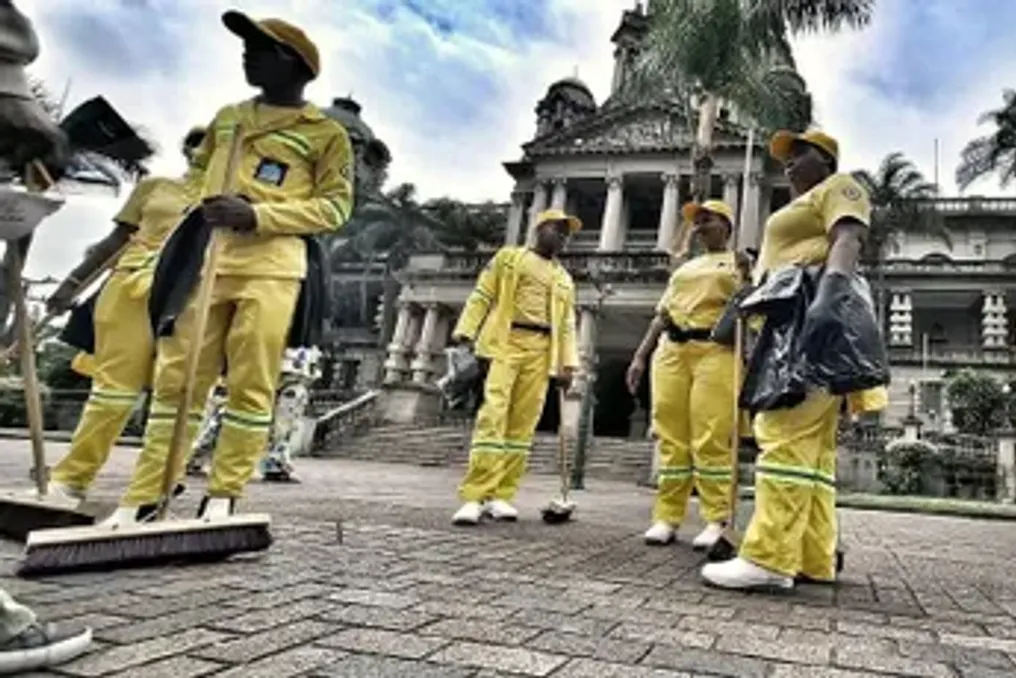
Eighteen months ago, the Durban centre was viewed as an example of urban decay. However, according to a recent interim review of the city's flagship regeneration program, it has now become an example of how to restore the situation by acting step by step, street by street, and day by day.
The interim review of 'Defend The City' (Month 18 of 36) was presented by the eThekwini municipality in collaboration with Ensure Ubuntu and implemented with support from Neon Pulse. It covers 546 days of implementation, starting in April 2025 and ending in August 2026, presenting a cumulative performance report intended to answer the complex question: what has actually changed?
At the heart of the report is a metrics table demonstrating significant results: 1,071,512 kg of waste was removed, and 160,098 bags of waste were collected from public areas. 568,722 km of visible patrols and 561,012 working hours were recorded. Furthermore, 113 direct crime interventions were conducted, where teams provided immediate assistance to citizens, and 548 positive public feedback responses were received.
The eThekwini municipality officially reported on April 6, 2026, a 28% reduction in visible serious crime and a 19% increase in emergency response time. An additional 13.2% decrease in crime was noted in the Durban Central area in the first quarter of 2026/27 (April–June 2026), supplementing the achievements of the first year.
The report emphasizes the importance of segregated accounting. The 28% figure reflects the municipal assessment of visible serious crime. Separate SAPS statistics show that the number of serious crime cases decreased from 2,044 to 1,784 by March 2026, a 12.7% reduction, as reported by media outlets on July 24, 2026.
SAPS category breakdowns further clarify the picture: property crimes fell by 32.2% (from 484 to 328 cases), vehicle thefts decreased by 27.6% (from 98 to 71 cases), contact crimes reduced by 16.3%, and aggravated robberies by 17.4%. In the first year alone, the municipality reported 101 incidents responded to and over 259 arrests made jointly with SAPS and Metro Police, although the review stresses that these are only first-year figures, not cumulative totals.
From Presidential Podium to Pavement
The significance of this project extends beyond the municipal level due to national recognition. In March and July 2026, President Cyril Ramaphosa, speaking through the eThekwini President's Working Group at the ICC Durban, stated that there were 'tangible signs that the decline has stopped. Durban has become a place worth visiting again.'
He linked this improvement to solid economic indicators: the Business Confidence Index stood at 63.38, the highest since the inception of the Durban index; tourism spending reached 9.72 billion Rand in 2025, an 18% increase from 2024 and 58% more than in 2023; and holiday season visitors numbered 1.2 million with a 77% occupancy rate.
Ramaphosa warned that 'stabilization does not equal transformation.' This context is critical because a safe and clean city centre forms the first impression tourists, investors, and conference attendees have of Durban. If the SA Auto Week 2026 exhibition is set to attract 5,000 delegates to the ICC in October, they will be passing through the very areas covered by this program.
More Than Just an Add-on Service
The report argues that the program succeeded because it ceased to be 'additional' and transformed into an integrated system. It encompasses six interconnected functions: safety (visible presence and response), cleanliness (daily standards and problem area elimination), public space (maintenance and restoration), social response, reporting (evidence and escalation), and trust.
The logic is as follows: 'A cleaner street increases visibility. A visible team detects incidents. Reporting triggers action. Supported space builds trust.' In practice, this manifested in three ways:
Commercial Corridor: Smith Street. Daily cleaning and deployment of teams in problem spots prevent the resurgence of distressed corners, maintaining a 31 out of 31-day standard, resulting in a total volume of 1,000 tons.
Civic Heart: Mduduzi Gardens and City Hall. The restored fountain, widely highlighted in the review, is now maintained as a functioning public space. The review notes that success is determined not by the opening ceremony, but by whether the fountain continues to operate and be serviced months later. Photos show wall restoration, landscaping, and daily maintenance.
City Entry: ICC Territory. During the SADC Ordinary Summit, tactical teams supported SAPS and Metro Police in securing routes and ensuring visibility. The report asserts that well-managed territory directly supports Durban's tourism economy of 9.72 billion Rand.
Real impact, not just statistics. The report details three of the 113 interventions to illustrate the range: a medical emergency where ambassadors were first on the scene, a hit-and-run where teams secured the scene for SAPS, and a week-long operation to secure the SADC Summit.
A five-tiered security model is described: walking patrols by 'street ambassadors' covering 568,722 km, rapid tactical response, coordination with SAPS in Durban Central, Point, and Umhlobo, as well as with Metro Police, and intelligence gathering, where every incident is logged and analyzed.
This reporting mechanism, powered by Neon Pulse, is presented as the foundation. The cycle is: observation, logging, analysis, action, verification, reporting. Every defect, from a broken bin to a crime hotspot, is logged and tracked until complete resolution.
Interim Assessment: What is Honest
The most credible page in the 26-page review is page 24, 'Interim Assessment.' It states clearly three things: the direction is positive, as crime rates are decreasing; the implementation model is consistent and reproducible; and the reporting is transparent.
It also states: 'The problems of the city centre are not solved.' For the period between month 19 and 36, four criteria will be used to evaluate the work, instead of counting the number of activities:
- Maintaining visible presence in all areas, including during less busy times.
- Preservation of restored assets, such as the fountain in Mduduzi Gardens, and its continuous maintenance.
- Maintaining or improving the 19% emergency response time improvement.
- Continued year-on-year decrease in SAPS registered crime, which currently aligns with the projected 13.2% decrease in the first quarter.
This is a shift in focus from activity to standards. Kyle Connolly from Ensure Security is quoted saying: 'We are very pleased with what the next 18 months can achieve.'
Analysis
For years, Durban conducted city centre cleanup initiatives that ceased after cameras were removed. What distinguishes this interim milestone is twofold: independent verification and cumulative evidence.
The timeline in the report shows that coverage deepened as results grew: from the launch announcement on April 9, 2025, to the official municipal results on April 6, 2026, and then detailed impact materials in the Daily News, IOL, and The Post in June and July 2026. This independent report, the review claims, serves as proof that the municipality was not obligated to provide it itself.
Secondly, the comparison is telling. In the first quarter of 2026/27, Durban Central (Ensure Ubuntu zone) saw a 13.2% decrease, while Marlvern, outside the program zone, recorded a 57% increase in crime, according to The South African, citing SAPS district statistics. Most of the 42 eThekwini districts improved their figures, but the contrast indicates that successes are concentrated where the integrated model is working.
The risk for the second half is complacency. Removing 1,071 tons of waste is impressive, but it also demonstrates how quickly waste accumulates. A 28% reduction in visible crime is a turning point, but Durban Central still recorded 1,784 serious crime cases in a year.
The mantra of the review is correct: '18 PASSED. 18 REMAINING. The first year laid the foundation. The first half proved it works. The second half is dedicated to cementing the standard so that changes last.'