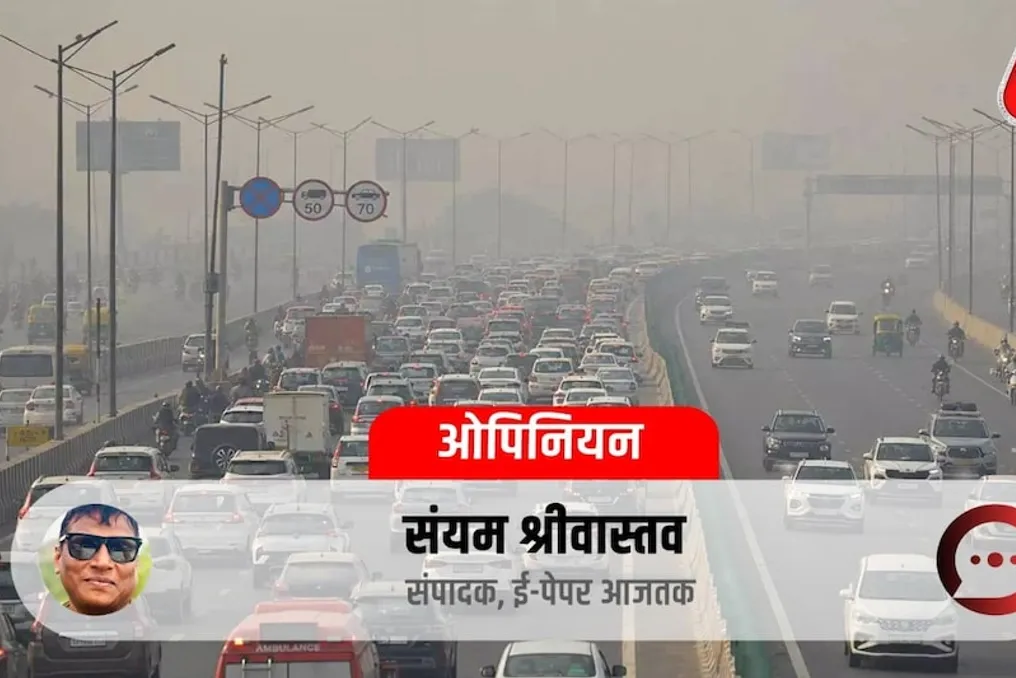
Citizens demand politicians adopt a decisive approach, similar to Amit Shah's style, to combat air pollution
Read more
Aaj Tak
www.aajtak.in

Citizens demand politicians adopt a decisive approach, similar to Amit Shah's style, to combat air pollution

Home Minister Amit Shah demonstrated his working approach by setting deadlines for resolving several complex internal security issues. Regarding Naxalism, he set clear timelines, stating that the problem would be largely eliminated by March 31, 2026. Concerning drug trafficking in Punjab and across the country, he set a deadline of December 31, 2029, promising to apply the same resolve.

It is worth noting that after the abrogation of Article 370 in Kashmir, the region has been successfully integrated into mainstream life, and the level of terrorist activity has decreased. These successes are the result of political will, coordination between the center and states, and an accountability system.

This is why residents of Delhi and North India now expect a similar approach to combating air pollution. However, the air in Delhi once again reached poor quality status at the end of October 2026. After Diwali, the Air Quality Index (AQI) exceeded 200, reaching nearly 300 in some areas, which led to the implementation of Phase-1 GRAP by the CAQM. It is predicted that the contribution from stubble burning will increase in the near future.

Weather conditions will not allow pollutants to disperse, leading the capital to become a 'gas chamber,' as happens every year. This annual cycle makes the public feel that the problem remains unchanged. The combination of emissions from transport, construction dust, industry, open waste burning, and smoke from neighboring states makes the air toxic. Children, the elderly, and people with respiratory diseases are the most vulnerable.

Under these circumstances, the public rightly demands that some leader publicly take responsibility and set deadlines. Although air pollution differs from Naxalism or drug trafficking because it is a multi-factorial, seasonal, and inter-state issue, unlike those two phenomena where there are clear enemies and organized groups.

Stubble burning is linked to farmers' economic needs, the number of vehicles is constantly growing, construction is part of urban expansion, and weather (wind speed, temperature, humidity) is beyond the control of any single government. Coordination is required between the central government, the governments of Delhi, Punjab, Haryana, and Uttar Pradesh. No single minister or department can handle this alone.

Nevertheless, the public opinion is correct: when political will and accountability are established, the administrative machinery starts working. Shah's style means not just making declarations, but having measurable goals, responsible officials, regular monitoring, and accountability for results. This is also possible in the case of pollution. Deadlines can be set for stubble management, including equipment availability, timely payment to farmers, alternative use (biomass, compost), and strict supervision.

For transport, standards higher than BS-6 can be introduced, old vehicles phased out, public transport expanded, and parking policies tightened. Responsibility can also be assigned for controlling dust at construction sites, regular road cleaning, and strict measures against open waste burning. Plans like GRAP already exist, but they require political support and continuous monitoring.

The central role is crucial because the Delhi-NCR problem is not limited to Delhi; a complete solution is impossible without controlling agricultural residue burning in neighboring states. This requires both coordination and funding from the center. At the same time, the Delhi government must strengthen control over local sources. The public wants a leader to publicly declare that within the next three years, the AQI will not exceed the poor category, the contribution from stubble will be reduced to a certain percentage, and transport pollution reduced by a specified amount. The public will monitor any leader who makes such a promise, regardless of their party.

This demand arises because many plans have been developed, meetings held, and expert committees formed in previous years, yet the situation shows no decisive change year after year. People recall the decisiveness shown in complex issues like Naxalism and Kashmir and ask why the same resolve is not shown in the everyday problem of air pollution. The health issue is no less important than national security. The burden of diseases caused by pollution falls on the economy and the public healthcare system.

To eliminate pollution, an approach similar to Shah's style is needed: deadlines, accountability, and continuous monitoring must be fully defined. However, this is only possible if all parties view the problem above political competition. The center, state governments, local authorities, and the public must fulfill their roles. Declarations are simple, but results are complex. Any leader who promises to clean the air of Delhi and takes responsibility for it will gain public trust. The problem is technical and administrative, but its solution requires political will. Until this will is demonstrated, every October-November autumn will repeat the same story.
Similar stories

Delhi's air became polluted before Diwali; pollution reached its worst level in October
Read more
www.aajtak.in

Delhi's air became polluted before Diwali; pollution reached its worst level in October

Even before the celebration of Diwali, Delhi experienced extremely heavy smog as air quality deteriorates earlier than usual. According to data from the Central Pollution Control Board (CPCB), on the night of October 21, when most city residents were asleep, 45 out of 53 monitoring stations recorded poor or worse air pollution.

According to CPCB readings, at 1 AM, the average PM2.5 level in Delhi was 191.2 micrograms per cubic meter, which falls into the 'very poor' category on the CPCB scale. This period, which began on October 14, was the most polluted of the week.

Under the national air quality standard set by CPCB in 2009, the established limit for the daily average PM2.5 in India is 60 micrograms per cubic meter.

However, when considering the overall Air Quality Index (AQI), the situation in October this year was slightly better compared to last year. The daily CPCB bulletin showed that on October 20, the AQI in Delhi was 179, corresponding to the 'moderate' category. The average AQI for the period from October 1 to October 20 reached 154.6, whereas in 2025, it was 178.7 for the same period. During this period, the AQI never reached the 'poor' or 'severe' category.

However, looking at hourly data paints a more alarming picture. Analysis of CPCB data by Aaj Tak revealed that during the last week, 24.9% of the 59 registered PM2.5 sensors were in poor or severe condition before 1 AM. The daily average does not reflect information about the dirtiest hours, which often occur during people's sleep, night shifts, or early morning work.

Analysis of hourly data for the week demonstrates that pollution levels increase at night. According to India Today, about two-thirds of the readings recorded in the 'very poor' and 'hazardous' categories occurred between 9:00 PM and 6:00 AM.

In the middle of the day, on October 15, when wind speed was higher, pollution levels significantly decreased. According to CPCB, at 2:00 PM, the wind speed was 2.3 meters per second, and the average PM2.5 level in the city dropped to 9 micrograms per cubic meter, marking the cleanest hour of the week.

The air in Delhi continues to become more polluted. An analysis by India Today shows that during the first week of October, the average PM2.5 content in the air was 59.3 micrograms per cubic meter. By October 20, this figure rose to 71.2 micrograms, representing an increase in pollution of approximately 20%.

According to CPCB, from October 1 until now, the average PM2.5 level in Delhi at 12:00 AM was the highest—80.4 micrograms per cubic meter, and at 3:00 PM, it was the lowest—44.4 micrograms. In the period from 12:00 AM to 6:00 AM, the PM2.5 concentration in the air was 1.6 times higher than in the period from 12:00 PM to 6:00 PM.

According to CPCB, around 12:00 AM, the average wind speed at Delhi stations was 0.6 meters per second, while at 3:00 PM, it increased to 1 meter per second. It was observed that pollution was higher during hours of low wind speed. However, based solely on this correlation, one cannot conclude that low wind speed is the cause of the rising pollution.

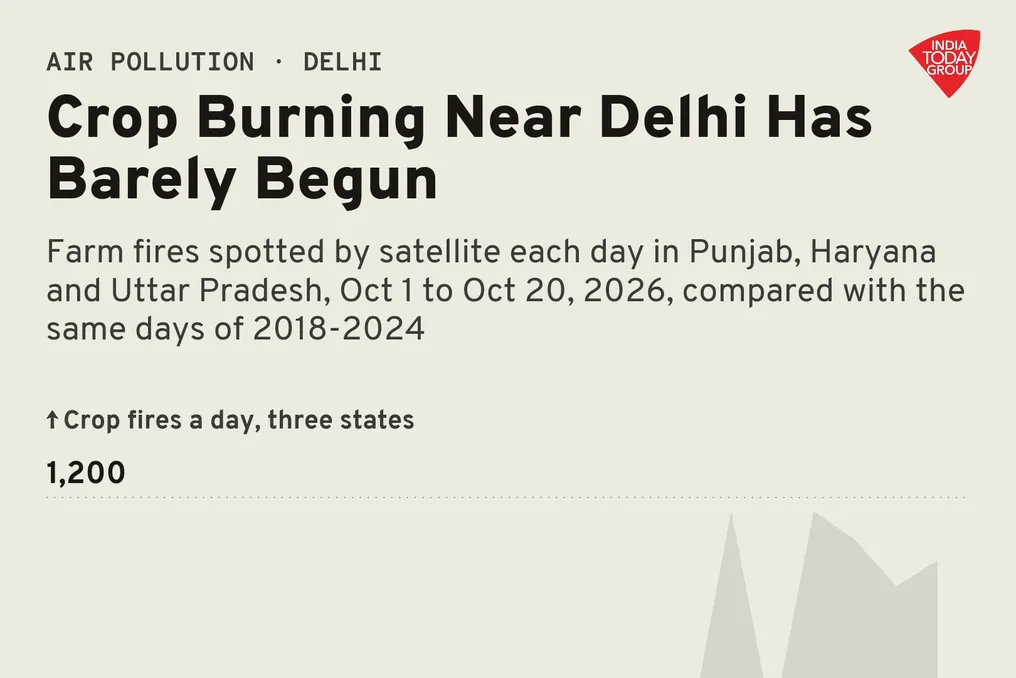
Every year, farmers from Punjab, Haryana, and Uttar Pradesh burn rice straw in October. The Indian Agricultural Research Institute (IARI) tracks these incidents using satellite imagery. According to IARI, from October 1 to October 20, 506 instances of straw burning were recorded in these three states: 345 in Punjab, 155 in Uttar Pradesh, and 6 in Haryana. Between 2018 and 2024, the number of such incidents on these dates fluctuated between 2031 and 9722. Last year, 817 cases were recorded for this period.

Despite the air being more polluted in Delhi this month, the number of straw burning incidents in the three neighboring states remains low. Typically, most straw burning occurs in the second half of October. According to IARI, between 2018 and 2024, 83.6% to 94.5% of all straw burning incidents in these three states were registered after October 20, meaning most incidents of this season are yet to come.

The rise in air pollution in Delhi is caused not only by smoke from field straw burning. A study conducted by The Energy and Resources Institute (TERI) and the Automotive Research Association of India (ARAI) assessed various sources of PM2.5 pollution in Delhi during the winter season of 2016-2017. According to this study, vehicle exhaust contributed 23%, while crop residue burning and domestic burning accounted for 22%. Road and construction dust made up 15%, and industrial units accounted for 10%. Furthermore, 26% of the pollution was caused by the formation of particles from other gases in the atmosphere.

Consider Five Important Points Before Buying an Air Purifier to Avoid Unnecessary Expenses
Read more
www.aajtak.in

Consider Five Important Points Before Buying an Air Purifier to Avoid Unnecessary Expenses

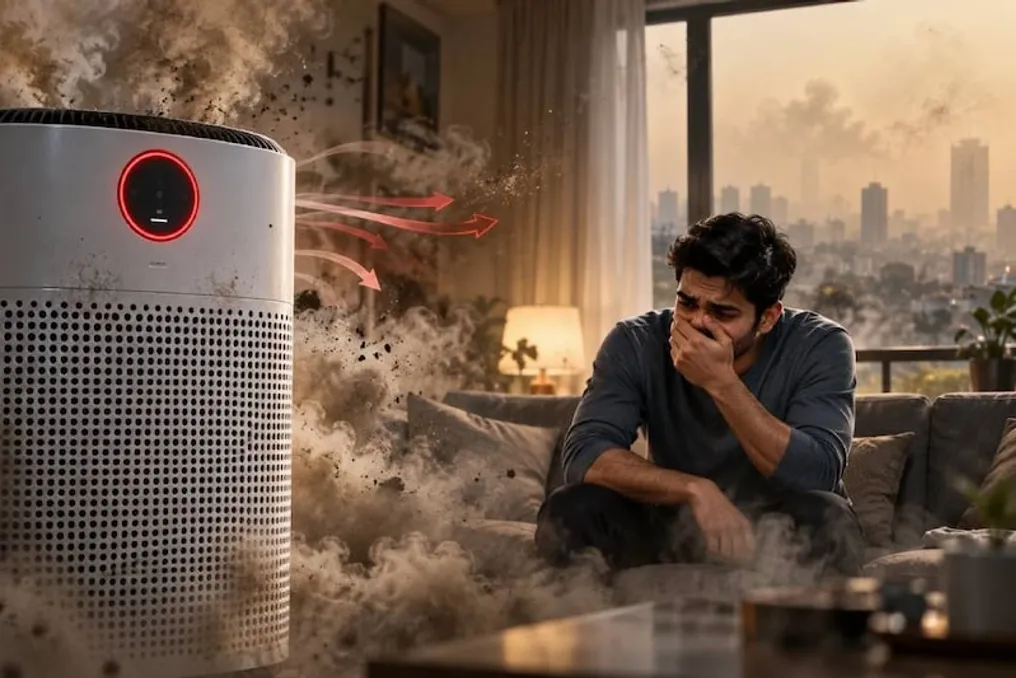
During the winter period, air quality in the Delhi-NCR region significantly deteriorates, leading to breathing problems for many people. When the Air Quality Index (AQI) rises, it can be harmful to health. To protect themselves from this, people install air purifiers in their homes.

However, if you do not check several important aspects before purchasing an air purifier, you might waste money. Below is a guide to five key points to consider when choosing a good air purifier.

The filter is the most important part of an air purifier. Therefore, when buying, you must check for the presence of a HEPA filter. HEPA stands for High Efficiency Particulate Air Filter. It helps remove fine dust particles and pollutants from the air.

A quality True HEPA filter is capable of filtering 99.97% of particles as small as 0.3 microns. Consequently, when choosing a purifier, you must ensure the type of filter installed and should not buy any purifier based solely on a low price.

When buying an air purifier, it is also important to know how quickly it can clean the air. For this, you should check the CADR rating, which stands for Clean Air Delivery Rate. This parameter shows the speed at which the purifier can provide clean air.

If the room is small, a purifier with a low CADR rating will suffice. However, for large spaces, a model with a higher CADR rating is preferable. For example, a model with a CADR of 100-150 may be suitable for a small room, whereas a large room might require a CADR of 200-300 or higher. Nevertheless, the correct rating depends on the room size and the capabilities of the purifier itself.

When buying an air purifier, it is crucial to consider the room size. If you buy a purifier designed for a small room for a large space, it will not be able to properly clean the entire volume of air.

Therefore, before purchasing, you should check the coverage area stated by the manufacturer. You must ensure that the purifier matches the size of your room. If you plan to use it in a large hall or extensive area, choose a model with a larger coverage.

It is not enough to look only at the initial price when choosing an air purifier. You also need to find out how often filters need replacement and what the cost of new filters will be. Some purifiers may have a low initial price, but their replacement filters can be expensive. Over a long period, this can increase the total cost.

Therefore, before buying, be sure to check the cost, replacement frequency, and availability of filters. This will help you assess the overall long-term cost of owning the air purifier.

Since the air purifier may run for many hours during the cold season to combat pollution, it is important to know how much electricity it consumes. Additionally, you should pay attention to the noise level of the purifier. If you plan to place it in a bedroom, it is better to choose a low-noise model so as not to disturb sleep.

Before buying, be sure to study the information on energy consumption, sleep mode, and noise level. If you are also considering buying an air purifier to protect against growing pollution in Delhi-NCR, be sure to take these five points into account. This will allow you to choose a suitable model for your needs and avoid unnecessary expenses.

Popular