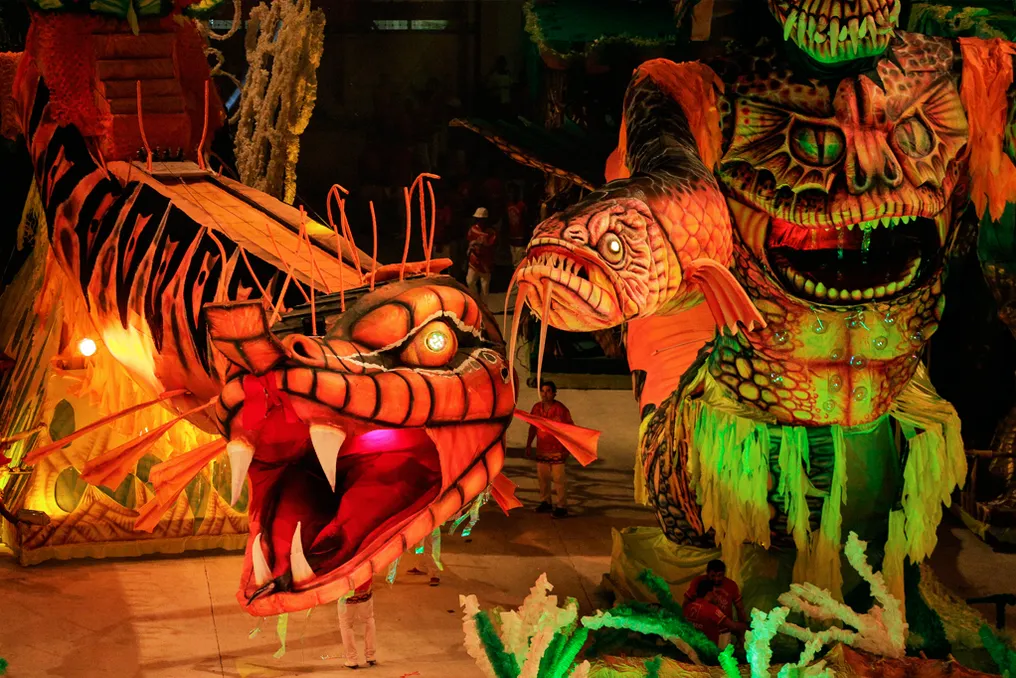
The Parintins Festival, recognized as one of Brazil's largest regional festivities, officially began in 1965. This annual event takes place during June on the island of Parintins, located on the banks of the Amazon River, and constitutes a symbol of Amazonian culture.
The driving force behind the festival lies in an ancient rivalry between two groups known as the 'bois,' who stage the folklore of the boi-bumbá. This version of the northeastern bumba-meu-boi tells the story of Catirina and Negro Francisco, a plot that addresses themes of desire and resurrection, defining the essence of the spectacle.
The central dispute of the Parintins Festival was formalized with the creation of the bois. Garantido, which adopts the color red and is popularly called the 'people's bull,' emerged in 1913. Later, in 1925, the bull Galante was renamed Caprichoso, beginning to use blue and gaining the reputation of the 'elite bull.'
The confrontation, which started as an informal street dispute, evolved into a large production. In 1988, the inauguration of the Bumbódromo, a monumental arena, elevated the level of the spectacle to a standard comparable to the parades of the Rio de Janeiro samba schools. During the three nights of presentation, the event manages to attract more than 100 thousand spectators.
The Bumbódromo, which has a capacity for over 25 thousand people, serves as the main stage where the magic of the Parintins Festival unfolds. The cheering crowds of each boi, divided equally within the arena, play a fundamental role through choreographies and animations that contribute to the scoring of their respective teams. Silence is required when the opposing boi is performing, under penalty of sanctions.
Each boi mobilizes approximately 3,500 participants per night, organized into 'tribes,' similar to the sections of samba schools. Notable elements include the porta-estandarte and the cunhã-poranga, which symbolizes the most beautiful indigenous woman of the tribe.
Giant allegories, moved by hundreds of people, can reach up to 30 meters in length and exceed 15 meters in height, representing figures from Amazonian folklore. The competition is judged by nine folklore specialists, covering 21 criteria, ranging from the rhythm of the drums, involving 400 to 600 musicians, to the quality of the allegories. Each boi displays between 15 and 22 'toadas,' traditional songs that narrate the legend of the boi-bumbá.
The performances last two and a half hours on each of the three nights of the festival, resulting from six months of intensive rehearsals held in the so-called 'currais.' The devotion to the colors—red for Garantido and blue for Caprichoso—is so intense that even the judges use green pens to ensure impartiality.