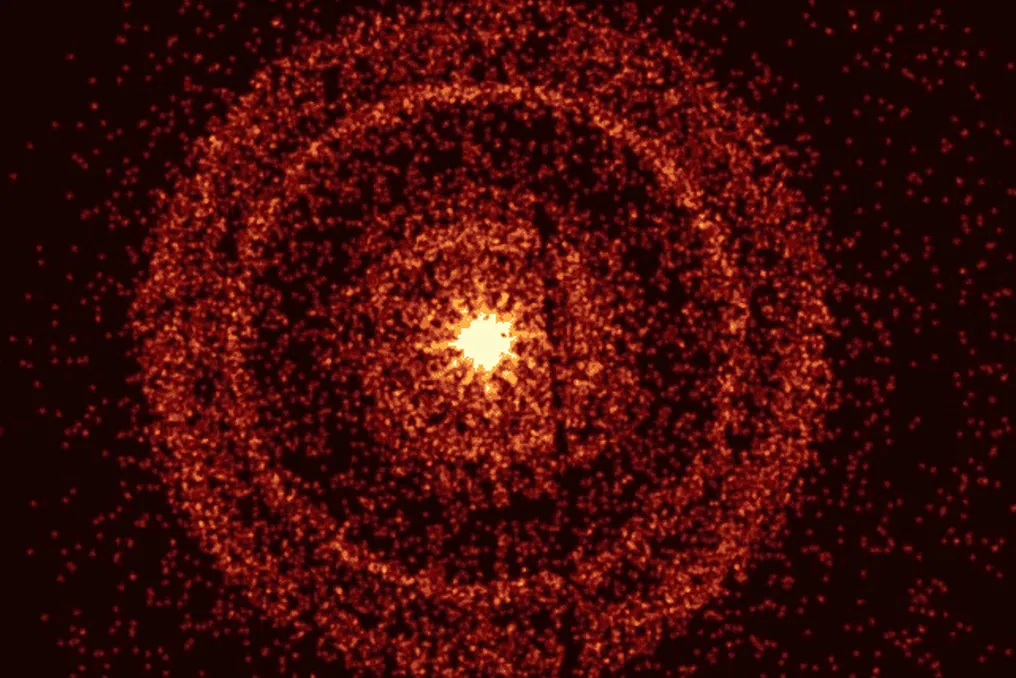
An intense cosmic explosion, known as BOAT (The Brightest of All Time), occurred on October 9, 2022, and reached Earth with a radiation wave capable of altering the ionosphere, one of the atmospheric layers. This phenomenon has attracted the attention of astronomers and continues to spark debate regarding its actual impact on the planet.
This event was identified as GRB 221009A and belongs to the category of Gamma-Ray Bursts (GRBs)—some of the most powerful energy releases in the Universe. They occur when very massive stars collapse, forming a black hole and ejecting jets of particles at speeds close to the speed of light.
Estimates suggest that this event could have been the brightest observed on Earth in approximately the last ten thousand years. According to NASA data, the explosion was so powerful that it temporarily overloaded gamma-ray detectors on various spacecraft.
One example is NASA's Fermi Gamma-ray Space Telescope. Two instruments on the observatory—the Gamma-ray Burst Monitor (GBM) and the Large Area Telescope (LAT)—encountered limitations in registering radiation during the most intense moments of the event.
The INTEGRAL mission, representing the European Space Agency's (ESA) International Laboratory for Gamma-ray Astrophysics, was also affected by BOAT. A study conducted by the Institute of Astrophysics of Andalusia in Spain and published in the journal Astronomy & Astrophysics in 2024 showed that the received radiation was sufficient to saturate the Anti-Coincidence Shield (ACS) and parts of the Imaging Spectrometer (ISGRI) detectors, which degraded data collection during the burst.
To overcome this issue, researchers used data from another INTEGRAL detector—the Microcalorimeter (MCAL)—which was not affected by saturation, to estimate the radiation intensity. Furthermore, they referred to data from the European probe BepiColombo, heading to Mercury, which registered the burst using the Mercury Gamma-ray and Neutron Spectrometer (MGNS). This instrument detected radiation in the energy range of 280 to 460 kilo-electron volts, recording a sequence of pulses lasting about 6.6 minutes.
Scientists combined measurements from two spacecraft to estimate the burst intensity during times when other INTEGRAL detectors were overloaded. This comparison allowed for the reconstruction of part of the signal that could not be measured directly.
Despite the exceptional intensity of the radiation, no signs of permanent physical damage to the spacecraft were found; the problem lay in the temporary overloading of the detectors, which affected some measurements.
The first signal was recorded at 13:16:59 UTC by the Fermi GBM instrument. Other space installations, including the Neil Gehrels Swift Observatory, also detected this radiation. The combination of observations allowed for the study of the phenomenon across different wavelengths and tracking the radiation after the initial flare.
Data indicated that the explosion occurred in a distant galaxy, approximately 2.4 billion light-years from Earth, although this distance may vary depending on the cosmological measurement method used. Even traversing such a vast distance, the radiation reached Earth with enough intensity to cause detectable effects in the atmosphere.
A spectroscopic measurement published in 2025 estimated the light distance at approximately 745 megaparsecs, equivalent to about 2.43 billion light-years. The ionosphere is a region of the atmosphere located between altitudes of 50 and 1000 kilometers. In it, solar radiation and other energy sources knock electrons out of atoms and molecules, forming charged particles. These changes affect the propagation of radio waves and can be detected by scientific instruments.
In November 2025, a study published in Geophysical Research Letters presented evidence that the explosion increased the electron density in the lower ionosphere, at an altitude of 50 to 90 kilometers. Researchers noticed changes in the propagation speed of extremely low frequency radio waves caused by lightning. This disturbance lasted for about 40 minutes.
The team also identified discrepancies between monitoring methods: some measurements showed signals related to radiation passage, while others, such as Schumann resonance observations, did not show obvious changes. The results suggested that the explosion caused a specific reaction in the ionosphere, different from what is usually observed during solar storms.
However, a study placed in the arXiv preprint repository in May of this year revised other changes previously attributed to BOAT. The authors analyzed data from different altitudes and concluded that some anomalies in satellite measurements, electron content, and equatorial electric circulation could be explained by natural conditions and instrumental limitations. The work did not find a consistent increase in total electron content that could be directly linked to the explosion. The authors also identified variations that occurred regularly under certain lighting conditions or began before the event itself. Since the text is still awaiting peer review, its conclusions should be considered in the context of independent scientific evaluation.
According to Marcelo Zurita, president of the Paraiban Astronomy Association (APA), member of the Brazilian Astronomical Society (SAB), technical director of the Brazilian Meteor Observation Network (BRAMON), and columnist for Olhar Digital, it is important to emphasize that this study does not call into question the fact of BOAT or the data recorded by the Institute of Astrophysics of Andalusia's gamma-ray detectors.
The expert explained: 'It disputes the effects of this GRB, and consequently, other gamma-ray bursts on the Earth's ionosphere in the 2025 paper.' He added: 'The ability of these explosions to affect the atmosphere has been discussed in the scientific community for many years. Thus, this study may finally resolve this controversy. If it is proven that the most powerful gamma-ray burst did not cause significant effects in our ionosphere, we can conclude that none of the others will be able to do so.'
This event remains important for astronomy as it helps investigate the interaction of extragalactic explosions with the Earth's environment. The research also highlights the need to use various instruments and independent analyses to separate the effects of cosmic phenomena from natural atmospheric fluctuations.