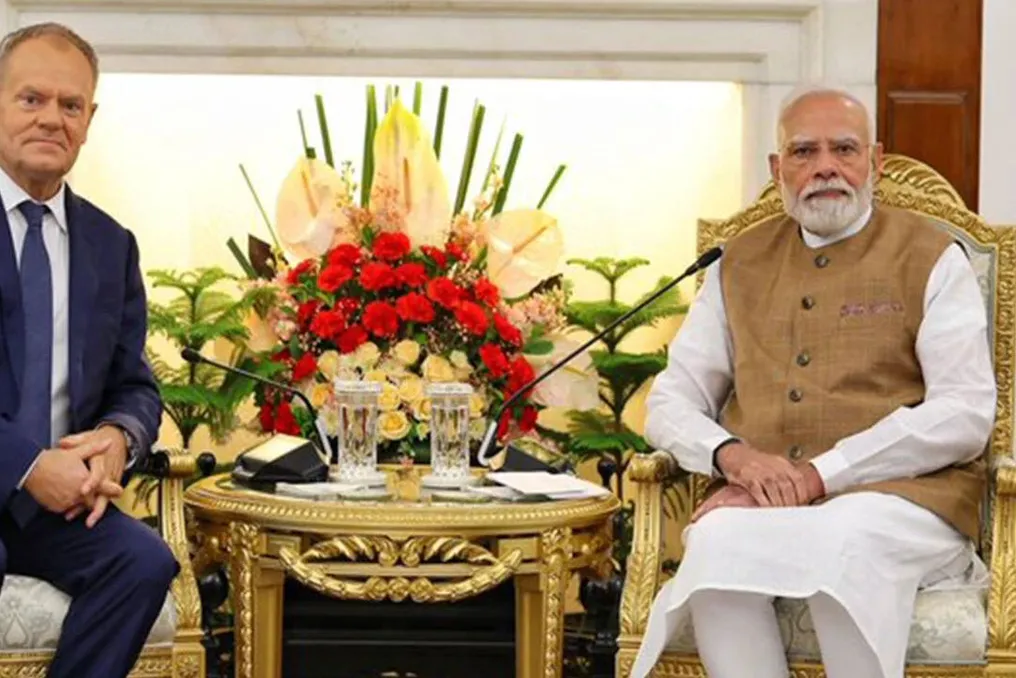
Prime Minister Narendra Modi affirmed India's commitment to supporting peace efforts in Ukraine and West Asia during bilateral meetings with his Polish counterpart Donald Tusk. The parties agreed to intensify cooperation in strategic areas amid growing global instability.
The leaders held extensive talks at the Hyderabad House in New Delhi, exploring opportunities for interaction in fields such as defense, space, nuclear energy, critical minerals, green technologies, and artificial intelligence (AI).
Furthermore, they discussed regional and global events and agreed on the goal of doubling bilateral trade by 2030. Tusk is in India on a three-day visit, which takes place against the backdrop of renewed international attempts to end the war in Ukraine.
Announcing the decisions made during the negotiations, Prime Minister Modi stated that India and Poland will expand cooperation in defense, space, and nuclear energy, and called on Polish companies to participate in joint projects.
Modi emphasized: 'Today we agreed to deepen ties in defense, space, and nuclear energy. We invite Polish companies to co-develop and co-produce with India in all these strategic directions.' He added that new partnerships would also develop in the areas of critical minerals and coal gasification, utilizing Polish experience.
The Ministry of External Affairs (MEA) reported that the discussions were aimed at developing the strategic partnership established between the two countries in 2024 and expanding cooperation in several areas.
According to the MEA statement, 'This is a new phase in the India-Poland Strategic Partnership. Prime Minister Narendra Modi and Polish Prime Minister Donald Tusk held extensive talks today. Building on the Strategic Partnership established in 2024, the leaders explored new avenues of cooperation in areas such as AI, green technologies, critical minerals, and defense, while deepening ties in trade, investment, education, culture, and people-to-people exchange.'
Both leaders also reaffirmed their commitment to the rules-based international order and reforms of global institutions, including the UN Security Council (UNSC).
Prime Minister Modi highlighted the growing economic interaction between the two nations, describing India and Poland as emerging centers of growth, technology, and innovation amidst global uncertainty.
He noted that the growing economic strength of both countries has opened up new opportunities for bilateral cooperation, further supported by the Free Trade Agreement between India and the European Union (FTA).
Modi stated: 'The Free Trade Agreement between India and the European Union has further expanded these opportunities. After coming into force, this agreement will open up new prospects for exports from India to Poland of machinery, chemicals, plastics, and engineering goods.'
Additionally, he announced that India will attract new investments from Poland in sectors such as railway transport and mobility, advanced manufacturing, food processing, and biotechnology.
Prime Minister Modi expressed confidence that the countries will work together to create resilient global supply chains and achieve the common goal of doubling bilateral trade by 2030.
The MEA stressed the significance of the India-EU FTA for strengthening economic interaction. In its post on X, it was stated: 'Both leaders agreed to work together to double bilateral trade by 2030. The leaders emphasized the importance of the India-EU FTA, which is intended to open up new opportunities for business and industry, giving a new impetus to economic interaction. Both leaders also exchanged views on regional and global events, reaffirming their commitment to the rules-based international order and the reform of global institutions, including the UN Security Council.'
Prime Minister Modi noted that the friendship between India and Poland is rooted not only in diplomatic relations but also in a shared humanistic heritage and compassion.
He recalled that during World War II, the royal families of Jamnagar and Kolapur provided shelter to thousands of Polish children and families in India. Poland also demonstrated this spirit of humanism by supporting the safe return of our students from Ukraine in 2022.
Earlier on Thursday, Foreign Minister G. Jaishankar met with Tusk to discuss ways to deepen cooperation between India and Poland in various sectors. Jaishankar wrote on X: 'Pleased to host Polish Prime Minister Donald Tusk. I value his exchange of views on deepening India-Poland cooperation across a wide range of areas.'
Tusk arrived in New Delhi on Wednesday evening for a three-day official visit aimed at strengthening bilateral cooperation in defense, trade, and strategic spheres. He was greeted at the airport by the State Minister for Food Industry and Jal Shakti, Raj Bhushan Choudhary.
The MEA welcomed the Polish leader, stating that the visit would give a new impetus to bilateral ties. MEA posted on X: 'Warm reception for Polish Prime Minister Donald Tusk upon arrival in New Delhi. He was greeted at the airport by State Minister Raj Bhushan Choudhary. The visit will give a new impetus to the India-Poland Strategic Partnership and further deepen our long-standing ties.'
Tusk is accompanied by the Polish Minister of Finance and Economy, Andrzej Domański, and a high-level business delegation. According to MEA data, this is Tusk's second visit to India as Prime Minister of Poland, following his previous visit in 2010.