
India's New Philosophy in T20: Team Ready to Attack Despite Bowling Issues
Read more
Aaj Tak
www.aajtak.in

India's New Philosophy in T20: Team Ready to Attack Despite Bowling Issues

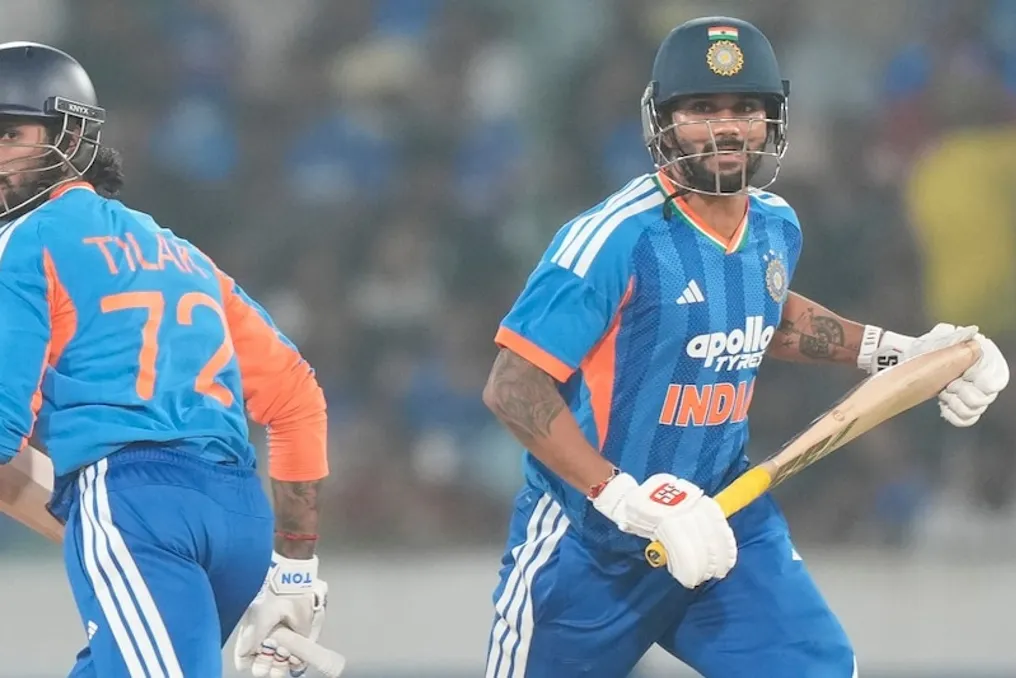
India won the first T20 match against New Zealand, achieving a target of 226 runs in 19.4 overs.

This victory was achieved not only through strong batting but also demonstrates the Indian team's aggressive approach to chasing targets, unafraid to take risks. Despite shortcomings in the bowling game, the batsmen managed to compensate for these weaknesses with their power.

India's strategy became clear: instead of restricting the opponent to a low score, the team found it more advantageous to surpass their total. However, such a tactic will only be effective if there are consistent high performances in the attack, as chasing a target of 225 runs every day will not be easy.

The target of 226 runs indicates that serious questions face the Indian bowling unit. Allowing over 200 runs in T20 itself is a signal that the strategy, length, and line of the delivery need improvement, especially towards the end of the match. Nevertheless, India's batting completely changed the course of the game.

By reaching 230/6, India proved that its batting does not depend solely on stars. The squad includes players capable of increasing aggression under the pressure of a difficult task.

This victory is more of a statement about batting strength than a success of bowling.

Sanjju Samson laid a solid foundation for the chase, scoring 67 runs off 33 balls, including eight fours and four sixes. His key contribution was preventing the pressure of a large score from overwhelming the Indian batting.

Samson showed from the beginning that simply preserving wickets is insufficient to achieve a target of 226 runs; maintaining tempo and putting pressure on the bowlers is necessary. His play allowed subsequent batsmen to play in a more open manner.

The performances of Shreyas Iyer with 42 runs and Naman Dira without getting out for 42 runs (off 15 balls) were important elements of this victory. Axar Patel also made a useful contribution of 24 runs.

The significance of these innings is not limited to the runs scored. When chasing a big score, the quick start of one batsman must be supported by others. This is where Shreyas and Naman played their role.

Naman's unbeaten knock was particularly crucial, as the match needed to be concluded even after approaching the target. India demonstrated that it has options to score runs at different stages of the match, winning in 19.4 overs.

Despite the brilliant victory, it is crucial to understand the other side of the coin. Reaching a target of 226 runs shows India's strength, but this does not allow for ignoring the bowling deficiencies.

India's aggressive strategy is its strength, but a truly strong team is one that can control the game with both batting and bowling. India has shown that a large score is an opportunity to attack, not a cause for fear.

However, to maintain this dominance in the series, the bowlers will have to raise their level. India's new T20 declaration is this: if you make 225, we will make 226. But true dominance will come when the ball rules over the opponent alongside the bat.

Similar stories

India lost to West Indies in T20 after two players from Hyderabad created a strong push
Read more
www.aajtak.in

India lost to West Indies in T20 after two players from Hyderabad created a strong push

In the fourth T20 match between India and West Indies, held at Rajiv Gandhi International Stadium in Hyderabad on October 14, West Indies initially posted a substantial total of 247/3, thanks to the performance of Shai Hope, who scored 102 runs off 50 balls. Consequently, the Indian team needed to chase a target of 248 runs.

The start of the game was promising for India: the team scored 60 runs in just 4.1 overs. However, a major setback soon occurred, leading to the dismissal of Sandeep Samson, who had shown a bright innings by scoring 56 runs off 23 balls.

Midway through the innings, the Indian team faced a series of setbacks. After Naman Dheer was dismissed, the team's score reached 130/5 by the 11.4 over, which seemed to predetermine the Indian squad's defeat, given the need to defend a large total.

Following Naman Dheer's exit, Nitish Kumar Reddy and Tilak Verma came to bat. Notably, Tilak Verma is from Hyderabad and plays for the Hyderabad team in domestic cricket, while Nitish plays for Sunrisers Hyderabad in the IPL. Thus, two players connected to Hyderabad were on the field.

The situation could have turned in India's favor. After 16 overs, the Indian team had a score of 189/5, and only 59 runs were needed in the next 24 balls to win. It seemed that chasing this target was quite achievable. In the 15th over, Nitish Kumar scored 21 runs against Shamra Joseph.

Romario Shepherd bowled the 16th over. Tilak hit a six on the first delivery. This was followed by one untouched ball, and then Tilak scored one run. The subsequent ball was a wide, and on the fourth legal delivery, Nitish scored one run. On the fifth delivery, Tilak Verma added two runs, but on the sixth delivery of the same over, Tilak Verma (with a score of 43 runs off 25 balls) was dismissed. After this, the score stood at 48 runs for 18 balls.

Shamr Springer bowled the 18th over, in which 5 runs were scored. This over increased the pressure on the Indian team, and Springer once again demonstrated his usefulness towards the end of the match.

Subsequently, in the 19th over, Kim Paul consecutively dismissed Nitish Kumar (41 runs off 20 balls) and Prince Yadav (0). On the fifth ball of the 19th over, Axar Patel (3) was also dismissed. As a result, the Indian team's score was 213/9. Kim Paul also completed his fifth wicket.

Overall, Tilak's dismissal, Shamr Springer's 18th over, and Kim Paul's bowling played a small pivotal role that allowed West Indies to win the match by 24 runs and level the series at 2-2. The next decisive match out of five is scheduled for Saturday in Bengaluru.

This marked the first time West Indies had defeated India on Indian soil, defending their T20I count, whereas the previous six attempts had been unsuccessful. Furthermore, it was the second-highest total ever scored by India while batting second in a T20I; previously, in 2016 against the same team in Lodderhill, India lost by 1 run, having scored 244/4.

High score possible in India vs West Indies T20 match in Hyderabad, potentially exceeding 300 runs
Read more
www.aajtak.in

High score possible in India vs West Indies T20 match in Hyderabad, potentially exceeding 300 runs

The T20 series between India and West Indies has reached a stage where a high run accumulation is expected due to the aggressive play of the batsmen. Although not as much scoring was seen in Indore as anticipated, the situation could change in Hyderabad. It was here that the Indian team was only three runs away from reaching the 300-run mark in a T20 International match.

The question arises whether rain showers of fours and sixes in Hyderabad will lead to the 300-run mark being surpassed. In the five-match series, India leads 2-1, so the team aims to strengthen its advantage, while West Indies needs to win the match to remain in contention. Considering the aggressive style of play of the Caribbean team, the encounter in Hyderabad promises to be exciting. If the pitch supports it, and dew complicates matters for the bowlers, a fierce battle for runs can be expected between both teams.

On October 12, 2024, in Hyderabad, Indian batsmen mounted a strong assault against Bangladesh, scoring 297/6 in 20 overs. India was just three runs short of the 300-run mark. In this match, Sanju Samson scored 111 runs off 47 balls, which is the highest score for India in a T20 International. The Indian batsmen scored at a rate of 14.85 per over in this innings.

India has also shown high performances in T20 previously and later. On November 15, 2024, in Johannesburg against South Africa, India scored 283/1. And on January 31, 2026, in Trivandrum against New Zealand, India posted 271/5. Nevertheless, the record of 297 runs in Hyderabad remains the biggest achievement of Indian T20 batting to date.

The upcoming match against West Indies will take place at the same venue. India has the opportunity to improve its record, while the Caribbean batsmen will also not want to lag in the race for big scores.

Rajiv Gandhi International Cricket Stadium is known as one of the IPL venues where batsmen can play freely. Large scores such as 286 and 277 were posted here during the IPL. Furthermore, India set its highest T20 International score of 297 against Bangladesh at this very stadium.

However, the pitch in Hyderabad was recently re-prepared. Therefore, old records cannot be relied upon, assuming the conditions for the batsmen will be the same. The current state of the pitch, its bounce, and the speed of the ball will be crucial in determining the course of the match.

Nevertheless, the history of the stadium motivates the batsmen. If the ball connects well with the bat, it may become easier for players who hit big shots to score runs. Bowlers should avoid any weakness in their line, as a few expensive overs in T20 cricket can change the entire equation of the match.

Dew can also play an important role during the match in Hyderabad. If dew appears in the second innings, bowlers may find it difficult to maintain control of the ball and catch it. This could benefit the batsmen, especially when they need to chase a large target.

The team that wins the toss must also make a decision based on circumstances. The choice between attack and defense will be important considering the pitch condition, the probability of dew, and the first innings score.

According to weather forecasts, there are no concerns that rain will disrupt the match. This means spectators can enjoy the cricket spectacle throughout the match. If the pitch and weather support the batsmen, another high-scoring match is expected in Hyderabad.

Hyderabad is also the home ground for the IPL franchise Sunrisers Hyderabad (SRH). This team is known for its aggressive batting and ability to score big runs. Batsmen like Abhishek Sharma, Travis Head, and Heinrich Klaasen have given a new look to the fast-scoring style in T20 cricket.

Abhishek has the potential for big hitting, and he is expected to provide a quick start for India. However, India will require the contribution of the entire attacking unit, not dependence on a single batsman. Recovering after losing early wickets in high-scoring matches can be difficult.

On the other hand, West Indies batsmen are also known for their aggressive style. If the Caribbean team needs to turn the series around, its batsmen will have to put pressure on the Indian bowlers. The conditions in Hyderabad could prove favorable for them too.

India's lead of 2-1 gives it a psychological advantage, but underestimating West Indies is a big mistake. The Caribbean team has batsmen who can change the course of the match in just a few overs. If their top batsmen provide a quick start, Indian bowlers will face the task of preventing a big score.

India will try to utilize its batting strength to gain an undeniable advantage in the series.

Sanju Samson scores a half-century off 21 balls in Ranchi, matching Virat Kohli's record
Read more
www.aajtak.in

Sanju Samson scores a half-century off 21 balls in Ranchi, matching Virat Kohli's record

During the second T20 series match between India and West Indies, held in Ranchi on Friday (October 9), Sanju Samson demonstrated an outstanding performance with the bat. Samson, who scored only 11 runs in the first match of the series, managed to score a half-century off just 21 balls in this game. This marked the fastest half-century by an Indian player against the West Indies in a T20 International match.

Virat Kohli had previously set a similar record, reaching fifty runs off 21 balls at the Wankhede Stadium in Mumbai in 2019. Sanju Samson's aggressive performance also positively impacted the start of the Indian team. During the powerplay, India scored 79 runs while losing one batsman, which is the highest total in the powerplay against the West Indies in T20 International history. Previously, the Indian team had scored 72 runs at the Wankhede Stadium in 2019 without losing any batsmen.

In Samson's innings, aggression was accompanied by luck. He avoided being dismissed for a personal score of six runs when he was caught in the third over. He then received another chance and scored 42 runs. These errors allowed the West Indies to face consequences. Samson completed his half-century by hitting the fourth boundary off Romario Shepherd's delivery in the sixth over.

He achieved this milestone by hitting two consecutive boundaries off just 21 balls. In total, Sanju Samson scored 82 runs off 41 balls, including 9 fours and 4 sixes. His attacking style forced the West Indies players to be under pressure from the beginning of the game.

Indian captain Shreyas Iyer decided to start the game despite losing the toss. Samson and Abhishek Sharma started the innings, adding 42 runs in four overs while losing the first batsman. Abhishek scored 20 runs off 12 balls, but even after his dismissal, Samson did not slow down the scoring rate. After that, he continued to accumulate runs with Ishan Kishan, and Samson's quick start allowed the team to reach a high score.

West Indies captain Shy Hap chose a strategy of starting the game with the visiting team, deciding that the situation with dew might become more complicated as the evening progressed. Gudakesh Motie was included in the squad, while India made no changes to its starting lineup. Samson's half-century off 21 balls not only matched Virat Kohli's record but also set a new benchmark for India's performances in the powerplay against the West Indies.

Popular