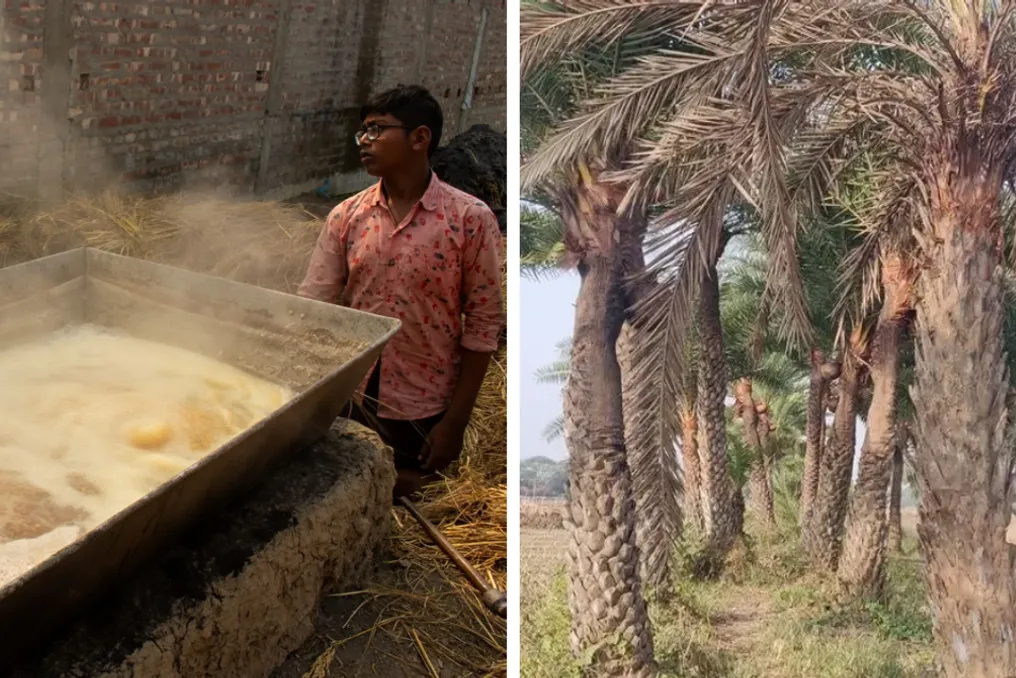
With the arrival of winter, the typical Bengali resident develops a romantic attraction to Nolen Gur. This fresh jaggery is made from the juice of the wild date palm (Phoenix sylvestris) and is usually available from mid-November to February.
The love for this product manifests in various forms. There is liquid, aromatic jaggery; Chhanagalla (cheese balls) are also prepared, shaped in fresh gur. If one wishes to treat themselves, they can eat a thin, layered paratha with a bowl of Jhol (Nolen) Gur. However, the author prefers a crispy piece of toast with Nolen Gur.
Literature has also romanticized this product. In the work 'Bhalo Rey Bhalo', the innovative Bengali writer and poet Sukumar Ray celebrates numerous joys of life, from the scent of flowers to the fluffy blossoms of Shimula. He asserts that few of these pleasures can compare to eating Nolen Gur with bread.
Nolen Gur belongs not only to cuisine but also to memory. However, it has a limitation that sugar and many other sweeteners do not: it can only be produced when the conditions of weather, tree condition, and juice collection coincide. This gives Bengal a short winter window to maximize this period.
Why the Window of Opportunity is So Short
This time interval is determined by the temperature, the chemical composition of the juice, and the speed of its collection and processing before fermentation begins.
Fermentation acts as a kind of clock. Fresh palm juice contains fermentable sugars, which microorganisms begin to convert into alcohol and organic acids. As fermentation progresses, the acidity, sweetness, and other properties of the juice change, affecting its suitability for jaggery production.
A study conducted in 1988 by T. R. Shamala and K. R. Srikantiah, published in the journal Food Microbiology, identified yeasts, including Saccharomyces cerevisiae, and various types of bacteria in freshly collected wild date palm juice. The researchers documented changes in microbial growth, as well as in the production of ethanol, acids, and esters during fermentation. Their findings help explain why freshly collected juice cannot be left unprocessed for long.
Cold slows down the process. Cooler winter conditions reduce the rate of fermentation, giving collectors more chances to gather suitable juice. Once the weather warms up, managing this window becomes more difficult. The juice must be collected early and processed promptly to maintain the qualities necessary for Nolen Gur.
Even during winter, the juice composition changes. A 2015 study in the Indian Journal of Agricultural Sciences examined this dynamic directly in Bengal. Dipak Girhepuje, S. Mondal, and P. K. Bandopadhyay from Bidhan Chandra Krishi Viswavidyalaya analyzed juice from 15–20-year-old trees in the Haringata block, Nadia district. They took individual samples from December to February over two seasons: 2012–13 and 2013–14.
Study Results
The total dissolved solids content, indicating the concentration of dissolved components, reached 14.33% in February. The total sugar content increased from 11.37% in December to 12.50% in February. The sugar-to-acid ratio sharply decreased, falling from 325.47 in January to 42.93 in February. Vitamin C decreased from 18.75 mg per 100 ml in December to 13.75 mg in February. The highest alcohol content was recorded in February. Thus, the juice does not remain chemically identical throughout the winter; its properties change even within the traditional collection period.
How Nolen Gur is Produced
Before confectionery shops in Kolkata fill their trays with Nolen Gur Sandesh, and before we taste it, many processes take place in the villages of Bankura, Birbhum, Jargaram, and Khejur (Purba Medinipur).
At night, the tree is filled with a vessel. The process begins with the Khejur Gaach, or date palm. Traditional collectors, known as Shiuli or Siuli, make a controlled incision on the tree and install a small bamboo channel to direct the juice into an earthen pot. The pot is hung overnight, collecting the liquid dripping from the cut. A few hours before dawn, the collector returns to the tree they climbed the previous evening and lowers the pot. Time is crucial for the aforementioned reasons.
When the juice meets fire. Freshly collected juice is not yet jaggery. It is filtered and heated in large pans so that water evaporates and sugars concentrate. As the liquid thickens, its color, viscosity, and taste change. The result can be Jhola Gur, liquid jaggery, or Patali Gur, a solid form used in sweets.
A 2009 study in the Journal of Food Engineering investigated this transformation. P. V. K. Jagannada Rao, Madhusweta Das, and S. K. Das studied how boiling alters the physical properties of sugarcane, palm, and date palm juices. As the total dissolved solids increased, the juices became more viscous, and the boiling point rose. For date palm juice, the changes were particularly noticeable at the final concentration stage.
For sweet makers, this means that the quality of the finished gur depends both on the obtained juice and the thoroughness of its processing.
More Than a Seasonal Dessert
Nolen Gur connects the winter landscape of Bengal with its culinary traditions and agriculture. It lends a seasonal character to pitha, payesh, and sandesh. Furthermore, it supports the people whose knowledge of trees, collection, and cooking makes it possible.
This dependence on winter has consequences. Since warmer weather threatens to shorten the collection season, producers face reduced yields, and confectioners face uncertainty in the supply of an ingredient that is central to the winter table. A shorter winter may mean less juice, less jaggery to sell, and lower income from months of specialized work.
Preserving Nolen Gur, therefore, requires looking beyond the sweet shops. It means understanding how changing temperatures affect the date palm harvesting cycle, documenting changes in juice yield over time, and supporting the collectors whose livelihoods depend on this narrow winter window. As climate change alters seasonal patterns, the task is to protect the ecological conditions and traditional knowledge that make Nolen Gur possible.