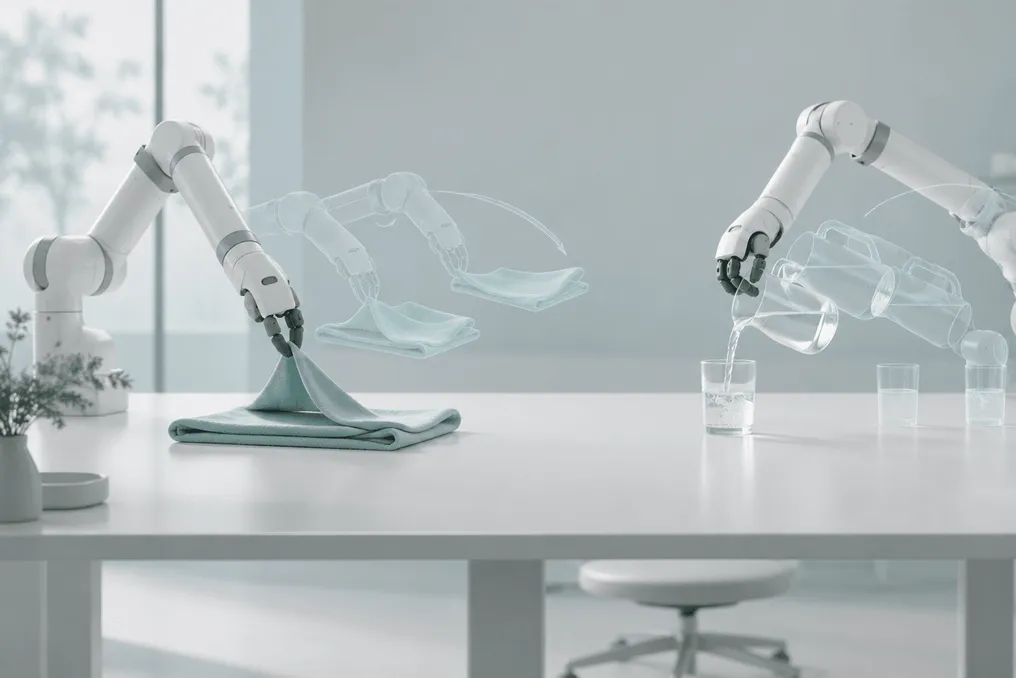
The global models team at ShengShu Technology has started a live stream of the entire training process for Motubrain 2.0, the next version of its embodied artificial intelligence model for robots. The broadcast began on October 21st and is scheduled to last about two weeks.
The company announced that Motubrain 2.0 will soon be released to the public and decided to demonstrate the training process before this release.
The Motubrain models represent a family of fundamental robot models from ShengShu, aimed at providing robots with a universal brain capable of applying skills across various tasks, scenarios, and robot types. The first version of Motubrain was introduced in April as a global model. It is worth noting that ShengShu is more widely known for its Vidu video generation models.
Stream Structure
The live stream is divided into four stages. The pre-training stage explores how training scale affects performance and zero-shot generalization ability. Subsequent training focuses on performing specific tasks to improve execution. This is followed by an agent task stage, which tests whether the model can transfer acquired knowledge to other assignments. The final stage is dedicated to recursive self-improvement to determine if the model can evaluate its actions based on execution feedback and improve them.
The real-time streaming page displays the training steps and success metrics as they are updated.
The main idea behind this demonstration is transparency. Progress in embodied AI is usually assessed by external observers through polished robot demonstrations, benchmark tables, and scientific papers, which rarely reveal exactly how capabilities are formed during training or what problems arise. ShengShu claims that the stream will show not only successes but also errors, the trial-and-error process, and adjustments, and hopes to share open questions regarding scaling, cross-task generalization, and autonomous improvement with other researchers.
This step aligns with a broader trend among Chinese AI teams who publicly share their training progress. Previously, Luo Fuli, head of Xiaomi's MiMo models, published details of the reinforcement learning training phase for MiMo-V2.6.
Nevertheless, there are limitations to what a live stream can prove. The model weights have not yet been released, and the company itself states that the research remains exploratory, and the results will require subsequent experiments and evaluation for confirmation. The announcement was made by ShengShu and covered by Chinese tech media. The true test will be the public release and whether its benchmarks match what was shown in the stream.