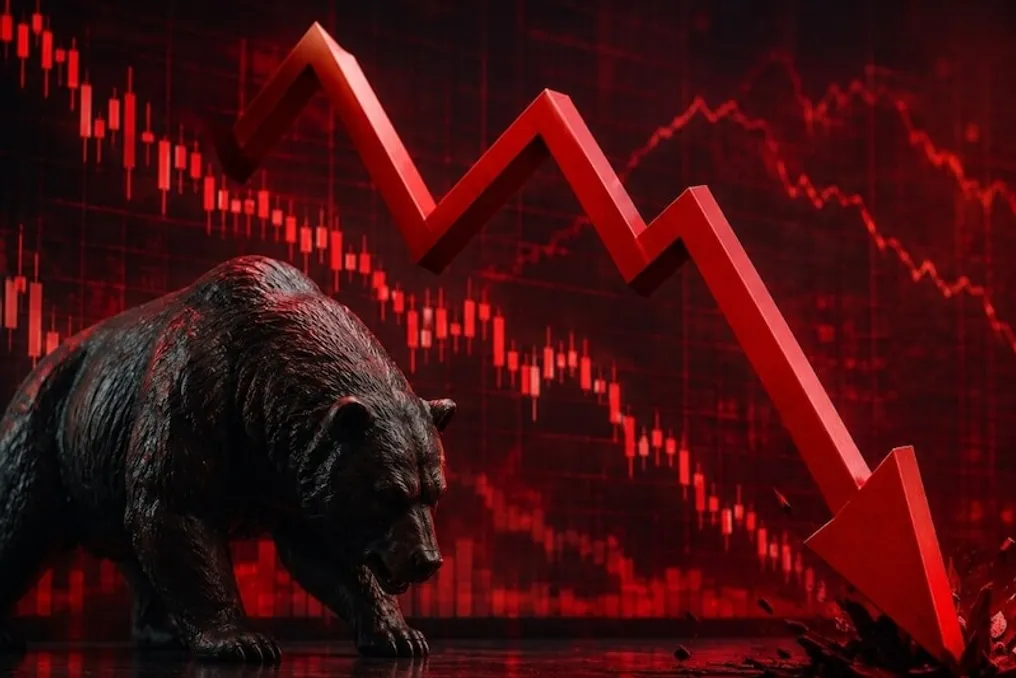
Market Opening Triggers Stock Market Crash: Sensex and Nifty Indices Plummet Sharply
Read more
Aaj Tak
www.aajtak.in

Market Opening Triggers Stock Market Crash: Sensex and Nifty Indices Plummet Sharply

On the fourth trading day of the week, Thursday, the stock market experienced another crash. Immediately after the market opened, both indices, Sensex and Nifty, showed a sharp decline. The BSE Sensex index, comprising 30 stocks, began its movement with a drop of 700 points, while the NSE Nifty lost over 200 points.

Amid this market turmoil, many large stocks, including Maruti, Tata Steel, Power Grid, and BEL, showed significant declines, resembling a house of cards.

On Thursday, the market faced a picture of chaos. The BSE Sensex opened at 73,343, which was lower than the previous close of 73,709. The rate of decline then accelerated, and in just five minutes, the thirty-stock index plummeted by more than 700 points, reaching the level of 73,005.

NSE Nifty followed the example of Sensex. It opened at 22,687 compared to the previous close of 22,811. After this, the pace of decline for the fifty-stock index also intensified, and it traded at 22,557.

As a result of the overall downturn, 28 out of the 30 stocks in the BSE large-cap category were trading in the red zone. Among the most affected assets were PowerGrid Share (down 2.60%), BEL Share (down 2.25%), Maruti Share (down 2%), Tata Steel Share (down 1.99%). HDFC Bank Share (down 1.80%) and Asian Paints Share (down 1.70%) also saw declines.

The previous trading day, Wednesday, proved to be extremely unsuccessful and unexpected for investors. At the start of trading, Sensex and Nifty showed rapid growth: BSE Sensex rose by more than 800 points, and NSE Nifty by approximately 200 points. However, sudden profit-taking at the upper levels led to a sharp halt in growth. Ultimately, BSE Sensex fell by 1400 points from its daily high. Despite this, at the end of trading, the thirty-stock Sensex closed down by 143 points at 73,709, and the fifty-stock Nifty Index closed with a drop of 77 points at 22,811.

Signs of an impending downturn on the market appeared even on Thursday. Asian stock markets were experiencing turmoil: the Japanese Nikkei index fell by almost 1000 points by the time of writing. The Hong Kong Hang Seng Index decreased by approximately 600 points. The Korean Kospi index also showed a drop of about 3 percent. Furthermore, Gift Nifty was trading with a decline of more than 100 points.

Similar stories

Sensex fell by 500 points, Nifty tested the 22,600 mark; PC Jeweller shares rose by 8% after second-quarter report
Read more
business-standard.com

Sensex fell by 500 points, Nifty tested the 22,600 mark; PC Jeweller shares rose by 8% after second-quarter report

On the National Stock Exchange (NSE), the Sensex index showed a decline of 500 points, while the Nifty approached the 22,600 level. In broader markets, the Nifty MidCap and Nifty SmallCap indices demonstrated drops of 1.04% and 0.91%, respectively.

As of 9:18 AM, the Sensex fell by 572.62 points or 0.78%, reaching 73,137.07, while the Nifty50 decreased by 199.15 points or 0.87%, settling at 22,610.30. Among the main losers in the Nifty50 index were Power Grid Corporation, Mahindra & Mahindra, and Nestle India. Sectorally, Nifty Chemical, Nifty Auto, and Nifty Metal showed reduced performance, whereas Nifty recorded growth.

As part of the second-quarter (Q2FY27) reporting, results from companies such as Adani Energy Solutions, Adani Total Gas, BlueStone Jewellery and Lifestyle, Chennai Petroleum Corporation, CIE Automotive India, Colgate-Palmolive (India), CreditAccess Grameen, Cyient, Hatsun Agro Product, Havells India, Hindustan Petroleum Corporation, Jammu & Kashmir Bank, Jindal Stainless, Mahindra Lifespace Developers, Maharashtra Scooters, Nippon Life India Asset Management, Nuvoco Vistas Corporation, Orient Cement, Paisalo Digital, Pitti Engineering, Rallis India, Sagility, Sapphire Foods India, Swiggy, and Tata Teleservices (Maharashtra) will be announced on Monday.

Sectoral Index Dynamics

In the early trading sessions, all major sectoral indices traded in the negative. The largest drop was recorded by Nifty Metal, which declined by almost 2%. Furthermore, Nifty FMCG and Nifty Pharma each lost 1.4%, and Nifty Auto also significantly dropped by 1.88%.

The broader market also showed deteriorating indicators: the Nifty Midcap 100 index fell by 1.53%, and the Nifty Smallcap 100 index lost 1.4%, which was worse than the benchmark Nifty 50 index.

At the 30-point level, only five stocks in the Sensex were trading higher, while 25 were in the red zone. The technology company Tech Mahindra led the gainers, showing an increase of only 0.28%. PowerGrid was the worst performer, losing 2.5%. Among other stocks that fell the most were Maruti Suzuki, M&M, Tata Steel, Bajaj Finserv, and IndiGo.

During the opening of trading, the Nifty 50 lost 157 points or 0.69%, opening at 22,626 on Thursday. Earlier, at the open, the Sensex index had fallen by 511 points or 0.69% to 73,198 amid rising crude oil prices to $110. Before trading began, the Nifty 50 was already down by 124 points or 0.54% at 22,687, and the BSE Sensex had fallen by more than 350 points in preliminary trades, reaching 73,337.

Regarding the foreign exchange market, the rupee opened stable against the US dollar at 94.47 on Thursday.

Reliance shares show sharp growth before Jio IPO; Sensex index rises by 800 points
Read more
www.aajtak.in

Reliance shares show sharp growth before Jio IPO; Sensex index rises by 800 points

The trading session on the stock market started splendidly on Wednesday. The Sensex and Nifty indices opened in the green zone and then demonstrated rapid growth. The BSE Sensex index, comprising 30 stocks, jumped by more than 800 points just minutes after opening, while the NSE Nifty also followed suit, rising by approximately 200 points.

This strong growth occurred against the backdrop of the upcoming launch of the country's largest IPO. Jio Platforms, owned by Mukesh Ambani, is preparing for an IPO placement worth over 30,200 crore rupees, which supported the overall market rise, causing a surge in the shares of both Reliance and Jio Financial Services.

At the opening of trading, the BSE Sensex started with a strong jump, reaching 74,337.93 compared to the previous closing level of 73,852.90. Its movement then accelerated, and it traded at 74,668, achieving a gain of over 800 points.

As for the NSE Nifty, its dynamics were similar to the Sensex. This index of 50 stocks opened above 23,000, compared to the previous closing level of 22,888.95, and, following the Sensex, rose by approximately 224 points, trading at 23,120.90.

The shares of Reliance Industries, owned by Mukesh Ambani, played a significant role in supporting this vigorous market growth. Since the Jio Platforms IPO opens to retail investors on Wednesday, Reliance shares have been showing impressive growth even before that. At the time of writing, Reliance shares were trading at 1234 rupees, showing a growth of 2.30 percent. Additionally, Jio Financial Services shares were trading at 216.30 rupees, increasing by more than 1 percent.

Indian stock market sharply declines: Sensex index loses over 1000 points
Read more
www.aajtak.in

Indian stock market sharply declines: Sensex index loses over 1000 points

The Indian stock market experienced a sudden and significant decline on Monday. The Sensex index lost about a thousand points, while the Nifty also fell by approximately 300 points.

By 1:30 PM, the Sensex had dropped by 930.80 points or 1.25%, reaching 73,798.47, while the Nifty closed at 22,867.75, showing a fall of 278.40 points or 1.20%.

Out of 30 stocks listed on the BSE, only 4 showed a slight increase, while the remaining 26 experienced a substantial drop. HDFC Bank contributed the most to the decline, with its shares falling by approximately 3%. This was followed by Axis Bank, which fell by about 4%, Infosys by 3%, as well as stocks like Trent, HDFC Bank, Hindustan Unilever, and Bajaj Finance, which decreased by more than 2%.

Investor losses amounted to 400 billion rupees

This sharp downturn led to a significant reduction in investor earnings. The market capitalization of BSE companies decreased from 472 billion rupees to approximately 468 billion rupees, corresponding to a loss of about 400 billion rupees.

Four reasons for the decline

1. Significant drop in banking stocks: Following the release of second-quarter results for the fiscal year 2027 by private banks, including HDFC Bank, bank stocks fell by 2%, and this bank entered the list of stocks with the largest losses in the Nifty 50. Furthermore, Axis Bank shares also fell by more than 4%; there was also a decline in the shares of Kotak Mahindra Bank and ICICI Bank.

2. Weak sentiment: The MSCI, the broadest index of the Asian stock market, declined by 0.5%. While the KOSPI of South Korea recovered from an initial fall and reached a gain of 0.2%, the Nikkei 225 futures of Japan dropped by 1.3%, the Hang Seng futures of Hong Kong fell by 0.2%, and the Shanghai Composite also dropped by 0.2%.

Additionally, the US market recorded a sharp decline on Friday as sales of AI-related IT stocks resumed, and crude oil prices continued to rise, which was also a blow to the Indian market.

3. High crude oil prices: Brent Crude fell by 1.5% to $108.27 per barrel, and WTI fell by 0.6% to $100.83 per barrel. Despite the drop on Monday, crude oil prices remained high, and the impact of geopolitical tensions persisted on market sentiment.

4. Rise in VIX in India: The fear index, or volatility index, rose by almost 4%, reaching 14.52, indicating increased uncertainty among investors.

Popular