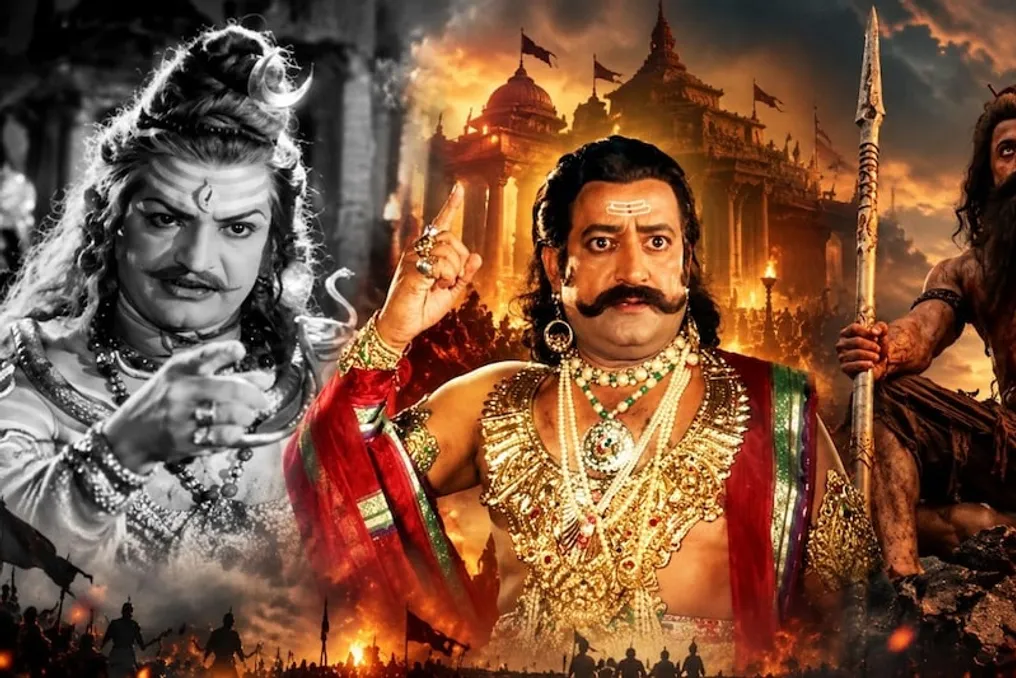
The journey of Shiva Tandava's image spans the period from 1958 to 2026, raising the question of whether Yash can replicate the magic created by Arvind Trivedi.
In the film 'Ramayana', released before the Dasara festival, the image of 'Ravana Tandava' is presented featuring Ranbir Kapoor as Rama and Yash as Ravana. This video clip, released for Dasara, garnered significant attention due to Yash's fierce appearance, his devotion to Shiva, and his strong screen presence.
However, alongside this grand appearance, an old question has resurfaced: is Yash capable of evoking the same magic with his Ravana that Arvind Trivedi created in Ramanan Sagar's 'Ramayana'?
The history of this narrative does not begin today, but in 1958 with the Telugu film 'Bhukailas'. Since then, from historical 'Ramayanas' on small screens to the new 'Ramayana' on the big screen, Shriva Tandava Stotra has taken various forms. Nevertheless, one character has always remained the focus—the King of Lanka, Ravana, whose identity is linked not only to his arrogance but also to his deep devotion to the god Shiva.
In 1958, Indian cinema possessed a unique charm in mythological films. It was during this period that the Telugu film 'Bhukailas' by director K. Shankar was released. This film, produced under the aegis of AVM Productions, featured Ravana played by N.T. Rama Rao. The film premiered on March 20, 1958, and also starred actors Akkineni Nageswara Rao and Jamuna.
'Bhukailas' immerses viewers in a world of mythological beliefs associated with the god Shiva and Ravana. The cinematic use of Shriva Tandava Stotra is also part of this cinematic tradition. However, it cannot be definitively proven historically that this Stotra was first shown in this film; a Telugu film with the same title also existed earlier in 1940. Therefore, it is more accurate to consider 'Bhukailas' of 1958 a significant milestone in the cinematic journey of Shiva Tandava.
But one thing was special from the beginning: Ravana was portrayed not merely as a villain, but as a scholar, a powerful warrior, and a devotee of Shiva. This contrast made the character interesting: he was as terrifying as he was majestic.
If you ask Indian audiences whose face comes to mind when mentioning Ravana, a significant number will name Arvind Trivedi. His portrayal of Ravana in Ramanan Sagar's 'Ramayana' is considered one of the most memorable roles in the history of Indian television. This television 'Ramayana', which began in 1987, brought the story of Rama to every home.
Trivedi's voice, his sharp facial expressions, regal style, and unique way of delivering lines gave Ravana such recognizability that it persists even decades later. His performance style, connected to the Shriva Tandava Stotra, became part of this unforgettable image. Here, Ravana's appearance was not filled only with anger; it also showed devotion to Shiva, pride in his own abilities, and the grandeur of his personality. It was this subtle nuance that saved Ravana from becoming just a simple villain.
Viewers were aware of his wicked deeds but could not ignore the strength of his character. Interestingly, Arvind Trivedi himself believed in religious teachings in real life. According to reports based on his old interviews, he would pray and repent after delivering harsh lines about God Rama during the filming of 'Ramayana'. This actor, who displayed Ravana's arrogance on screen, held a completely different personal faith.
This is why Arvind Trivedi's legacy is not limited to one famous line or one scene. He gave Ravana a cinematic identity by which new actors are still compared.
Now let's move to 2026, when Yash will play Ravana. Before Yash, who gained nationwide popularity through the 'KGF' franchise, was the task of embodying a completely different character. On October 20, 2026, for the Dasara festival, the video clip 'Ravan Tandava,' related to Nitish Tiwari's film 'Ramayana,' was released. His powerful and wild appearance is presented through the English title 'Rise of Asura.'
In this video, lasting about 1 minute and 55 seconds, Yash is depicted worshipping the god Shiva in the guise of Ravana. At the beginning of the video, he makes a cut on his arm and then applies a tilak on his forehead. After this, he performs Aarti before a huge statue of Shiva, and then his fierce appearance unfolds through the Tandava.
Yash's presence on screen clearly attracts attention. His look, body language, and facial expression emphasize Ravana's power and aggression. The goal of the video is not just to present a song, but to show how Ravana is conceived in this film.
This presentation also received support from major names on the musical front. The music was composed by A.R. Rahman, Vishal Dadlani provided the vocals in Hindi version, and Kumar Vishwas wrote the lyrics. This large team involved in the film's music tried to give Ravana's image a majestic sound and drama.
This video clip was released before the film's premiere. In 'Ramayana', Ranbir Kapoor plays God Rama, and Yash plays Ravana, while...