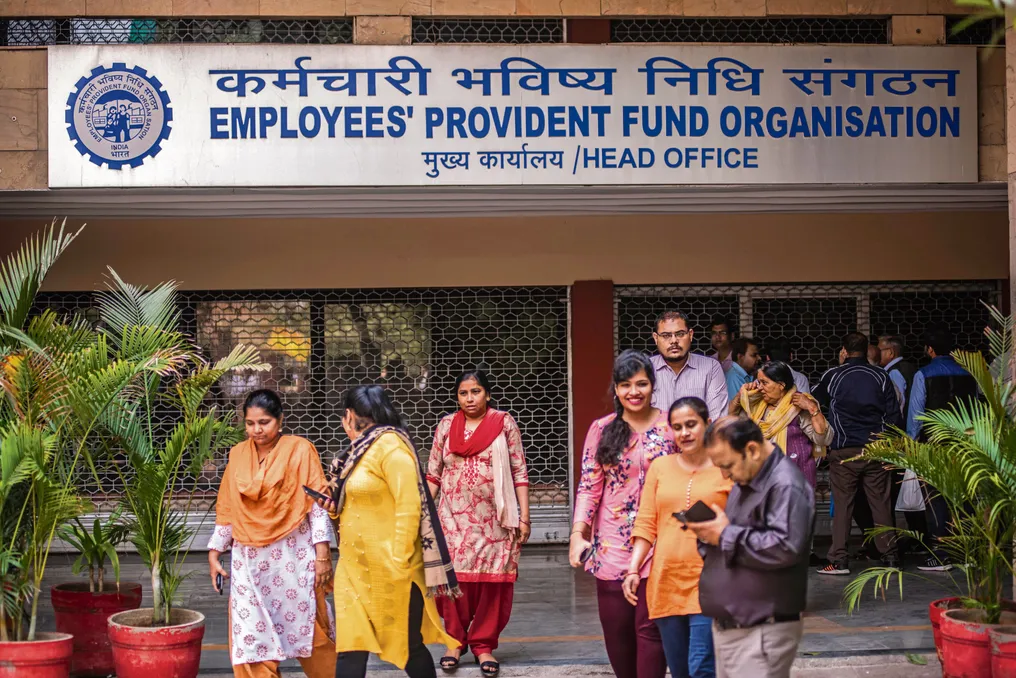
Increase in EPFO's wage limit to 25,000 rupees: information for employees
Read more
Aaj Tak
www.aajtak.in

Increase in EPFO's wage limit to 25,000 rupees: information for employees

If your salary exceeds 15,000 rupees (basic pay plus inflation allowance), but you were previously not covered by the Employees' Provident Fund (EPF), this news may be important for you. The Employees' Provident Fund Organisation (EPFO) has increased its Wage Limit. EPF is not just the amount deducted monthly from the salary, but also a tool for accumulating retirement funds. Contributions are made by both employees and employers, and interest is accrued on the accumulated funds.

The central government has raised the monthly EPFO wage threshold from 15,000 to 25,000 rupees for mandatory social security. According to government estimates, this decision, which will come into effect on September 17, will benefit approximately 510,000 new employees who will first be covered under EPF, pension, and EPFO insurance. Therefore, if you fall under the mandatory coverage according to the new threshold, be sure to check your registration with your company.

This revision primarily benefits employees whose Basic Pay and Dearness Allowance (DA) combined exceeded the previous limit of 15,000 rupees, which prevented them from participating in mandatory EPF coverage. Now, employees with a salary in the range of 15,000 to 25,000 rupees can join the program subject to applicable rules and conditions. However, meeting the threshold alone does not guarantee eligibility for participation.

Employees who meet the criteria under the new threshold can be included in EPF coverage. Nevertheless, each employee's situation will differ. This depends on whether the employee is already an EPF member and what program rules apply to them. Therefore, it is crucial to contact your company's HR or accounting team to determine your eligibility.

Instead of applying individually to these programs, the employee must go through their employer, i.e., the company. First, they should check their eligibility with the HR team or accounting departments. Then, they need to provide necessary information related to identification, employment, Aadhaar, and bank account. After registration, ensure that your EPF contribution is correctly reflected in your payslip and EPFO passbook.

Contributions to the Employees' Provident Fund (EPF) are made by both employees and employers. The interest accrued on this amount helps build the pension fund over time. If you work for a long time and continue regular contributions, the accumulated amount can increase. The new wage limit opens the door for eligible employees to participate in this social security scheme.

Eligible members can receive a pension under the Employees' Pension Scheme (EPS) provided the established rules and required service period are met. A portion of the employer's contribution is directed to this program as per the rules. However, the right to receive a pension and its amount depend on factors such as the employee's membership, pensionable salary, and length of service. Thus, inclusion in EPF does not mean that every employee will immediately start receiving a pension.

The insurance associated with EPF membership is called the Employees' Deposit Linked Insurance Scheme (EDLI). In the event of the death of an eligible member, their nominee or legal heir may claim an amount of no less than 2.5 lakh and no more than 7 lakh according to the rules. The claim is filed by the nominee or legal heir through Form 5 IF. The premium for this program is not deducted separately from the employee's salary but is paid by the employer. This provides financial protection to the employees' families.

It is not necessary for PF deductions to automatically increase for every employee. The new wage limit may increase the base for calculating contributions for eligible employees, but the actual deduction depends on prevailing rules and salary structure. The employee's basic pay, Dearness Allowance, existing EPF membership status, and applicable provisions play a decisive role in determining the contribution amount.

If a qualifying employee is subject to a 12% employee contribution based on a full salary of 25,000 rupees, then 3,000 rupees will be deducted monthly for PF. The employer also contributes according to the rules, of which 3.67% goes to EPF, and 8.33% goes to EPS. The EDLI premium is paid separately by the employer. It should be noted that this is just an example; the actual contribution may vary depending on applicable rules and the employee's situation.


Similar stories

EPFO Salary Limit Increased to 25,000 Rupees and Conditions for Pension Payments
Read more
www.aajtak.in

EPFO Salary Limit Increased to 25,000 Rupees and Conditions for Pension Payments

The government has increased the salary threshold for mandatory coverage by the Employees' Provident Fund Organisation (EPFO). Previously, this threshold was 15,000 rupees per month, but it has now been raised to 25,000 rupees. This change is expected to extend social security coverage to over 510,000 additional employees earning a monthly salary between 15,000 and 25,000 rupees.

However, it is important to understand that raising the limit does not guarantee automatic eligibility for benefits under the Employees' Pension Scheme (EPS) for every worker. EPFO published information on its X account (formerly Twitter), clarifying which employees may qualify for EPS membership under the new limit and which do not. The employee's current salary and their previous status in the pension scheme are decisive factors.

The Ministry of Labour and Employment has set the new limit at 25,000 rupees for mandatory coverage through EPFO. This change became effective on September 17, 2026. The goal of this modification is to expand the scope of social security for workers who were previously excluded from mandatory coverage due to the old limit.

Under the new system, employees can receive benefits related to the Employees' Provident Fund (EPF), the Employees' Pension Scheme (EPS), and the Employees' Deposit Linked Insurance Scheme (EDLI). EPF accumulates funds for retirement; EPS provides pensions to eligible members; and EDLI offers insurance benefits to families in case of an employee's death.

The EPFO publication specifically emphasizes that the new threshold amount cannot be equated with automatic entitlement to EPS participation. Even with a monthly salary of 25,000 rupees or less, membership in the pension scheme will depend on existing rules and the employee's prior status. For those falling under the new limit, membership and contributions to EPS may apply according to established norms.

Nevertheless, employees earning above 25,000 rupees who have never been EPS members will not automatically gain pension scheme membership under the new provision. Therefore, if your salary is in the range of 15,000 to 25,000 rupees, you cannot assume EPS eligibility solely based on salary size; you must also check whether you were previously an EPS member and what program conditions apply to you.

The new salary limit may also affect the contributions made by the employer (company) to EPS. At a rate of 8.33% for EPS, if the pension salary limit increases from 15,000 to 25,000 rupees, the maximum monthly contribution could increase from approximately 1,250 to 2,083 rupees. However, this does not mean that every employee earning up to 25,000 rupees will automatically contribute 2,083 rupees monthly; the actual contribution amount depends on the employee meeting the requirements, the pension salary, and applicable rules.

After the introduction of the new limit, it is important to distinguish between these three schemes. EPF: Future savings are built up through contributions from the employee and the employer. According to the rules, the employee can use these funds upon retirement or in other stipulated circumstances.

EPS: Eligible members receive a pension according to the scheme's rules. Membership and pension entitlement are determined by separate conditions.

EDLI: This is an insurance scheme linked to eligible employees. In the event of a member's death, their family or nominee may receive a benefit according to the scheme's rules.

Thus, being covered by EPF and having the right to a pension under EPS are two different matters. The type of benefit an employee receives is determined by the rules of the respective program.

If you believe that your contribution to EPF or EPS should be made according to the new rules after the new limit comes into effect, but this is not happening, you should first contact your company's HR department or your employer. If the issue is not resolved at this level, you can file a complaint through the EPFO EPFiGMS dispute resolution portal. When filing a complaint, it is recommended to have payslips, UAN, and other relevant employment documents ready to facilitate verification and understanding of the situation.

EPFO is preparing to implement PF withdrawal via UPI; launch expected by the end of 2026
Read more
www.aajtak.in

EPFO is preparing to implement PF withdrawal via UPI; launch expected by the end of 2026

Future accumulation funds (PF) can be a significant help for working people in unforeseen situations, such as paying for children's education, treating family members, weddings, or building a home. However, the traditional process of withdrawing funds from a PF account and receiving money into a bank account requires waiting.

Currently, the Employees' Provident Fund Organisation (EPFO) is working to provide its members with the option to withdraw PF funds through the Unified Payments Interface (UPI). EPFO plans to integrate the UAN portal with members' UPI accounts and is developing a new mobile application for this purpose. The proposed system will allow the use of various UPI applications, such as BHIM, PhonePe, and Google Pay, alongside bank accounts.

According to the report, under this feature, eligible members will be able to withdraw up to 75% of the amount in their account. The formal launch of this service is expected by the end of December 2026.

Currently, to withdraw funds from PF, members must submit an online application through the UAN portal. After this, the application is verified by EPFO, and the funds are transferred to the bank account. This process can take some time. The goal of the new system is to reduce this waiting period, and EPFO, together with banks, is trying to enable PF withdrawals via UPI. This feature is currently in the testing phase.

A limit on withdrawing funds from the PF account will be set in the new system. According to a senior government official, members who meet the established conditions will be able to withdraw up to 75% of their EPF balance via UPI. This means that it is not possible to withdraw the entire amount accumulated in the account at once. According to current rules, at least 25% of the funds must be maintained in the account.

PF funds often serve as support during difficult periods in people's lives, helping with children's education, weddings, illness treatment, or home construction. The new system aims to simplify access to these funds for eligible members during such times. If the UPI withdrawal feature is launched, a reduction in the lengthy application process for fund disbursement can be expected. Nevertheless, full information on the conditions and criteria for withdrawal will only become clear after the service launch.

The report indicates that the total EPFO fund has reached approximately 26 trillion rupees. More than 300 million members are registered in the organization, of which about 75 million are active contributors. It is expected that the launch of PF withdrawal via UPI will particularly benefit these active members. However, the actual benefit will depend on who exactly will have access to this service and what withdrawal rules will be established.

Popular