After a seven-year hiatus, Amman Design Week returned to Jordan with the theme 'Accumulations'. This fourth biennial edition brought together over 220 designers, architects, and collectives in activities held from October 2 to 17, encompassing exhibitions, public interventions, lectures, workshops, and performances.
The event's premise resonated deeply with Amman, a city whose architecture reflects waves of migration, adaptation, and reuse, making the concept of accumulation intrinsic to its urban reality.
Founded in 2016 by Queen Rania Al Abdullah, Amman Design Week has established itself as a bridge between design practice and Jordan's cultural and urban life. The event's direction was taken over by Sarah Hejazin and Bisher Tabbaa, co-founders of the Jordanian firm FADAA, marking a shift towards architectural professionals whose work is based on researching Jordan's cultural and material landscape.
The program featured curation by Faysal Tabbarah for the exhibitions and Khaled Al-Bashir for the public program. Tabbarah, an architect and co-founder of Architecture + Other Things (A+OT), focused on researching local construction practices and regional environments. Al-Bashir, an architect and art and culture director at Darat al Funun, analyzed the event from cultural, political, and spatial perspectives.
The term 'accumulations' holds a vast meaning, referring not only to the gathering of materials but also to knowledge, memory, labor, daily rituals, social relations, and construction techniques. The structure of the exhibitions aims to provoke reflection on how cultural memories and material environments accumulate, influencing what people value and how they coexist.
Geographically, the event spanned Ras El Ain, Jabal Al Lweibdeh, Jabal Amman, Iraq Al Amir, and Aqaba, giving dimension to the theme. In Qasr Al Abd, in Iraq Al Amir, Dima Srouji's work *Natural Residents* used historical accounts of water availability in the area. Concurrently, *Lamella Series in Clay* by Kais Al Rawi and Julia Koerner explored the combination of local clay with 3D printing. In Aqaba, there was a collaboration with the WUJŨD Art Foundation, showcasing works by Tasneem Zraikat and Yazeed Khaldoun Balqar, among others.
This geographical dispersion was highlighted as a central aspect: understanding accumulation requires going beyond the traditional exhibition space and experiencing the city where these layers of material transformation and memory have settled, transforming Amman into a text to be read through its multiple layers.
Design focused on aging, deterioration, and open use
The idea of accumulation manifests even before contact with individual pieces. The Hangar in Ras El Ain, the main exhibition venue, exemplifies this layered narrative. Built in the 1930s to generate electricity during a period of urban expansion, the building was restored by the firm TURATH: Architecture and Urban Design, in partnership with the Greater Amman Municipality. Its own history makes it an ideal stage for debating accumulation.
Inside the Hangar, the works 'Al-Mastaba' by Laith Matarweh Studio for Architecture, and 'Common Ground' by DA+SA, address continuity from different perspectives. 'Al-Mastaba', made of stone and concrete, is designed as a future ruin, where cracks and gravel foreshadow plant growth, integrating weathering into the work's plan. Meanwhile, 'Common Ground' uses modular grid blocks to create a meeting space without defining a specific activity, contrasting with the ecological transformation openness of 'Al-Mastaba.'
Also in the Hangar, Praxis's project *Infusing Green Infrastructure in Amman* investigated how green infrastructures could be integrated into common urban spaces, such as parks and vacant lots. Moving from urban ecology to cultural memory, Abeer Seikaly's work *Uyun* combined wool produced by women in the Jordanian Badia and woven in Amman with recycled glass beads from Damascus, mapping the flow of knowledge and materials between generations and territories.
Reactivating existing resources in the city
The link between design and environmental resources extended to direct urban interventions. In an environment marked by water scarcity, construction debris, and growth pressure, sustainability can only be discussed by considering local materials and infrastructures. The most impactful projects were not necessarily those that introduced new technologies, but rather those that reevaluated the use of resources already present in the urban space.
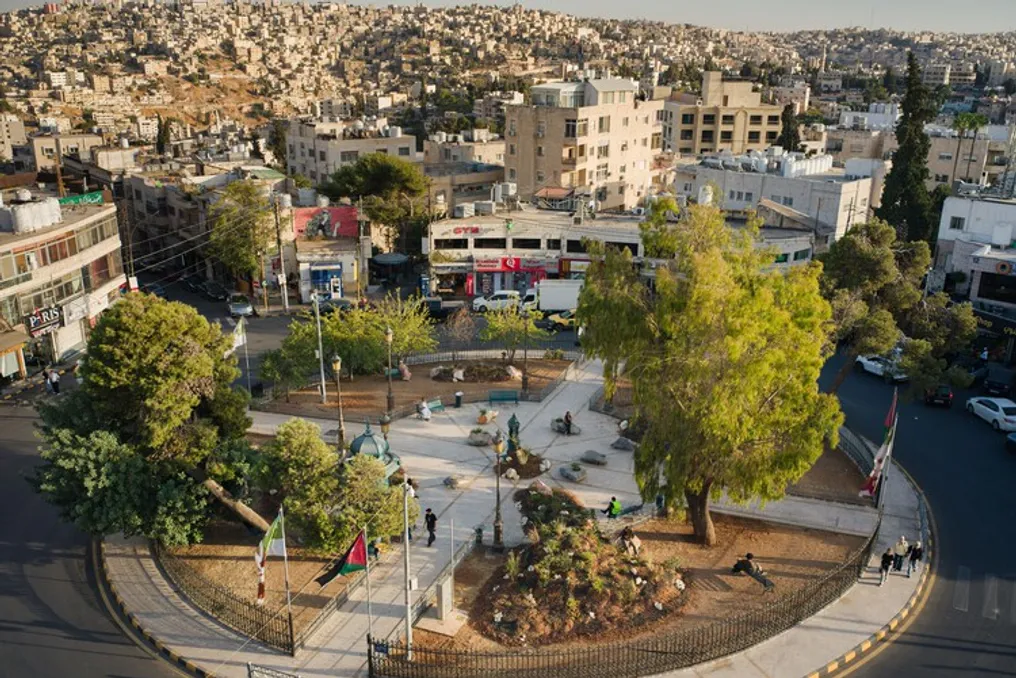
At the Paris Circle, FADAA's installation 'A Brief Untaming' temporarily modified the roundabout using earth and stones recovered from excavations, supplemented by planters with native flora. By allowing vegetation and topography to exceed formal boundaries, the intervention challenged the rigid aesthetic of conventional public landscaping, proposing a less controlled view of the topography.
The work 'Bracing Accumulations' by EAST Architecture Studio, located in Darat Abu Adnan, addressed the issue of existing resources on another scale. The firm adapted the roof and facade of a 1950s historic mansion into a rainwater harvesting and redistribution system, anchoring adaptive reuse in Jordan's long history of water management.
These examples show that sustainability moves out of the abstract field and becomes fixed in the real conditions of a place. The space also hosted part of *Nuzul*, a bird shelter project curated by Faysal Tabbarah, which included works such as *Dār Al ʿAwda* by Mariam Arwa and Yasmine Mansour; *Binayat Al-Douri* by Omar Darwish; *In the Nectar of the Flower of Cities* by Jessica Azizeh and Yasmin Tams; and *Of Kin* by Nada Barqawi.
Designing for existing practices
Crucial moments of the edition occurred at the intersection of design and the city's daily activities. At Ras El Ain Park, the permanent installation 'Folly' by Civil Architecture offers a shaded gathering spot under ceramic tiles locally made by Haswa. Human and animal figures placed on the roof add ambiguity, while the structure fulfills a basic public function of shelter.
Near this location, the permanent installation *Domes of the Rock* by Mohamad Nahleh embeds architectural memory into daily life. By referencing the Dome of the Rock in Jerusalem through a reduced structure of wood and steel with seating and lighting, the work removes a known architectural image from its usual monumental context.
At the intersection of the Faculty of Sharia, in Jabal Al Lweibdeh, the permanent intervention 'Ard Al Sahn' by Ziad Jamaleddine and Makram el Kadi of the L.E.FT office, in collaboration with Iheb Guermazi and Beya Othmani, makes visible the relationship between design and pre-existing practices. Constructed with local stone waste, the intervention creates a surface oriented towards the Qibla, with sculpted elements resembling prayer rugs, situated in front of the Shariah Mosque, where Friday prayers are held.
Amman Design Week 2026 presented design not as an isolated act, but as part of a continuous process, shaped by cultural exchange and material knowledge. Old buildings, neglected resources, and public spaces became active starting points for new interpretations. Accumulation refers to the capacity to rework inherited conditions to meet current needs without losing connection to the place.
The debates generated transcend the event, driving discussions on how local knowledge and material traditions can sustain modern construction practices, allowing future generations to reinterpret heritage. The interventions in Amman demonstrated diverse forms of response, from utilizing construction waste to creating spaces that dialogue with established social practices, proving that accumulation is never static.