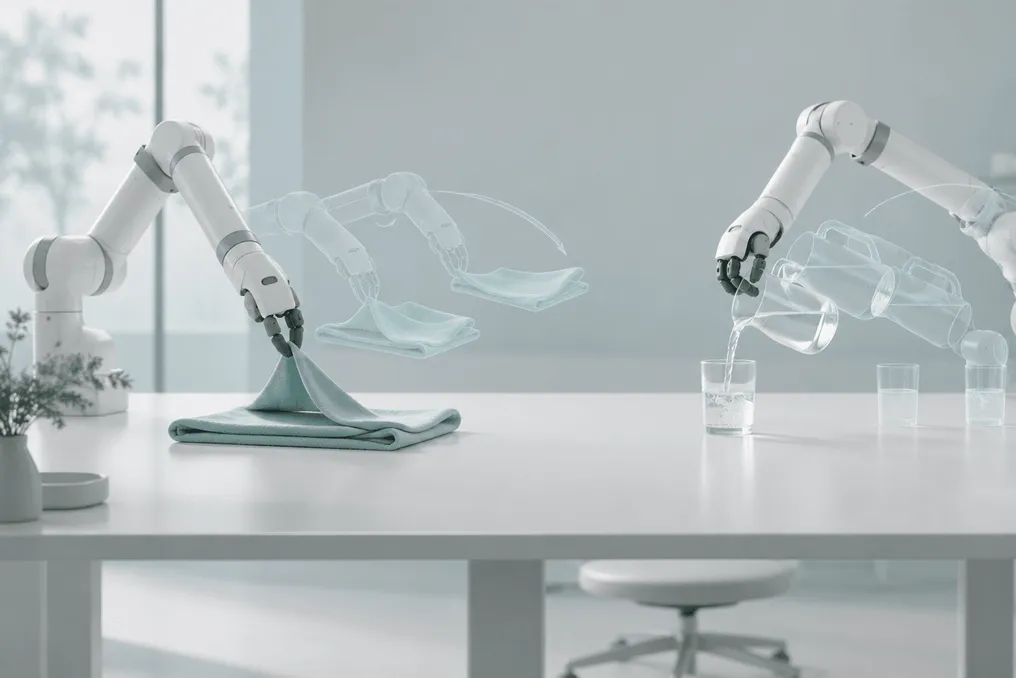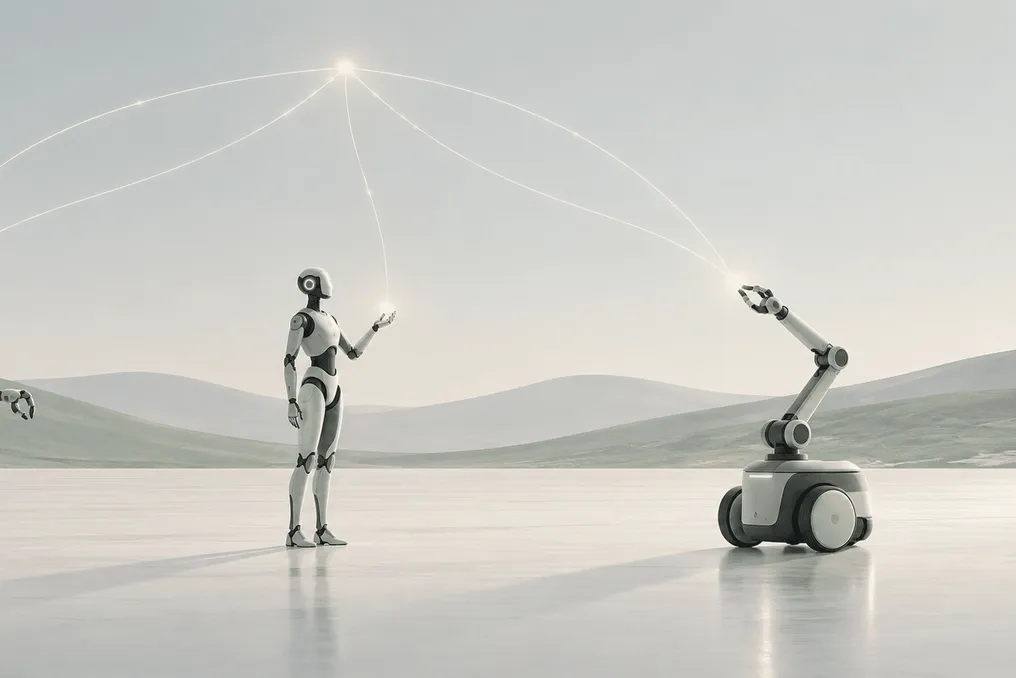
Qianjue, a company specializing in embodied artificial intelligence with roots at Tsinghua University, has announced Polibrain—a predictive world model designed for robots. The presentation took place at the first Conference on Physical AI and World Models in Nanjing on October 20th, where founder Gao Haichuan presented the model during the opening keynote address.
Polibrain does not aim to generate every future video frame. Instead, it studies the relationships between environmental state, history, and action outcomes, predicting how task-relevant states will change within the latent representation space. The company asserts that in a garbage collection task for a robot, the color of the ground is less significant than the object's location, the manipulator's position relative to it, and how the grasp will alter the state.
The model integrates perception, state understanding, action prediction, decision-making, execution, and feedback into a closed loop. When the obtained results deviate from predictions, such as after an unsuccessful grasp, the system re-evaluates the task based on the new state and adjusts subsequent steps. Qianjue states that decoding key features allows it to track discrepancies between expected and actual states, aiding in error detection and recovery.
In a demonstration video provided by the company, a quadruped robot equipped with a manipulator and a collection basket searches for trash on the street, approaches it, plans the manipulator's movement, and places items in the basket. Qianjue reports that Polibrain adapts for use in quadruped, humanoid, wheeled, single-armed, and two-armed robots to perform tasks such as companion care, food service, cleaning, and fine manipulation. However, the company acknowledges that the model's reliability in complex scenes still requires more thorough testing in real-world conditions.
Qianjue positions itself as a provider of 'brains' for robots, rather than a hardware manufacturer. Its loosely coupled architecture separates the general understanding of the environment and the task from the individual control of each machine, allowing different robots or even connected devices to perform the same intended change in their own way. The company hopes this will also allow data from different robot forms to feed into one model.
This development builds upon research published by Qianjue in collaboration with a team from Tsinghua University at the ICML 2025 conference regarding when neural networks learn world models, as well as later work concerning the 'Effective Degree' model complexity measure and a counterfactual method for determining which past observations should be retained.