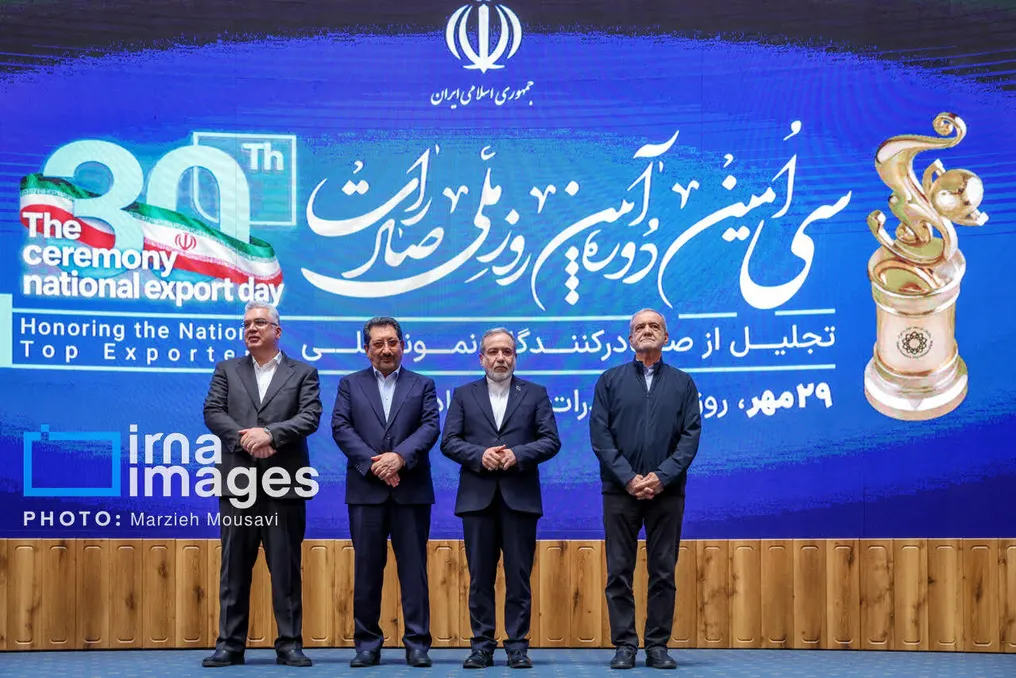
On Wednesday morning, October 21, the National Export Day ceremony took place in the Summit Hall. Attendees included President Masoud Pezeshkian, Foreign Minister Abbas Araghi, Minister of Industry, Mining and Trade Seyed Mohammad Atabak, Head of the Organization for the Promotion of Trade Mohammad Ali Dehghan Dehnavi, Head of the Iranian Chamber of Commerce, Industry and Agriculture Samad Hassanzadeh, as well as representatives from foreign trade and relevant experts. The goal of the event was to honor outstanding national exporters.
As part of the thirtieth National Export Day, the 'Export Atlas' system was presented, and 13 national premium companies and 43 national exemplary companies were awarded.
The Minister of Industry, Mining and Trade emphasized the importance of accelerating the removal of export obstacles and called for the creation of a joint committee. This committee should include the Iranian Chamber of Commerce, Industry and Agriculture, the Ministry of Industry, Mining and Trade, and the Central Bank to promptly resolve exporters' issues.
Seyed Mohammad Atabak, speaking at the ceremony, noted the presence of private sector representatives in the High Council for Non-Resource Exports. He stated that given the numerous state bodies within the council, it is necessary to first form a specialized committee to review issues at the highest level and make necessary decisions.
Addressing the President, the minister added that in the current situation, especially considering frequent changes in the status of some borders, decisions must be made faster. Therefore, he proposed creating a committee involving the Iranian Chamber of Commerce, Industry and Agriculture, the Ministry of Industry, Mining and Trade, and the Central Bank. This body could address current exporter problems, while issues requiring higher-level decision-making would be forwarded for final approval to the High Council for Non-Resource Exports.
Atabak also commented on the presentation of a comprehensive atlas of the country's official trade gateways. He expressed hope that this atlas would serve as a reference material for foreign trade participants, but for it to remain relevant, the information must be constantly updated under the guidance of the Iranian Organization for the Promotion of Trade.
Furthermore, the minister highlighted the need to strengthen the presence of Iranian traders in target markets, mentioning the potential of the country's trade agreements. He noted that barriers to trade development are decreasing in some markets, including the Eurasian Economic Union, but the presence of Iranian traders there still needs strengthening.
Referring to a meeting with Eurasian Economic Union officials last week, Atabak reported that the Union's representatives did not consider the number of active Iranian traders proportional to existing opportunities. Nevertheless, he stressed that the efforts of the country's exporters have already placed Iran among the leading countries in this field, and yet, increasing the presence of Iranian traders in the member states' markets remains necessary.
The minister also announced agreements reached in the field of standards. It was agreed that existing national standards and certificates of origin would be used to prevent export stoppages due to standard issues, allowing the export process to continue without goods facing such barriers.
He concluded this segment by emphasizing the need to monitor the achieved agreements, continuously update the comprehensive atlas of the country's official trade gateways, and strengthen decision-making mechanisms to eliminate export barriers.
The Head of the Iranian Organization for the Promotion of Trade, emphasizing the need to facilitate regulation, compensate for rising transportation costs, and strengthen the position of Iranian firms in global markets, announced the preparation of ten proposals. These proposals aim to be incorporated into the decision-making cycle and simplify exporters' operations.
Mohammad Ali Dehghan Dehnavi stressed the importance of supporting exporters, removing internal obstacles, and strengthening infrastructure for export development during the 30th National Export Day ceremony.
Dehghan Dehnavi, speaking about the role of exporters in the country's economy, stated that National Export Day is not just a day for announcing figures and action lists, but rather a day to recognize those who have created and maintained the link between the domestic market and foreign buyers.
He added that exporters have not stopped the trade process under difficult conditions caused by war, sanctions, and economic blockade. Despite difficulties in fund transfers, exporters remained committed to their obligations and worked to maintain employment. This resilience demonstrates their decisive role in preserving trade turnover and the continuity of the country's economic activity.
Referring to the slogan 'Dynamic Trade, Value-Creating Export,' the Head of the Iranian Organization for the Promotion of Trade noted that this year's slogan cannot be reduced to a mere name; it is a criterion for assessing the effectiveness of participants in non-resource exports.
Speaking about the significance of transport routes in the country's foreign trade, Dehghan Dehnavi pointed out that seventy-five percent of the country's foreign trade was conducted by sea, but thanks to the efforts of various agencies, especially the private sector, alternative routes were reviewed during this period, allowing the trade process to continue.
Highlighting Iran's potential in trade development, Dehghan Dehnavi added that the country possesses the capabilities, knowledge, skills, and specialized human resources that can be utilized to increase trade volume and raise it from one billion dollars per week to one billion dollars per day.
The Deputy Minister of Industry, Mining and Trade called exporters the vanguard of economic warfare, stating: 'Our duty is to remove internal barriers standing before exporters and facilitate their activities.'
Dehghan Dehnavi, regarding the rise in transportation costs under current conditions, considered that allocating appropriate incentives is one solution to compensate for these costs. He stated: 'We must remove existing barriers to trade, simplify regulations, and develop the necessary executive capabilities for the effective presence of economic entities in global markets.'
He further emphasized the importance of maintaining target markets and achieving value-creating exports: 'Exporters have ensured the stability of the country's trade despite numerous pressures. On this path, we must create a foundation for a more sustainable presence of Iranian products and services in global markets by enhancing export potential and focusing on value creation.'
The Head of the Iranian Organization for the Promotion of Trade also stressed the need for solution-oriented decision-making and announced the preparation of 10 proposals, expressing hope that incorporating these proposals into the decision-making cycle would accelerate the process of resolving issues and eliminating barriers to export development.
In conclusion, Dehghan Dehnavi thanked economic entities and everyone involved in the country's export development.
Speaking at the same ceremony, the President of the Iranian Chamber of Commerce, Industry and Agriculture, Samad Hassanzadeh, praised exporters for maintaining export flows despite difficult economic and military conditions, as well as for resisting hostile intentions. He noted that protecting exports in recent critical military conditions was a strategic necessity to ensure employment, foreign currency inflows, and Iran's economic credibility, and thanked the Ministry of Industry, Mining and Trade, the Organization for the Promotion of Trade, and other agencies for combating barriers and supporting trade routes.
Hassanzadeh stated that Iran is in a state of 'neither war nor peace,' marked by uncertainty, economic pressure, trade restrictions, and threats to transport routes. Foreign trade is increasingly suffering, and the adversary seeks to weaken Iran's economic competitiveness by increasing transaction costs. He argued that the response must be a unified message from government officials and the private sector: transforming external pressure into a coordinated will to maintain trade turnover, eliminate internal barriers, and neutralize the cost of external pressure through rationality, pragmatism, and decisions based on national interests.
He called for moving from daily crisis management to sustainable trade mechanisms and rethinking the place of exports in macroeconomic policy. This requires coordination of monetary, industrial, financial, and trade policies, as well as avoiding decisions that increase the cost of Iranian firms' presence in markets. He proposed establishing a Headquarters for Ensuring Continuity of Foreign Trade involving the government and the private sector, customs, the Central Bank, and other agencies to develop an operational plan. Priorities should include diversifying transport routes, simplifying customs and border procedures, strengthening trade insurance and risk management, and improving interagency coordination.
Regarding monetary policy, Hassanzadeh strongly urged aligning currency and working capital repatriation mechanisms with trade realities. He demanded a review of restrictive procedures using business cards, distinguishing between intentional violations and limited and recoverable obligations, providing adequate time to fulfill currency obligations, and abandoning punitive measures against honest exporters.
He emphasized that maintaining traditional markets and developing new ones requires attention to costs, payment terms, tariffs, and freight. Without logical support, Iranian exporters cannot compete with regional and international rivals, and lost markets are not easily regained. He called for making economic diplomacy operational—securing tariff and transport agreements, removing customs obstacles, and expanding cooperation with neighbors with greater coordination between relevant agencies, the Iranian Chamber of Commerce, and joint chambers.
Finally, Hassanzadeh called for shifting from sporadic exports to a sustainable market presence through added value, quality, completed production chains, and stronger Iranian brands, while simultaneously supporting related industries, technical and engineering services, knowledge-based products, and service exports. He also called for revising the relationship between the public and private sectors based on trust, partnership, and responsibility, and turning private sector requests into a priority, time-bound action plan.