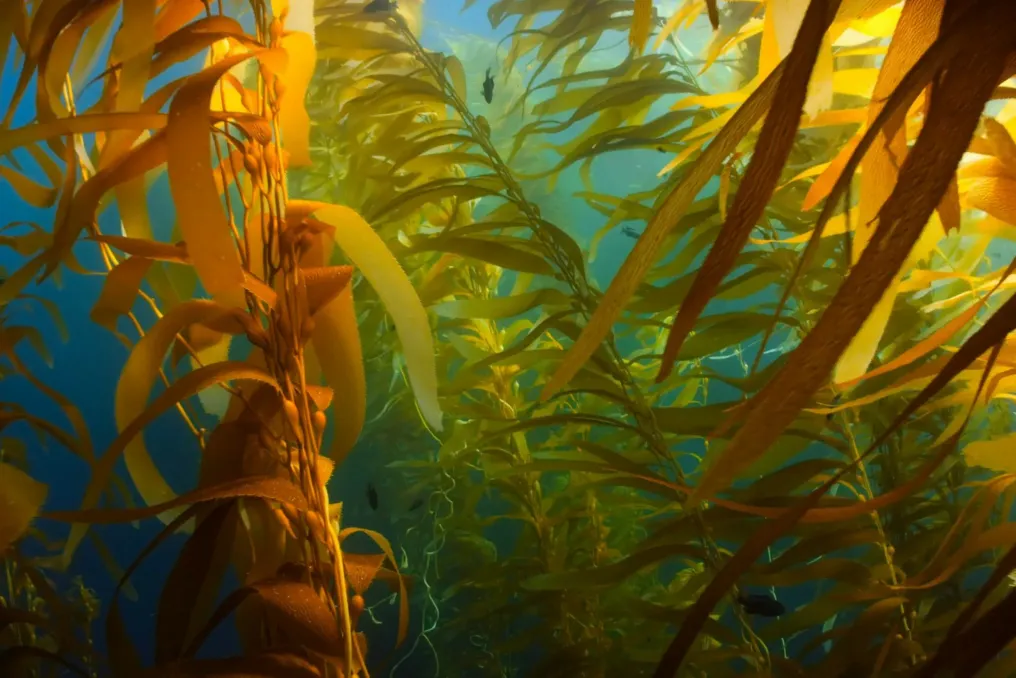
From the seashore, the submerged forests of the West Cape may appear quite ordinary—dark bands moving in the water, swaying with the waves. However, beneath the surface of these forests lies a dense underwater world teeming with fish, sharks, abalones, sea urchins, sponges, and numerous small creatures.
The Great African kelp forest extends approximately 1000 kilometers along the west and southwest coast of South Africa and further into Namibia. This massive marine ecosystem is dominated by giant laminaria, such as sea bamboo (Ecklonia maxima) and divided-fan laminaria (Laminaria pallida).
Laminaria thrives in the cold, nutrient-rich waters of the Benguela Current. Coastal upwelling brings nutrients to the surface, creating highly productive conditions for marine life. Sea bamboo is capable of growing towards the surface, forming a floating canopy, while below it is anchored to rocky reefs using holdfasts. These intricate structures are miniature habitats in themselves.
Studies conducted on Ecklonia maxima have revealed various communities living among the canopy, leaf blades, stems, and holdfasts; the holdfasts support a particularly large number of marine invertebrates. Sponges, crustaceans, worms, and other small animals find home among the laminaria, and scientists continue to discover new species. The 1001 Seaforest Species project documents the biodiversity of the Great African kelp forest, and eDNA research helps scientists study fish communities across its vast territory.
Laminaria serves not only as shelter; its structure creates feeding grounds and nursery areas for juvenile marine species. Only the Table Mountain National Park Marine Protected Area contains hundreds of recorded species of marine invertebrates, as well as fish, sharks, rays, and marine mammals. Among the species associated with this ecosystem are abalone, Kamchatka lobster, and sea urchins. For example, sea urchins play an important role as herbivores and can also provide shelter for abalone juveniles.
It is an interconnected world where changes in one species can affect many others. One of the most striking aspects of these underwater forests is their proximity to the shore. The Table Mountain National Park Marine Protected Area covers 127 kilometers of coastline between Muizenberg and Muizen Point, encompassing about 1000 square kilometers of ocean. In places like Oudekraal, dense clumps of laminaria are located right near the shore, supporting a vibrant marine ecosystem beneath the waves.
The coastline has supported populations for millennia, and archaeological evidence shows how communities on the Cape Peninsula have long depended on the sea. Today, we are still discovering how rich life in it is. Although laminaria is resilient and grows in the harshest waters of the Cape, the ecosystem faces pressure from fishing, poaching, pollution, harvesting, and climate change.
Changes in ocean temperature and extreme marine heat events can impact laminaria forests and their associated food chains. The situation is not simply one of decline; recent studies suggest that laminaria has expanded its range in some areas as conditions change. Scientists continue to investigate what these shifts mean for the broader ecosystem. Clearly, the forest is dynamic, and its future is closely tied to the changing ocean.
Marine protected areas play a crucial role in safeguarding these ecosystems. The Table Mountain National Park Marine Protected Area protects extensive laminaria forests alongside rocky reefs and other marine habitats. Other protected areas, including the Robben Island and Betty's Bay Marine Protected Areas, also protect laminaria-associated species. Further south, laminaria forests grow around Alferd Banks, where volcanic peaks rise from Agulhas Bank. Protecting laminaria means protecting much more than just the seaweed—it is protecting the habitat, food, and shelter that sustain an entire marine community.