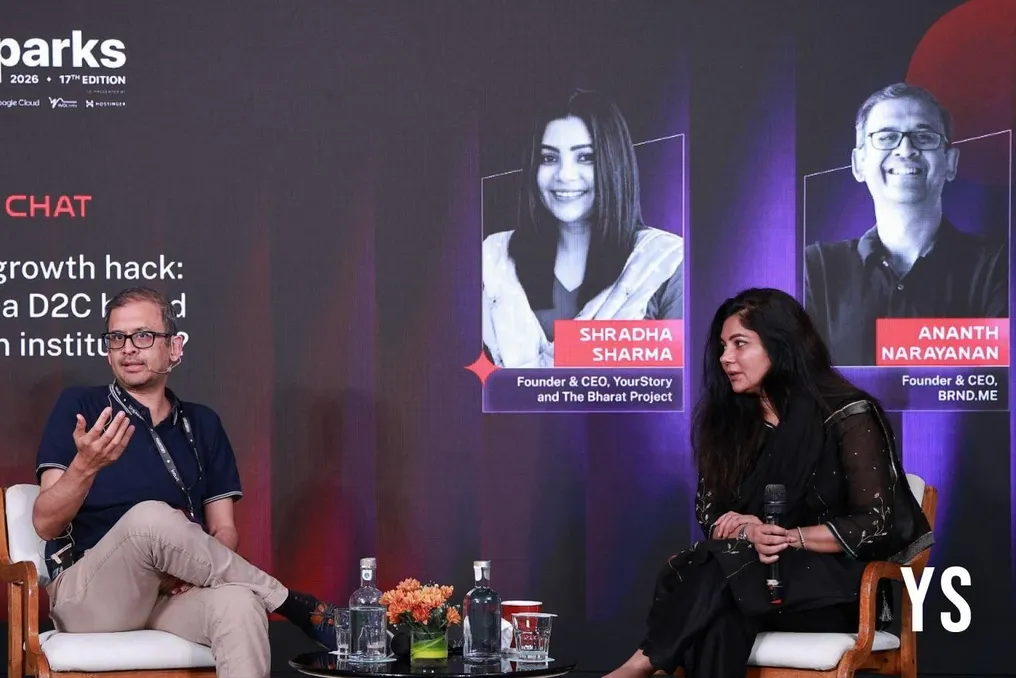
Ananta Narayanan, founder and CEO of BRND.ME, stated that the phase of rapid growth in the D2C sector has ended, and brands aiming for long-term success will have to earn it gradually. He shared this view during the 17th TechSparks event by YourStory.
In a conversation with Shraddha Sharma, founder and CEO of YourStory and The Bharat Project, Narayanan noted that the transition to a profitable business began about two or three years ago. He emphasized that simple scaling, which many D2C brands practiced, is no longer valued without product-market fit. 'You need real cash flows and genuine love for the product, which is very difficult,' he said.
He added that there are no shortcuts to building a brand's success. In his experience, it takes a brand seven to fifteen years to gain true loyalty and create cohorts that last five or ten years. Narayanan reported that finding patient capital has become easier thanks to large FMCG manufacturers like Unilever and P&P acquiring D2C brands, as well as the coming wave of IPOs.
He advised founders to be frugal, noting that most large FMCG companies never took external investments. Narayanan believes the D2C sector can do the same, although it is extremely difficult and 'not very attractive.'
Narayanan believes that future major Indian brands will be focused on overseas buyers. He explained that old barriers in consumer understanding and distribution are weakening due to Amazon Global Selling for reach and the use of AI agents trained on Reddit discussions and Amazon reviews to substitute foreign consumers. BRND.ME, which derives over half of its revenue outside India, uses such agents in product development.
As an example, he cited the brand Majestic Pure, an aromatherapy brand of the group. India is one of the world's leading producers of essential oils, and the two largest aromatherapy brands, doTERRA and Young Living, both American, purchase over 30% of their products here. Majestic Pure sells similar goods for about $25 compared to $65 from competitors. Narayanan explained that the difference lies in packaging, and to justify a higher price, one must be able to tell the right story.
His advice to founders was to study goods that India exports in bulk and identify opportunities to build a brand based on them. He named categories such as health and wellness, as well as pet care. BRND.ME narrowed its portfolio to MyFitness, Majestic Pure, Botanic Heart, and Party Props. He noted that while the company's overall business grew, the number of brands decreased. Furthermore, he urged Indian FMCG firms to pay more attention to real research and development, citing Botanic Heart's two-year focus on efficacy testing to substantiate claims in the US market.
Regarding packaging, he admitted that the company still hires an American agency for design. 'Packaging is marketing,' he stated, mentioning competition from Korean and European brands.
Narayanan was blunt regarding celebrity-endorsed brands. He stated that a face can provide an initial boost, but in his opinion, it cannot ensure repeat purchases. Paying an ambassador for a campaign is acceptable if the return on investment justifies it. However, turning a celebrity into a partner is another matter, which only works if the star aligns with the brand, and an experienced businessman makes decisions on product, marketing, and pricing. Otherwise, 'you think the celebrity is selling, but in reality, the product is selling.'
Sharma called this the central theme of the session. He also warned that misleading brands do not survive. 'You might fool consumers once, but I don't think you can fool them again.' His recommendation was to retain 8 to 20% of revenue coming through the brand's own channel, as fast commercial turnover and marketplaces provide little feedback, and honesty regarding reviews and ratings is necessary.
Narayanan believes that express delivery will remain a trend and works best where speed impacts the purchase, such as with Party Props. For FMCG goods bought once a month or less, shelf space is limited, and platforms take up most of the value. He rejected the idea of a monopoly, stating: 'There is no monopolistic world in India. If you can compete here, you can compete globally.'
He does not condemn founders who create companies for sale, but noted that 'ultimately all valuation games must be cash flow games, because the only real exit is an IPO.' His own goal is a long-term strategy. In conclusion, he advised founders to build with heart: 'Create products that you love. Otherwise, you become a bit of a machine generating unit economics.'
When asked how to present India as a brand, Narayanan replied that today India represents talent, and now it should move towards culture, from yoga and Ayurveda to mindfulness. 'Why not make the Indian lifestyle the most important thing in the digital age?'
Responding to the audience's question about the difficulty of securing early-stage D2C funding, he disagreed. 'There is a lot of money available if you have a good consumer brand idea. In fact, later stages are much harder. Early stage is about the idea, and most people like ideas.'