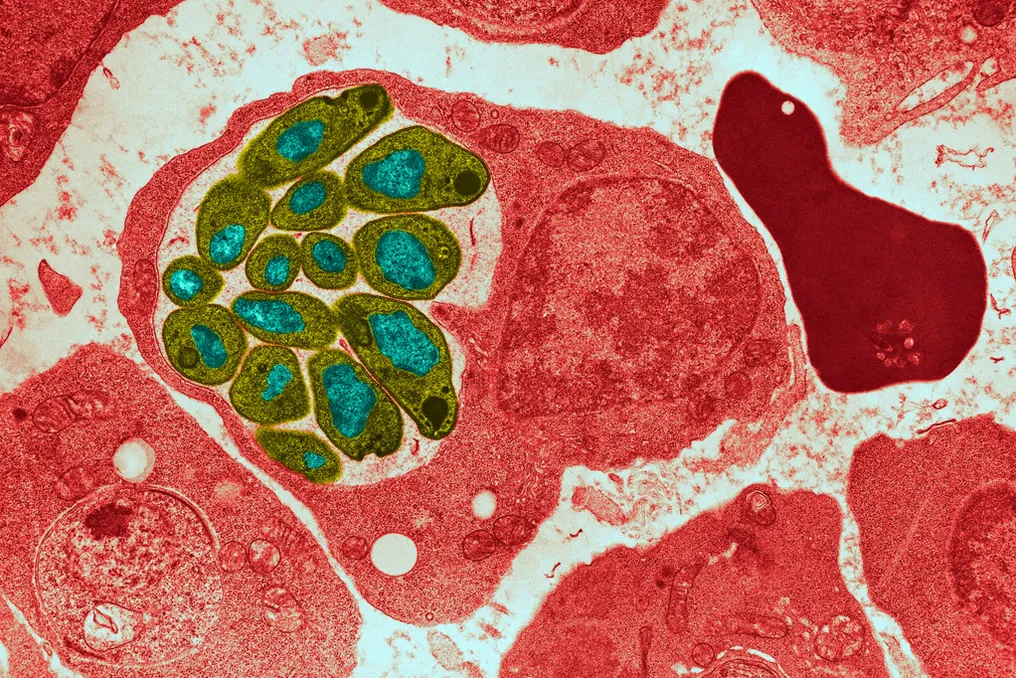
Researchers from USP, in collaboration with scientists from Université Paris Cité in France, discovered that the malaria parasite, specifically Plasmodium falciparum, uses the MT-PfSR1 receptor to detect the hormone melatonin, which could drive the development of new medications against the disease.
Twenty-six years ago, studies at USP already indicated that melatonin could affect the development and synchronization of the malaria parasite in cell cultures. The identification of the MT-PfSR1 receptor details how the parasite captures this hormone.
Bárbara Dias, a researcher at the Institute of Biomedical Sciences (ICB) and the Faculty of Pharmaceutical Sciences (FCF) at USP and author of the study, points out that the main current obstacle in combating malaria is the emergence of parasites resistant to existing antimalarials.
Melatonin, produced by the pineal gland in the brain, is released at night and peaks hours later, aiding in the onset of sleep. In mammals, it acts through G protein-coupled receptors (GPCRs), structures on cell membranes that transmit hormonal and neurotransmitter signals into the cells.
Celia Regina da Silva Garcia, a professor at FCF, explains that a striking characteristic of malaria parasites is their ability to coordinate development within red blood cells. In an infected host, many parasites advance in a coordinated manner over a cycle of about 48 hours, resulting in the rupture of red blood cells and the simultaneous release of new parasites into the bloodstream, a process linked to periodic fever episodes known as tertian fever.
This initial knowledge about synchronization was established by Celia Regina Garcia's group in the 2000s. This raised the question of whether the parasite possessed its own receptor protein to detect melatonin. In 2008, the same group identified four potential GPCR receptors in the Plasmodium genome, offering a new view on how these parasites interact with the host environment.
Professor Celia Regina Garcia emphasizes that GPCRs are a crucial family of cellular receptors and serve as targets for many current drugs. Studying these receptors in Plasmodium is particularly valuable due to the parasite's unique cellular biology, which develops in red blood cells and has a very different ionic physiology from most human cells.
In a recent study, Bárbara Dias, co-authored with Maneesh Kumar Singh (affiliated with FCF and Université Paris Cité), the scientists analyzed two of the four receptor candidates. Using in silico and in vitro assays, they proved that MT-PfSR1 functionally reacts to melatonin.
Professor Bárbara Dias highlights that this discovery is significant because it reveals a sophisticated and unprecedented capacity of Plasmodium falciparum to use host circadian signals to modulate its own development.
Additionally, the researchers managed to identify and characterize a synthetic compound capable of activating the MT-PfSR1 receptor. Bárbara Dias commented that the compound AR34 activates MT-PfSR1 but does not bind to human melatonin receptors, demonstrating its selectivity and inhibiting parasite growth in culture.
Malaria is caused by parasites of the genus Plasmodium and transmitted by infected female Anopheles mosquitoes. Although there are five causative species in humans, P. falciparum and P. vivax are the most concerning. P. falciparum causes the most severe form, potentially leading to renal or hepatic failure, acute encephalopathy, and pulmonary edema, with a mortality rate of 10%.
According to the latest World Health Organization (WHO) report, there were 282 million cases in 2024, an increase of approximately 9 million (3%) compared to 2023. In the Americas, 536,700 cases and about 136 deaths were recorded in the same period.
For Maneesh Kumar Singh, the research is important because it maps a previously uncharacterized parasitic signaling pathway, providing a pharmacological basis to target melatonin-responsive signaling in P. falciparum.
The study received funding from the São Paulo State Research Foundation (Fapesp) and the Coordination for the Improvement of Higher Education Personnel (Capes).