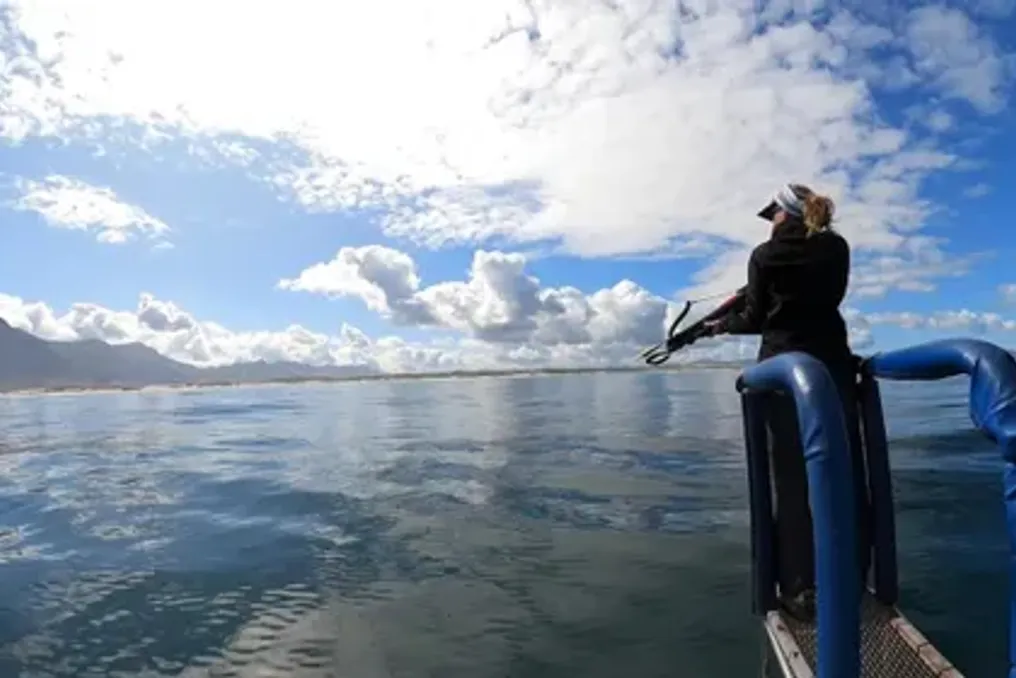
Professor Els Vermeulen from the University of Pretoria (UP) has become the first representative from South Africa appointed to a leadership position on the Scientific Committee of the International Whaling Commission (IWC).
As the Chief Scientific Officer and Head of the Marine Research Institute's Whale Unit at the University of Pretoria, Vermeulen has been granted a six-year term. This role is intended to strengthen Africa's representation in global marine conservation efforts.
She expressed her gratitude for this opportunity, stating that her goal is to amplify Africa's voice in the matter of global marine fauna conservation. Vermeulen hopes that South Africa can serve as a starting point for the entire African region in addressing regional issues such as shipping pressure and accidental dolphin bycatch in fishing gear.
The appointment is based on decades of fundamental research conducted by the MRI Whale Unit, which was established by the late Professor Peter Best in 1985. Currently, researchers monitor southern right whales, humpback whales, resident Bryde's whales, and coastal dolphins.
Using a southern right whale database dating back to 1979, scientists identify individual animals by characteristic skin patterns, which are rough patches on their heads. Photographs taken across consecutive seasons allow researchers to track reproductive history and generational changes.
Over the past fifteen years, these long-term datasets have revealed significant changes in the populations of southern and humpback whales, including increased calving intervals, poorer overall body condition, and shifts in migration routes. While these trends may reflect changes in the Antarctic ecosystem and climate change, local studies also investigate closer-to-shore issues such as pollution, fisheries interaction, entanglement, and shipping.
Vermeulen emphasized that only through such datasets can long-term shifts caused by factors like climate change be studied in detail. She noted the existence of data spanning decades.
For Vermeulen, research goes beyond simple population counts; it concerns the individual lives of the animals. She described the emotional experience of discovering a whale photographed in the 1980s returning to South African waters after 40 years with a healthy calf.
Through the 'Adopt-a-Whale' initiative, the public can follow the stories of individual whales, such as Maggie, first identified in 1979, who has had at least 10 calves, and Granny, registered in 1981 and presumed to be over 50 years old.
Vermeulen stressed that this is not just about a large group of animals, but about individual beings with their own stories, personalities, and characteristics, much like every human being.
Sustaining this research depends on external funding for fieldwork, including aerial and marine surveys, as well as maintaining long-term databases and training the next generation of South African marine scientists. Vermeulen views the link between public participation, research, and policy as a continuous cycle that directly influences national and international conservation discussions.