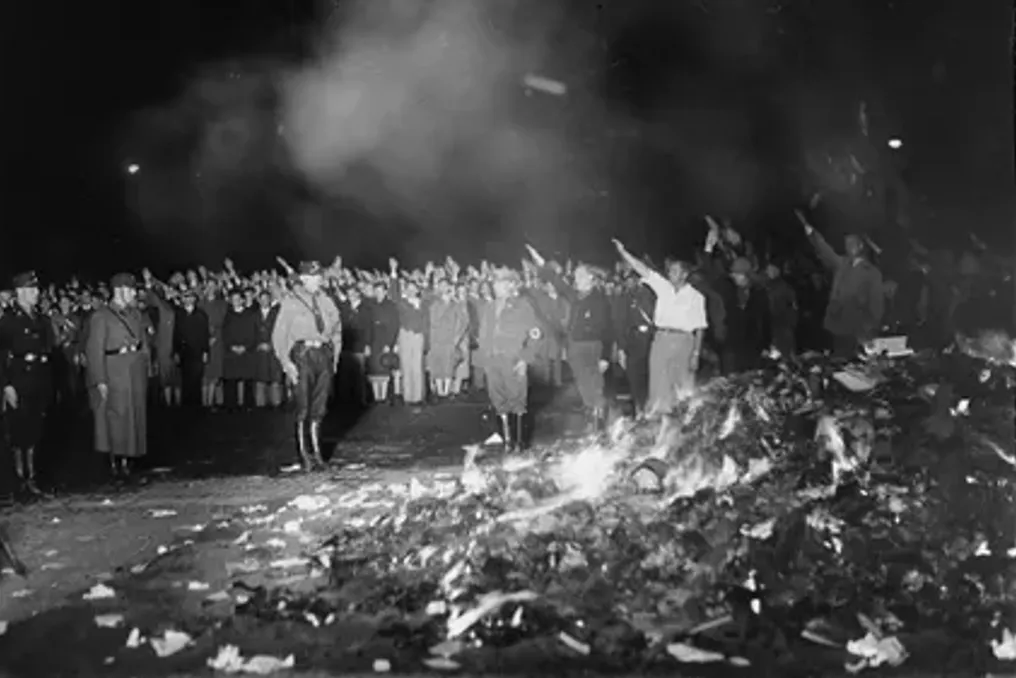
Burning a book possesses a peculiar power, perhaps because a book seems something innocent and soft. It is merely paper, ink, and thoughts contained within a cover, quietly resting on a shelf until someone decides to open it.
Nevertheless, throughout millennia, people have felt enough fear about what might happen if someone opened a manuscript they tried to destroy countless times.
Long before books were printed in thousands of copies, they were painstakingly and lovingly copied by hand, often in monasteries where monks and other scribes could spend months creating a single manuscript. Books were precious treasures, but they were also dangerously vulnerable; if there were only a few copies of a work, their destruction could mean the loss of the words themselves.
Progress in Book Printing
In the 15th century, Johannes Gutenberg changed the rules of the game. His printing press helped move books out of the hands of the wealthy, the clergy, and the educated classes, eventually making them accessible to ordinary people. However, this also complicated the task of destroying ideas.
When hundreds of copies of a book could be produced, destroying one became insufficient. Another copy might exist elsewhere that could be passed on. Printing also allowed ideas to spread faster and wider than ever before, including those that challenged religious and political authority. As books multiplied, censorship became more organized: publishers were monitored, books were confiscated, and lists of prohibited reading materials were compiled.
The most famous example was the Catholic Church's Index of Forbidden Books (Index Librorum Prohibitorum), which listed works that Catholics were forbidden to read for centuries.
The Forbidden Fruit
Of course, there is a problem with telling curious people that they absolutely cannot read something. This prompts some of us to immediately want to read it.
As books became increasingly difficult to completely eradicate, their burning took on an increasingly symbolic character—a public declaration that certain ideas, and sometimes the people behind them, were unacceptable. In May 1933, students in university towns in Nazi Germany burned tens of thousands of books deemed 'un-German.' Jewish writers were persecuted alongside pacifists and authors associated with socialism and communism. About 40,000 people gathered in Berlin, during which approximately 20,000 volumes were burned. Speeches, torchlight parades, and orchestral performances took place. This was not just getting rid of unnecessary books—it was an attempt to kill theatre, yet the words survived.
Closer to Home
South Africa has a long history of attempts to make books invisible. Apartheid created a massive apparatus of censorship under which books could be banned, imports could be stopped, and books could be removed from library shelves, or sometimes actually burned.
In the 1950s, 1960s, and 1970s, thousands of banned books and magazines were destroyed in furnaces across the country. Former director of the State Library Piet Vestra later recalled overseeing a truckload of books and magazines seized from the Pretoria Central Police Station and delivered to the Iscor steelworks, where a mechanical shovel dumped them into a 20-meter furnace. Among the burned books was Ray Bradbury's 'Fahrenheit 451,' a novel about a society where books are banned and burned; this is impossible to invent.
South African writers were not spared. Andre Brink's 'Kennis van die Aand' became the first literary work in Afrikaans to be banned, while Nadine Gordimer's 'Burger's Daughter' was banned in 1979 after being considered, among other things, a threat to state security.
Still Burning
Today, we don't necessarily need matches to get rid of a book. It can be prevented from publication or import, removed from school or library, restricted by law, or made unavailable online. Technology changes, as do the arguments and the people deciding what is dangerous, but the impulse to decide what someone else has the right to read has proven remarkably resilient.
Perhaps this is because reading is so wonderful and deeply personal. No one standing next to you can control what will happen once you open a book. You may disagree with it, be outraged by it, learn from it, laugh at it, put it down after three pages because it is terrible, or let it change your mind.
A manuscript once could disappear forever in a fire. A printed book could have hundreds of siblings, and today a book can have millions of physical and digital copies scattered around the world. The easier it becomes to reproduce books, the harder they are to destroy. When you share a love of reading, read widely and voraciously, question anyone who tells you that you should not read, and pass on your favorite books to others—you impede book burners. And you might discover something wonderful between the covers.