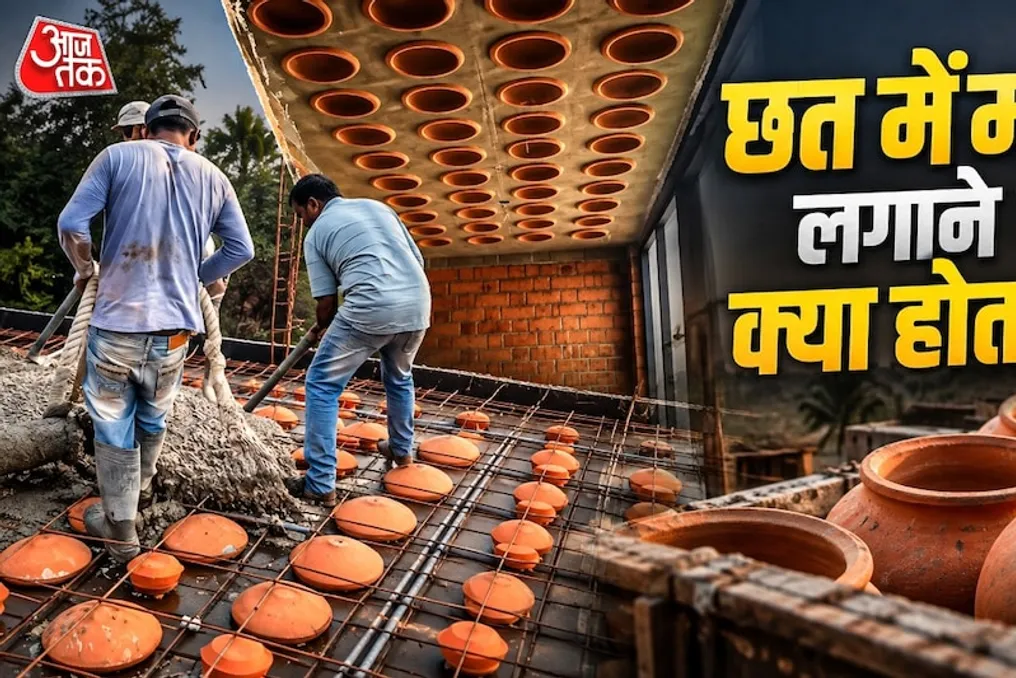
During the construction of residential buildings, it is often observed that contractors order clay pots before pouring the roof. This raises questions among people: why are pots needed in the center of the roof? Are they used to strengthen the structure, or are there other reasons?
In fact, clay pots or other hollow blocks are used in some specific types of construction when creating a roof. They are placed according to the roof design. The goal may be to reduce the amount of concrete in certain parts of the roof and decrease the overall weight of the structure.
Additionally, sometimes contractors install pots in parts of the house or balcony to create a decorative pattern, which is later destroyed during the design finishing process.
It is important to note that such pots are not required in all houses.
There are several advantages to using pots in a roof. Firstly, they help reduce the overall weight of the roof. Since the pots are hollow, their use in certain structures allows for a reduction in the volume of concrete, thereby decreasing the total mass of the roof. However, this effect is achieved only if the roof design was originally developed in this manner.
Secondly, there may be concrete savings. In areas where monolithic concrete is not required according to the design, hollow pots or blocks can be used. This can reduce concrete consumption. Nevertheless, the cost of the pots themselves and the costs of their installation must be taken into account.
Thirdly, pots allow the roof to have a special design. Clay pots or tiles are used in some traditional and decorative roofs to form a unique pattern under the roof. Sometimes the design visible after construction completion is part of this process.
One of the significant benefits is assistance in heat protection. Since there is air inside the clay pot, when used in a specific construction technology, the trapped air can help reduce heat impact. This can help maintain a lower temperature inside the house to some extent.
Another advantage is concrete saving. When building a roof using some special methods, pots are used, which reduces the amount of concrete in certain sections. This can lead to material savings and construction costs reduction. However, this gain depends on the roof design and its construction method.
It entirely depends on what purpose the pots were installed for. If they are used as a permanent part of the roof design, they do not necessarily need to be destroyed. However, if they were used as a temporary template within some construction process, they may be dismantled later.
One cannot assume that every contractor installs pots in the roof solely to destroy them later and create a design. The reason for this action is determined by the construction method and the roof plan.
The mere installation of pots does not make the roof stronger. The strength of the roof depends on its design, the quality of the concrete, the reinforcement, the level of construction, and the engineer's plan. If the pots are installed in the wrong place or the reinforcement and concrete system is compromised, it can affect the safety of the roof. Therefore, when constructing a roof, you should ask the contractor why the pots are being installed. It is also necessary to ensure that the roof is being built according to the design of a qualified structural engineer.