
Huawei and Shaanxi Telecom implement Dual-Band Massive MIMO on High-Speed Railways
Read more
Pandaily
pandaily.com

Huawei and Shaanxi Telecom implement Dual-Band Massive MIMO on High-Speed Railways

Huawei, in collaboration with the China Telecom branch in Shaanxi Province, has commercially deployed 32T32R FDD Massive MIMO technology on the Shu-Lan and Yinxi high-speed railway lines. This equipment operates simultaneously on 1.8 GHz and 2.1 GHz frequencies.

Huawei states that this is the first commercial use of FDD Massive MIMO in a high-speed railway environment in China. High-speed rail networks present significant challenges for mobile coverage due to the large distance between towers, train speeds up to 350 km/h, and penetration losses caused by metal carriages.

Massive MIMO technology, which is often used to increase capacity in densely populated urban areas, forms narrower beams compared to traditional wide-beam antennas. Huawei asserts that this beam shape is suitable for a linear route: the beams can be directed along the tracks, follow the train through cells, and adapt to compensate for the Doppler effect, which could degrade the connection.

The company highlighted three key design aspects for railway application. Adaptive beams are designed to limit frequency shift effects at high speeds. Inter-cell beam tracking and coordinated planning aim to reduce the number of handovers when a train crosses multiple cells. Furthermore, broadcast beams and pilots are configured to ensure linear coverage so that energy remains within the corridor rather than scattering in open terrain.

According to the statement, measurements conducted on the Yinxi section in Shaanxi showed an approximate 200-meter expansion of cell coverage after modernization, a 24% increase in average 5G uplink speed, and an increase in average downlink speed of over 50%. User experience improvements were even more pronounced: uplink speed at the zone boundary increased by 95%, and downlink speed by over 100%.

Although FDD Massive MIMO has long served as a tool for increasing capacity in urban macrocells, deploying 32 transmit and 32 receive chains on a high-speed corridor represents an attempt to apply this urban capacity model to a fast-moving linear cell. Huawei and Shaanxi Telecom present the deployment in Shaanxi as an operational commercial network, not a laboratory experiment. It should be noted that all claimed gains in coverage and throughput are assertions made by the company and operator from the announcement in October and have not undergone independent verification.
Similar stories

Richard Yu states that more Huawei phones will receive LogicFolding chips as part of the Tau roadmap
Read more
pandaily.com

Richard Yu states that more Huawei phones will receive LogicFolding chips as part of the Tau roadmap

Richard Yu, CEO of Huawei and Chairman of its Consumer Business Group, announced at an international roundtable that Huawei's LogicFolding chips will not be limited to just a few flagship devices. He stated that more Huawei phones utilizing chips developed according to the Tau scaling law (τ) will be released.

The LogicFolding technology first appeared in Huawei phones with the Mate XT 2 tri-fold model, and Yu noted that it will gradually begin to be integrated into a wider range of the company's smartphones. However, he did not specify particular models or timelines for mass release.

The speed of this expansion, according to Yu, partially depends on production capacity. He expressed hope that China's semiconductor industry can increase its manufacturing capacity so that Huawei can create more advanced products for consumers both domestically and internationally.

Details of the Kirin 9050 Pro chip

At the same roundtable, Yu presented details of the Kirin 9050 Pro chip, which is used in the top-tier Mate 90 models. Huawei independently developed components such as the Balong modem, Image Signal Processor (ISP), Mobile Security Processor (MSP), Lingxi CPU, Maleoon GPU, and an NPU built on the Da Vinci architecture. He emphasized that the overall phone performance is 31% higher than the previous generation, and the in-house development ensured better energy efficiency and system performance despite limited access to advanced manufacturing processes.

Technology Development Roadmap

Comments on the expansion are accompanied by a long-term development plan. According to the trajectory of the Tau scaling law, Huawei chips in 2026 will reach a performance core frequency of 3.1 GHz, which is 12.7% higher than the 2.75 GHz of the Kirin 9030 Pro. Further plans include stable growth in frequency and transistor density, reaching over 400 million transistors per square millimeter and a clock frequency of 5.0 GHz by 2031.

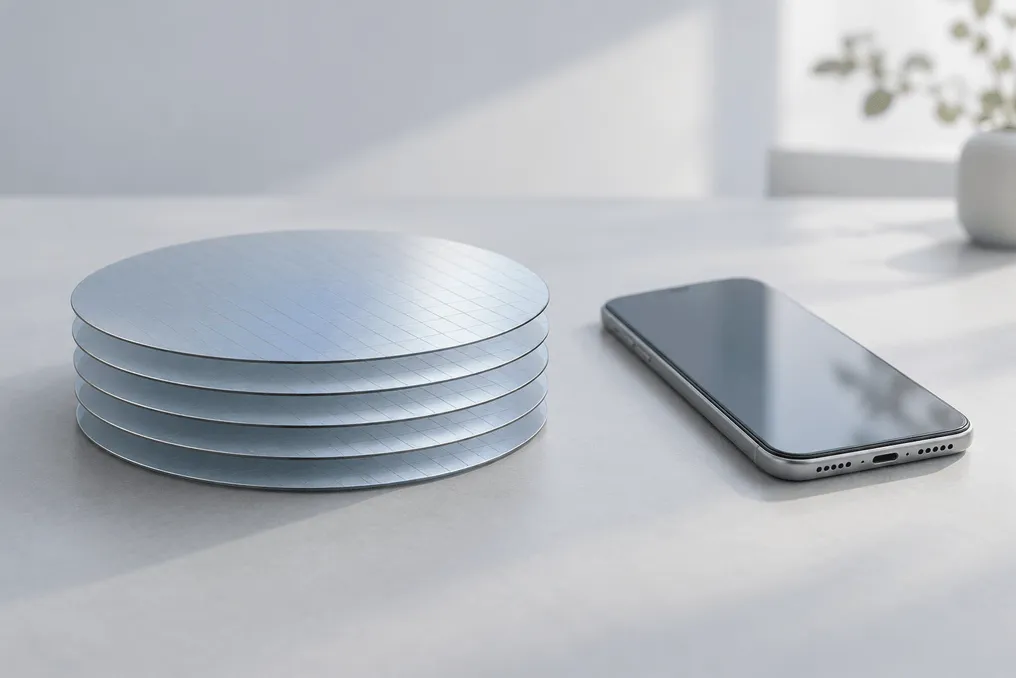
The LogicFolding technology works by vertically stacking logical layers of the chip and using dense inter-layer connections to shorten critical paths and reduce latency, instead of relying solely on reducing transistor size. Huawei has not yet specified which product lines will use this technology in the next phase, or whether mid-range phones will be included.

Popular