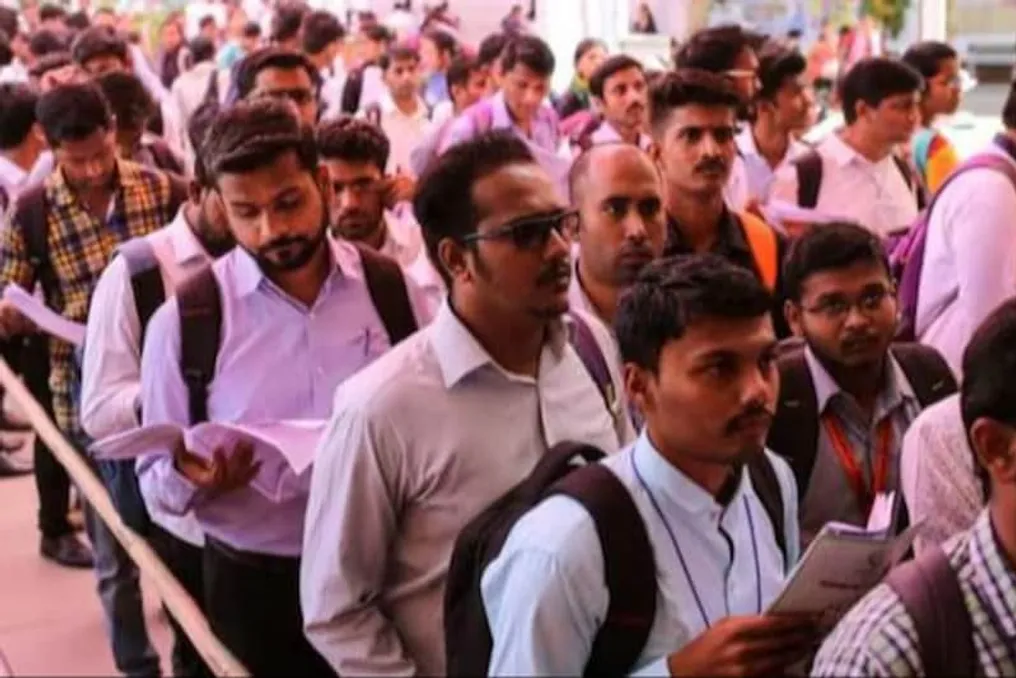
The story of Vivek, a 23-year-old preparing for a career in the police force, reflects the situation of millions of educated citizens in the country who have been waiting for employment opportunities for a long time. Securing stable work in the private sector is difficult, and in the public sector, difficulties are compounded by a lack of vacancies, lengthy procedures, and the cancellation of exams.
According to official data, the youth unemployment rate is rising, while the number of available positions is significantly lower than the number of applicants. Furthermore, there is a gap between the skills required for education and work, and factors such as contract hiring, low wages, and poor working conditions complicate the lives of young people.
Vivek graduated with a bachelor's degree two years ago and has been continuously preparing to join the police corps. His expectations were complicated after one of the exams was canceled. Currently, he helps his family earn money by working at a packaging factory in Aligarh. He lives in a single room with three young colleagues and is simultaneously taking partial computer science courses while continuing to prepare for other exams.
Vivek hopes that the next exam will take place within the next six months, allowing him to be accepted into service. He is the youngest in his family, with two older sisters; his mother, Rupa, moved to Delhi, and his father, Arvind, works as a driver. Although his current job provides Vivek with some financial independence, his parents are concerned.
His mother, Rupa, notes: 'We worked very hard on his education. He still dreams of working in the police, but it is difficult for him to balance studies and work while being away from family.'
Vivek's problems are typical for millions of young men and women in the country who hold bachelor's, master's, or technical degrees and are seeking employment. Among them are those who take exams for government service, but their education does not always meet labor market requirements. According to the Economic Review for 2025-26, the workforce aged 15 and over in India is expected to increase from the current 616 million to over 980 million over the next decade, intensifying pressure on youth regarding job searching.
According to a labor force survey report published by the government in August 2026, the youth unemployment rate for those aged 15 and over was 15.1%, which is three times higher than the overall unemployment rate of 5%. In 2025, these figures were 9.9% and 3.1%, respectively. A recent report by CAREAGE Ratings attributed this to a persistent mismatch between educational attainment and the availability of suitable jobs. The report also indicated that the growth of self-employment and hidden unemployment in agriculture may inflate unemployment statistics, and an economy with seasonal, temporary, and irregular employment may underestimate the real scale of the problem.
Some young people's problems do not disappear even after they find a job. Indrajit, a nearly 20-year-old bachelor graduate, currently works as a delivery partner for a food platform after recently being laid off from his job at Delhi airport, and continues to look for another position. He does not prefer factory work due to low pay. Indrajit says: 'As a delivery partner, I earn 700-800 rupees daily. Many of my friends are drivers, and I hope to find a job that pays at least 30,000 rupees per month.' To cut costs, Indrajit stopped visiting his family living near Lucknow, noting that in Delhi, he barely has enough money to live on, and travel leads to unnecessary expenses.
According to the latest International Labour Organization report, global youth unemployment is rising due to slowing global economic growth, job losses, geopolitical tensions, and rapidly changing technologies. In 2025, this figure stood at 12.4%. In many sectors, job creation is not keeping pace with the youth population growth. In India, youth discontent in 2026 was expressed through several protests. Industrial workers in Delhi and the National Capital protested against low wages and poor working conditions. Students demonstrated against the cancellation of the NEET exam. Protests also took place in states like Jharkhand and Bihar against irregularities in conducting state administrative service exams.
Alhak N. Sharma, Director of the Institute of Human Development, asserts that jobs and salaries are not growing in line with economic growth rates. In his view, unemployment is a serious problem, especially for educated youth in urban areas. In rural areas, educated young people can find employment by working part-time in agriculture or family businesses, but urban educated residents have far fewer options.
Data from the 2025 Labor Force Survey also confirms this: the unemployment rate among individuals with secondary and above education was 6.5% across all groups, whereas among those not considered educated, the rate was only 0.3%. Even individuals with degrees such as engineering and MBA are struggling to find employment.