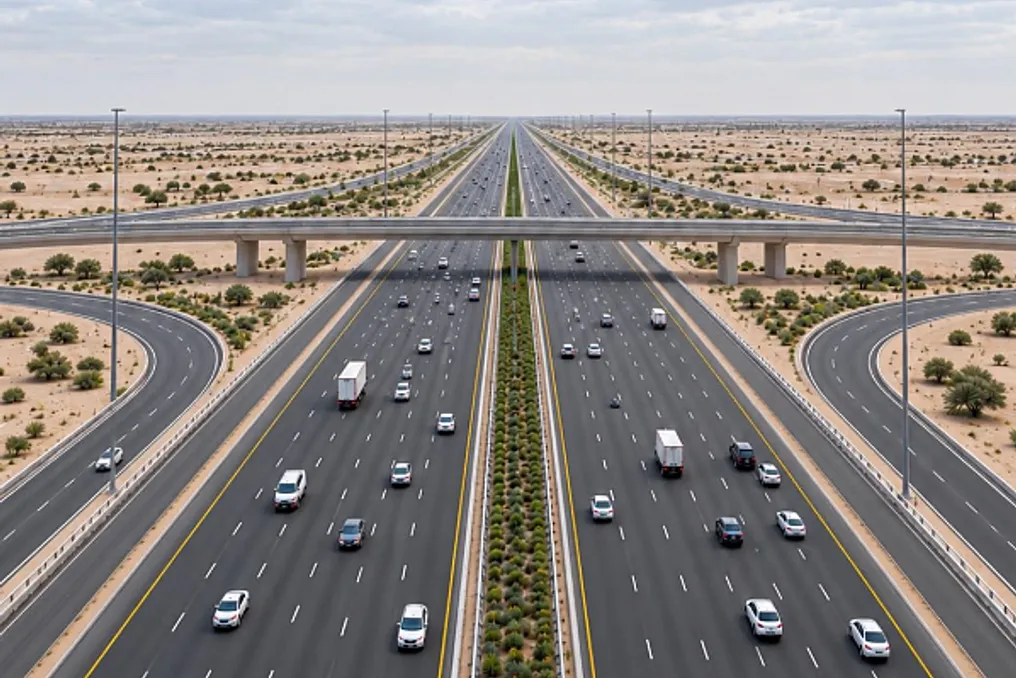
The UAE Ministry of Energy and Infrastructure has announced a tender for engineering consulting and design services for a new project—the country's fourth federal highway. This project, designated E-911, is planned to be 68 kilometers long.
According to the tender documentation, the E-911 route will connect the border between Dubai and Sharjah with the Al Sughada Road (E-87) in Ras Al Khaimah. The project envisions having between 12 and 16 lanes in both directions. Furthermore, it will include an 8-kilometer connecting road linking the new corridor to Emirates Road (E-611) in Umm Al Quwain.
The documents indicate that the route has been approved by the relevant local authorities of the emirates, and the conceptual design is already complete. Under Tender No. 2026-022, the selected consultant will be responsible for reviewing and confirming the finished conceptual design, conducting necessary technical studies, and preparing the preliminary, detailed design and tender documentation. The Ministry invited Category A consultants to submit their applications by October 23, 2026.
The E-911 corridor will become the country's fourth major federal highway, alongside Al Ittihad Road (E-11), Sheikh Mohammed bin Zayed Road (E-311), and Emirates Road (E-611). The official UAE government portal states that E-11 is the longest road in the country, stretching from Abu Dhabi to Ras Al Khaimah, while E-311 connects the emirates, and E-611 offers an alternative route between Abu Dhabi and the Northern Emirates.
Project valued at 6 billion dirhams
The fourth federal corridor was one of the major infrastructure projects reviewed by the UAE Council for Infrastructure and Housing at its first meeting in 2026. According to Khaleej Times, this corridor is expected to feature 10 main intersections and four flyovers, with an estimated cost of 6 billion dirhams. The Council noted that the project's goal is to improve connectivity between the emirates, increase road capacity, and reduce congestion.
At the same meeting, the council also reviewed plans to enhance transport links between Dubai, Sharjah, and Ajman. These plans include a proposed network of 10 routes supported by Bus Rapid Transit systems and dedicated lanes, connecting to metro stations and major city centers. Officials added that work is underway to improve Ajman's connections to the Third and Fourth Federal Corridors to provide drivers with alternative routes.
Traffic issues raised in FNC
The proposed highway emerges against a backdrop of persistent concerns regarding traffic jams between Dubai and the Northern Emirates, especially during peak hours. This issue has been raised in the Federal National Council (FNC), where members have called for solutions to the growing number of vehicles on the roads.
During the FNC session in March 2025, council member Dr. Adnan Al Hammadi questioned the Ministry of Energy and Infrastructure about the deteriorating road situation between Dubai and Sharjah. Al Hammadi stated that an employee commuting daily between the two emirates could spend approximately 460 hours a year on the road, equivalent to nearly 60 working days.
Responding to these concerns, Minister of Energy and Infrastructure Suhail Mohammed Al Mazrouei reported that development work on key federal road corridors began in 2024 and is ongoing. Al Mazrouei also pointed to the need to update policies governing vehicle ownership and registration, noting that car growth in Dubai has exceeded 8 percent compared to the global average of about 2 percent.
The issue was brought up again in the FNC in April 2026, when Al Hammadi once more raised the topic of population growth, vehicle registration, and congestion. He called for studies on future population growth, the introduction of restrictions on heavy transport during peak hours, and stricter control over driver's licenses and vehicle registration. In response, Al Mazrouei stated that a major project is being implemented to solve the congestion problem between Sharjah and Dubai. He presented the plans for the Fourth Federal Corridor, indicating that the proposed highway could handle approximately 360,000 trips per day.
This project is part of the UAE's efforts to expand its road network and address overload issues, as the number of vehicles and population continues to grow. In November 2025, Al Mazrouei announced a national investment program for roads and transport worth 170 billion dirhams until 2030, which includes plans to expand three existing major federal highways and study the construction of a fourth. The Minister emphasized that the program aims to increase the efficiency of the federal road network by 73 percent within five years.