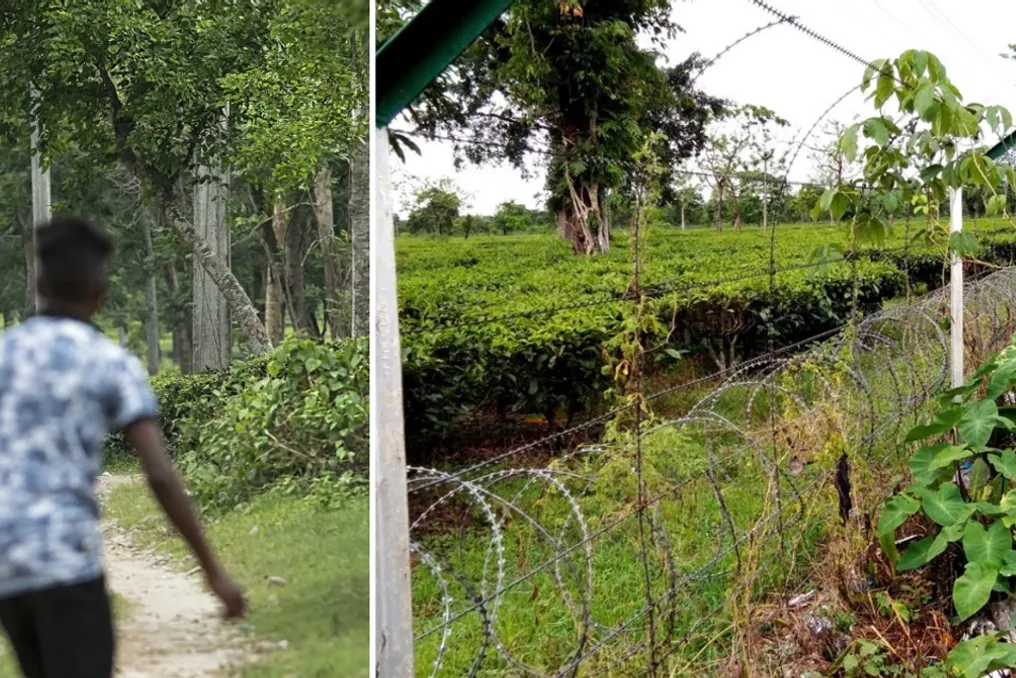
In November 2018, nature defenders working in the Duars region of North Bengal raised alarms about barriers increasingly obstructing elephant movement: these were sharply pointed fences around tea plantations.
The Wildlife Trust of India (WTI) reported a series of stakeholder meetings organized by its conservation partner, the Society for Protecting Ophiofauna and Animal Rights (SPOAR), which took place from November 11 to 16 of that year. It was noted that randomly installed barbed wire fences forced elephant herds to deviate from their usual routes.
The organization stated that the sharp wires caused serious injuries to elephants and other wildlife, and that some animals died while attempting to cross these enclosures. Although the report did not specify individual animals or provide a count of injuries from barbed wire, it highlighted an issue beyond the fences themselves: when elephants could not follow familiar paths, their movement could lead to closer contact with humans.
Seven years later, a reassessment conducted by WTI and SPOAR provided a measurable picture of landscape changes. Between 2019 and 2026, the length of barbed wire fencing mapped across the assessed tea plantations decreased from approximately 134.7 km to 34.8 km, representing a reduction of 74.2%.
These changes resulted from years of work with tea plantation management, local communities, and government agencies. It also raised the question of how much safer an elephant's path can become when the landscape begins to account for its movement.
A Corridor Is Not Always Forest
In the Terai and Duars regions of North Bengal, elephant movement is not confined to forest boundaries. Routes pass through forest areas, tea plantations, workers' settlements, roads, and railway lines. These connections allow elephants to move between habitats in search of food, water, and space. However, when the land is divided by fences, trenches, and other obstacles, the usual passage can become difficult or dangerous to traverse.
For tea plantations, fences may be intended to protect workers, crops, and property. Nevertheless, barriers located on elephant movement routes can also redirect herds toward working lines, roads, and settlements, creating risks for both people and wildlife.
To understand the scale of the problem, WTI and SPOAR conducted a year-long field study in 2019 across eight designated elephant corridors in North Bengal. The study documented how elephants used tea plantations and identified barriers that might impede their movement.
From Study to General Commitment
The findings served as a starting point for discussions with those managing the landscape. On Elephant Day in August 2019, about 50 representatives from tea plantations, the Forest Department, tea associations, administration, and conservation organizations gathered for a consultative seminar on ensuring elephant passage through tea gardens.
Discussions focused on practical measures such as identifying problematic barriers, maintaining open movement routes, and reducing losses for both humans and elephants. Camera traps captured during a herd of wild elephants crossing the Apalchand-Kalimpong corridor through the Minglas tea plantation in North Bengal were installed by WTI's partner, Green Corridor Champion (GCC), @SPOAR_India.
Some tea plantation representatives shared examples of areas left open for elephants. Others discussed commitments to dismantle existing barbed wire or refrain from installing it in the future. WTI, SPOAR, the Forest Department, and tea plantation management continued to work on the landscape, while awareness initiatives helped workers and residents understand elephant movements and the risks associated with blocked routes.
What Changed Between 2019 and 2026?
The reassessment conducted by WTI and SPOAR in 2026 provided a way to measure changes in the fence landscape. In 2019, the study covered 291.7 km of fencing in the surveyed area. By 2026, the total length had decreased to 104.5 km. The reduction in barbed wire was particularly noticeable in 2026: from 134.7 km to 34.8 km.
However, these figures do not mean that all missing fences were intentionally dismantled. According to the WTI report, the reduction is attributed to a combination of removal, wear, and lack of reinstallation. Furthermore, this data does not establish how many elephant injuries or human-elephant conflict incidents were prevented; it measures the change in physical barriers in the landscape, not confirmed reductions in casualties.
Nevertheless, the reassessment indicates that plantation practices have changed over time due to continuous interaction and discussion regarding safer elephant movement.
The Next Danger Is From Above
The same assessment identified another problem: low-hanging electrical infrastructure. The study recorded 54 power lines lower than 13 feet, with 47.4% hanging below 10 feet. These elements were noted as a serious threat to elephants.
An elephant might pass a fence but then encounter a low electrical line or another obstacle in its path. The findings are intended to guide joint inspections and corrective actions involving tea plantation management, the Forest Department, West Bengal State Electricity Distribution Company Limited (WBSEDCL), and conservation partners.
Charter of Coexistence
In August 2026, WTI and SPOAR brought together tea plantation representatives, government bodies, and conservation organizations in Chalsa, Jalpaiguri, to discuss elephant-friendly management. This consultation led to the development of the Charter of Elephant-Friendly Tea Plantations. The proposed framework focuses on keeping known elephant routes open, reviewing hazardous fences, improving electrical safety, preparing workers and residents for encounters, crowd management, and strengthening monitoring.
The reduction in barbed wire length from 134.7 km to 34.8 km is a measurable change. In itself, it does not prove that elephants are safer. Establishing this fact will require continuous monitoring of injuries, deaths, movement patterns, and human contact.