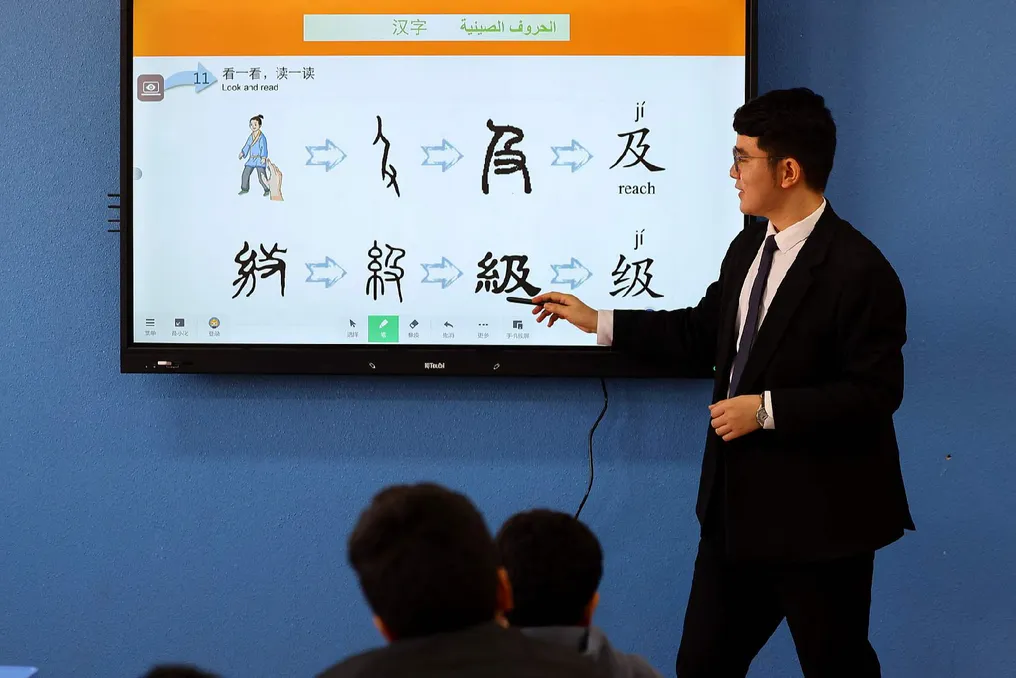
Interest in learning Mandarin Chinese is showing steady global growth, with 210 million learners worldwide already. This language is the second most spoken in the world by total number of speakers.
Recent experiences of students participating in NYU Shanghai's annual summer immersion program in Chinese culture reflect this growing interest. Approximately 60 students joined the nine-week program in Shanghai, where there was a strict rule to speak only Chinese. Faith Parker, a student from Virginia Commonwealth University, noted that despite the difficulties, the participation was a very valuable experience.
Learning Mandarin is becoming increasingly common among the children of famous personalities. According to ABC, the granddaughter of US President Donald Trump, Elon Musk's son, founder and CEO of SpaceX and Tesla, as well as the children of Amazon founder Jeff Bezos and Meta CEO Mark Zuckerberg, are also studying Chinese Mandarin.
British actress Rosamund Pike, known for her fluent command of Chinese and deep understanding of Chinese culture, adopted the Chinese name Pei Chunhua many years ago. She called Chinese the 'language of the future' during a visit to Shanghai with then-UK Prime Minister Keir Starmer in early 2026, emphasizing that learning Mandarin alongside English provides interesting mental training.
The China Language Education and Cooperation Center reported in May that the number of global Chinese language learners reached 210 million. According to the global language database Ethnologue, in 2025, Mandarin Chinese had 1.18 billion speakers worldwide, including 990 million native speakers and 194 million who study it as a second language, cementing its status as a global language after English.
Although mastering Mandarin requires effort, especially for those unfamiliar with Chinese characters and Pinyin, learners worldwide are making significant efforts. This is evidenced by the explosive growth in paid Chinese proficiency tests (HSK), which increased 21 times between 2004 and 2024. Annual participation in 2025 reached 810,000 people, and the cumulative number of test-takers exceeded 8.5 million by the end of the year.
In Duolingo's 2025 report, Mandarin ranked eighth in popularity on the platform globally. Its appeal is growing in South America, Asia, and Europe. In 12 countries, Mandarin was the fastest-growing language in the app in 2025, including Argentina, Brazil, Colombia, France, Germany, Indonesia, Mexico, Poland, South Korea, Spain, Thailand, and Turkey. It also ranked second in growth rate on Duolingo in the United States.
From the Middle East to Europe and the Americas, Mandarin is increasingly finding its place in curricula. In the Middle East, Saudi Arabia's Ministry of Education announced in April 2025 that 174 public secondary schools have implemented Mandarin courses. The country aims to provide Mandarin education to over 600,000 middle and high school students by 2030.
In the UK, parliamentary data from July 2026 showed that 31% of state secondary schools in England had at least one student studying Chinese under the GCSE program in 2025. In the United States, a 2026 report by the American Council on the Teaching of Foreign Languages (ACTFL) found that Chinese, including Mandarin and Cantonese, is taught in 6% of public high schools offering foreign language courses.