Rashmi Sampath, a resident of Bengaluru, shared how a swivel seat significantly improved the trips of her 16-year-old daughter Diksha, who suffers from spinal muscular atrophy. Previously, lifting her daughter, weighing 55 kilograms, into the car was exhausting; however, thanks to the seat's 90-degree rotation, journeys have become much more comfortable.
Thanks to this solution, the family was able to make a trip of nearly 1000 kilometers from Bengaluru to Kanyakumari last year without encountering obstacles during the journey. Rashmi noted that her daughter felt comfortable throughout the entire trip, and they only made two stops.
For millions of Indians living with disabilities or mobility issues, the most difficult part of traveling often begins even before the vehicle starts moving. Getting into a car may require the involvement of several people, the use of unsafe lifting methods, or simply deciding against the trip.
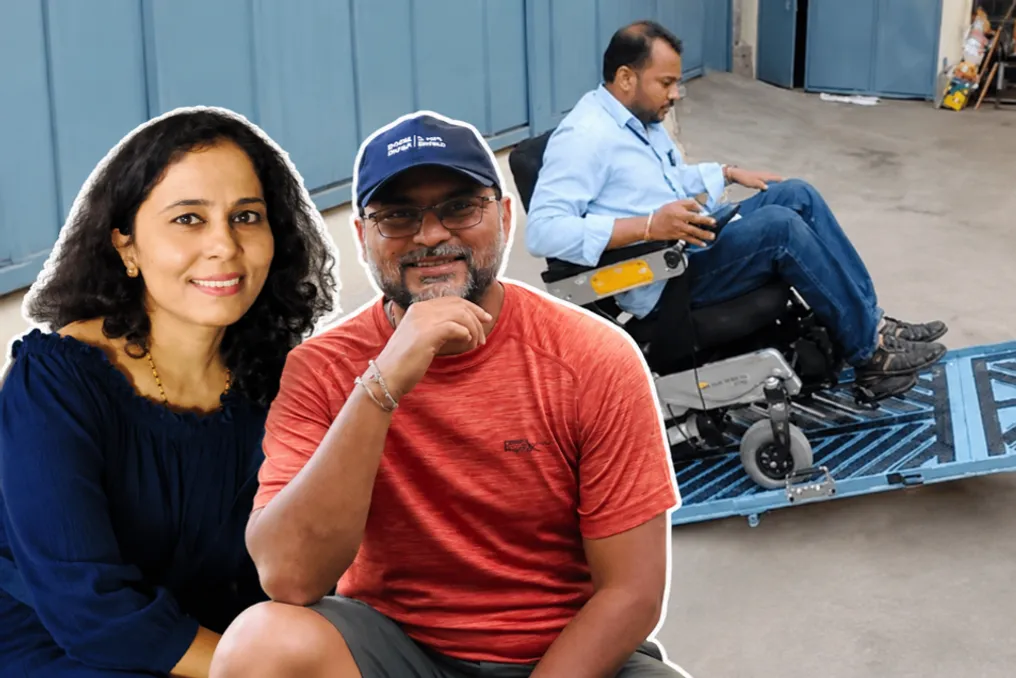
TRUE Assistive Technology, a company based in Bengaluru, was created precisely to solve this overlooked problem. Founded by engineers Naina Padaki and Anand Kutre, the company develops mobile assistive solutions, including swivel seats, portable ramps, transfer systems, and vehicle modifications for wheelchair access, making daily commutes safer and more accessible.
Since its inception, the company claims to have provided mobility for over 1000 users across India, supporting people with conditions such as paralysis, Parkinson's disease, post-polio complications, and age-related mobility issues.
Project that revealed a broader issue
Neither Naina nor Anand initially planned to create a company in the field of assistive technology. Both spent over two decades working as engineers—Naina in software and compliance engineering, and Anand in the automotive sector. Their path to accessible mobility began unexpectedly in 2013 when Toyota approached them with a project to develop a swivel seat for the Corolla Altis.
The prototype was presented at an auto show but did not gain widespread adoption due to its high cost. Naina recalls: 'We decided to explore how we could bring this solution to the Indian market.'
The idea was also shaped by another experience. Having previously lived in the United States before returning to India, the couple saw people with disabilities participating independently in daily life. Naina shares: 'We saw many disabled people in the US who were still leading their daily lives with full potential. We thought we should do something similar in India.'
However, this path was not easy. Without external funding, they developed the venture using income from consulting assignments. Anand recalls: 'Sometimes we had money, but no people, and sometimes we had people, but no funds. That's why it took about four years to put everything together.'
Interest slowly began to grow after an article about their work was published, prompting families to contact them directly. After serving the first hundred clients, the founders realized that there was a real demand for accessible mobility solutions in India. They expanded the design to fit almost 80 percent of Indian car models before officially establishing TRUE Assistive Technology in 2022.
Development considering Indian conditions
When Anand started designing products, one principle remained non-negotiable. He stated: 'I didn't want to do anything in a jugaad style.'
Instead of making permanent changes to vehicles, the founders focused on creating solutions that could fit into existing cars without affecting warranties, insurance, or resale value. Their flagship development, TurnPlus, is a patented swivel seat mechanism that converts a standard car seat into a rotating one. Instead of awkwardly climbing into or up to the cabin, the passenger first sits on the seat facing the door, and then it rotates back into the cabin, easing movement for the elderly and people with conditions such as paralysis, Parkinson's disease, multiple sclerosis, post-polio complications, and spinal injuries.
Unlike many vehicle modifications that require structural changes, TurnPlus uses the existing car seat. The mechanism is installed underneath it, allowing the seat to rotate without permanently altering the car's structure. Naina explains: 'We didn't want people to leave their cars in garages for days. You don't need to leave the car with us. We deliver the product to your door.'
Since the original seat remains untouched, the system can also be removed later if the owner decides to sell the car, thus preserving its market value. As they worked with more users, the founders realized that mobility issues rarely end once a person is in the car.
Some wheelchair users required a safer way to enter the vehicle without manual lifting. Others struggled with small steps near homes, clinics, or public buildings. This led to the creation of RamPlus—a lightweight portable ramp that can be carried in a car and deployed when there are steps or a raised entrance blocking wheelchair access. The company later introduced TransPlus and HoistPlus—transfer assistance systems and devices that help caregivers safely lift and move people between wheelchairs, beds, and vehicles, reducing physical strain on both users and families.
For people needing more extensive support, TRUE also performs comprehensive vehicle modifications, including wheelchair ramps, hydraulic lifts, and roof height adjustments, turning standard cars into wheelchair accessible vehicles. Before reaching users, every solution undergoes safety testing in the automotive industry, including front and rear crash tests, seatbelt attachment testing, and durability assessment across temperature ranges from minus 20°C to plus 60°C. These tests apply only to their products, not to the vehicle modifications themselves.
Anand emphasizes: 'If I had to sell this across India, it had to be as reliable as the car itself.'
Dependence on someone is very painful
For Jatin Gandotra, a resident of Amritsar, the technology entered his life after a close relative suffered a stroke. His relative, now over 60, has severely limited mobility and spent almost two years in bed. Jatin first learned about TRUE Assistive Technology while reading about their collaboration with Maruti Suzuki. He noted: 'I found this technology very fascinating because my close relative is a stroke patient. I wanted to see how we could help her.'
Today, the family uses TurnPlus to help her get into the car more comfortably. Speaking about the emotional impact, Jatin believes it goes far beyond the simple physical act of traveling. He says: 'Being dependent on someone is very, very painful. When you look into the patient's eyes, you see the satisfaction of being cared for.'
For him, accessible mobility ultimately means giving families more choice. He concludes: 'Look what freedom you can bring into their lives.'
More than just easier rides
The founders assert that these stories continue to strengthen their conviction in their chosen path. Among their earliest clients was a woman who completed her doctoral program earlier thanks to the ability to attend college more frequently after installing the mobility solution. Another user, Vijay Kannan, fulfilled a long-held dream of taking his parents to Ayodhya after equipping his car with an accessible ramp.
Naina notes: 'It's not just for the person using it. It helps the whole family. When they see how conveniently they can travel together, it changes things for everyone.'
Rashmi personally witnessed these changes. She says: 'The more we socialize these children, the happier they become. We shouldn't limit them to one room.'
Her daughter now plans trips with a confidence that many teenagers take for granted. She says: 'She says, 'We will go anywhere. We will explore this place.' She doesn't consider anything limited anymore.'
According to the 2011 census, over 26.8 million people in India live with disabilities, alongside a rapidly growing elderly population. Nevertheless, for many, something as ordinary as getting into a vehicle remains one of the biggest barriers to participation in daily life. For families like Rashmi's and Jatin's, accessible mobility is not just a vehicle modification; it is the ability to visit relatives without anxiety, travel to school or work more comfortably, take long-planned trips, or go out after months of staying at home. Sometimes, regaining independence starts with making the first step into a vehicle a little easier.