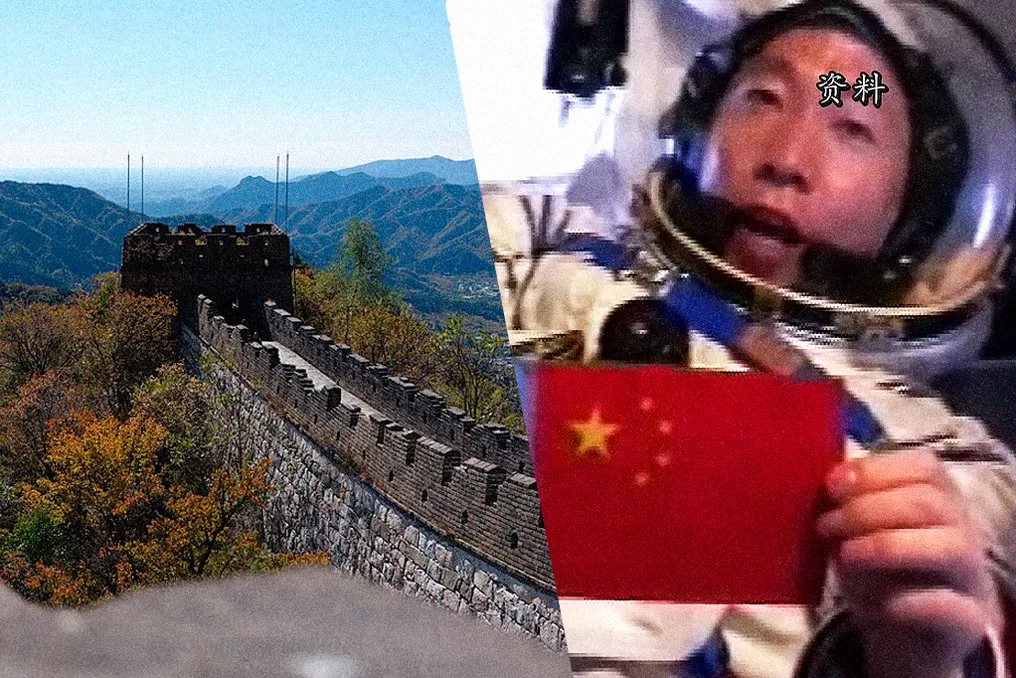
The belief that the Great Wall of China is visible from space dates back to the 18th century. In 1754, the English antiquarian William Stukeley mentioned in correspondence that the wall 'could be distinguished on the Moon,' more than two centuries before any human spaceflight.
This claim was reiterated in the 19th century. For example, in 1895, the British journalist Henry Norman stated that the wall was famous for being the only man-made structure on Earth visible from the Moon. However, the myth gained modern traction in 1932, through a cartoon in Ripley's Believe It or Not!, where the Great Wall was presented as 'the greatest work of man' and the only edifice visible to the naked eye from the Moon.
However, the reality is that this is merely a myth. This became evident when Yang Liwei, the first Chinese taikonaut, participated in a press conference in October 2003, shortly after his mission return. During this interview, he was questioned about the matter. Liwei had remained in orbit for 21 hours aboard the Shenzhou 5 spacecraft, an achievement that established China as the third independent country to send humans into space, after the Soviet Union and the USA.
Upon his return, Liwei was received as a hero, but he expressed his disappointment, commenting: 'Earth looked very beautiful from space, but I did not see our Great Wall.' This comment generated significant repercussion in China, leading to various reports suggesting that the structure would not be visible to any astronaut, frustrating many Chinese people who believed it to be the only man-made structure visible in space.
Despite debunking this fact, Liwei reported another occurrence during his orbital isolation: he heard a series of inexplicable knocks on the hull of the spacecraft, which he described as 'a wooden hammer hitting an iron bucket.' Given that space is an absolute vacuum and sound does not propagate in it, this noise should theoretically not exist.
According to Liwei, the sound did not seem to clearly emanate from inside or outside the capsule. Frightened, the taikonaut looked out the spacecraft window looking for any collision, but observed nothing. Subsequently, Chinese astronauts from the Shenzhou 6 and Shenzhou 7 missions, conducted in 2005 and 2008, respectively, also reported perceiving the same sound. The most plausible explanation for these events is that the crew members were hearing the spacecraft hull expanding and contracting due to temperature fluctuations.