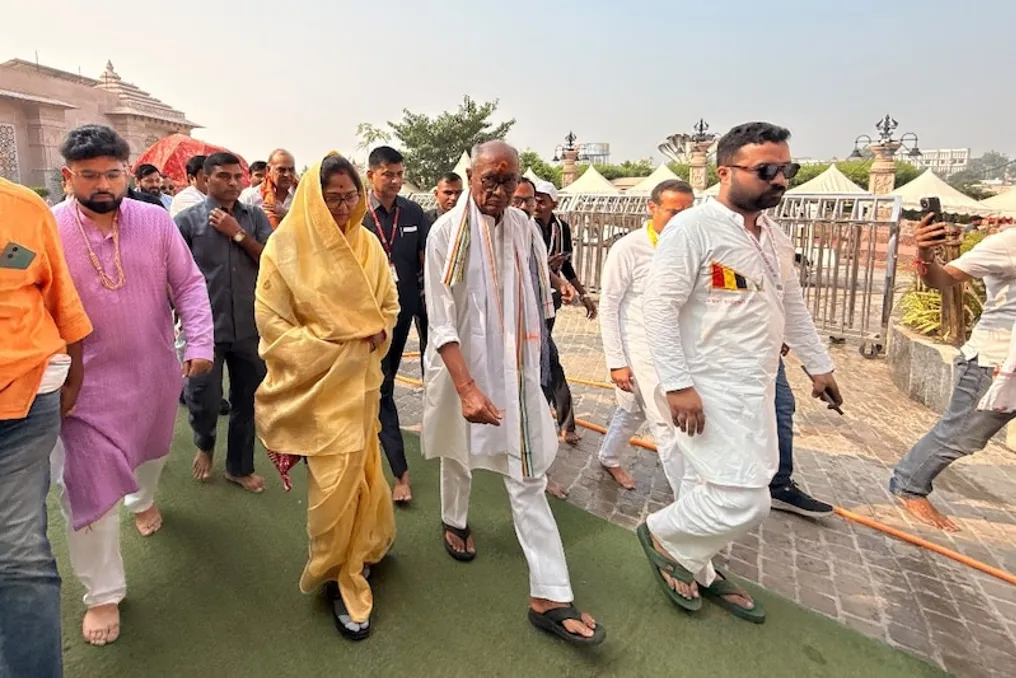
The start of the journey by Digvijay Singh, former Chief Minister of Madhya Pradesh, was shown, which began on October 20 in Ujjain. This foot expedition, named 'Satya Sanatana Swabhiman,' aims to cover a distance of about 950 kilometers and reach the Rama temple in Ayodhya in approximately 70 days. On the first day of the journey, various aspects of religion, faith, and politics were evident.
After visiting the Mahakal temple, creating a party Shivling, the presence of saints, the Devi cult, and holding charitable feasts, the procession continued to the sound of hymns, drums, and religious processions.
On the morning of October 20 in Ujjain, the journey started with a visit to the Mahakal temple. Then, Digvijay Singh and his wife Amrita Singh visited the Chintaman Ganesh temple. After this, upon arriving at Balaji Garden, the participants saw a large number of saints and organized the creation of party Shivlings. The area had many representatives of the religious community who collectively engaged in creating these Shivlings, while others prepared for rituals. The atmosphere was religious, accompanied by melodies of hymns dedicated to Rama and Shiva.
Digvijay Singh's son and Congress leader Jayvardhan Singh actively participated in organizing the event. After the completion of creating the party Shivlings and conducting worship, the Devi cult took place, followed by an organized feast. After all religious rituals were completed, the caravan set off from the venue onto the streets. Around noon, the official movement began for the long journey from Ujjain to Ayodhya.
In the caravan, a procession of Shiva-Parvati led the way, along with mobile vans equipped with LEDs, DJs, singing groups, and drummers. In addition to the national flag, religious banners were also visible. A group of sadhus and saints also participated in the procession. People walked carrying a portrait of Lord Rama and water from five rivers: Shipra, Narmada, Yamuna, Ganga, and Saru.
Behind the religious carriage, Digvijay Singh walked on foot with his wife Amrita Singh, hundreds of saints, and supporters. As the caravan moved through the streets, it was accompanied by the sounds of hymns and drums. This caravan, adorned with religious symbols, demonstrated the stated purpose of the trip: it is not just a path from Ujjain to Ayodhya, but also an opportunity to raise issues regarding the transparency of donations in temples and the accountability of religious institution management.
Digvijay Singh's journey name, 'Satya Sanatana Swabhiman,' reflects his stated themes, including the demand for transparency in temple donations and accountability in the management of religious institutions. He raises questions regarding the donation system in Ram Mandir and alleged misappropriation of funds. Furthermore, he touches upon the issue of vote theft. Although the journey began with religious events, such as visiting Mahakala and creating party Shivlings, it is also connected to issues concerning the functioning of temples.
Digvijay Singh intends to bring these issues to the public arena through this journey. However, accusations of irregularities in the collection or distribution of donations cannot be considered proven facts until appropriate evidence emerges. Therefore, the reaction of the relevant authorities to the issues raised during the journey will be significant.
The religious aspect in Digvijay Singh's politics is not new. His critics have often labeled him as an anti-Sanatan figure. On the other hand, his participation in religious events, such as the pilgrimage to Narmada and the visit to Lord Vitthal in Pandharpur, has also been part of his public life. Now, the 'Satya Sanatana Swabhiman' journey from Ujjain to Ayodhya has once again placed him at the center of the discussion surrounding religion and politics.
Questions arise as to whether this is an expression of religious faith, an attempt to draw attention to the transparency of temple management, or if there is a political message embedded within it. On the first day of the journey in Ujjain, all these facets were evident against the backdrop of religious events and the presence of saints. However, the true impact of the journey will become clear as it progresses and as the issues are raised in subsequent stages.
Digvijay Singh's plan involves covering a distance of about 950 kilometers in approximately 70 days to reach Ram Mandir in Ayodhya. During this journey, he will have the opportunity to interact with people at various stops and voice his concerns. In Ujjain, the journey began with a distinctly religious character: from visiting Mahakala to creating party Shivlings, the Devi cult, charitable feasts, and singing hymns; the first day was dedicated to various forms of faith. Along with this...