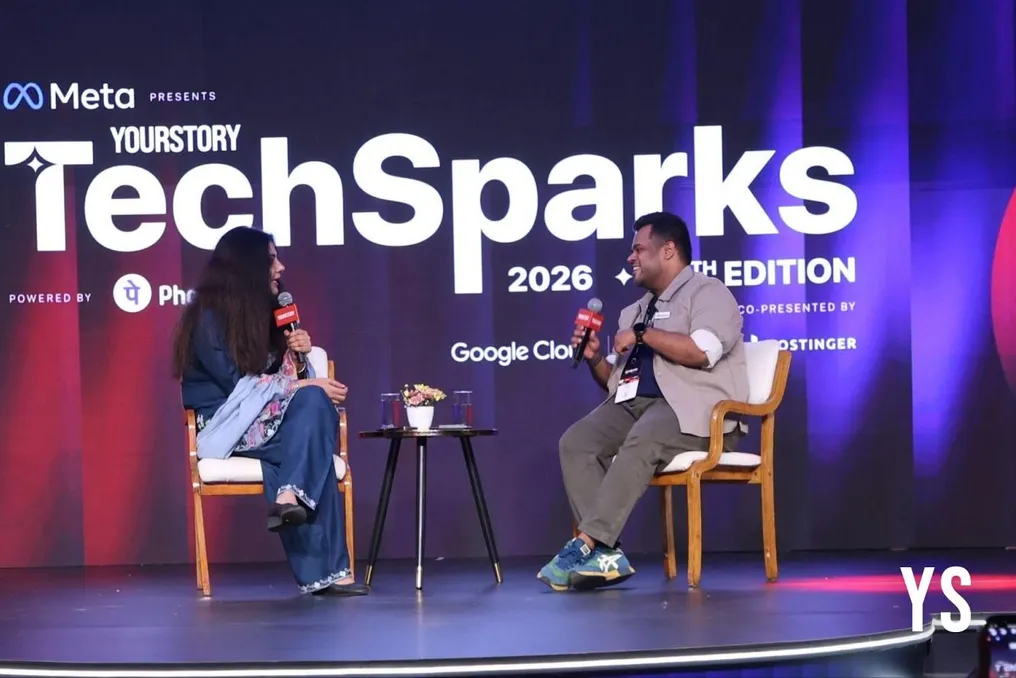
Saurabh Pandey, founder and CEO of Eloelo Group, posits that artificial intelligence is capable of overcoming barriers in the creation of Indian content. He noted that when James Cameron's epic sci-fi film 'Avatar' was released in the late 2000s, many Indians questioned why their own cinema did not reach such a level.
Eloelo is an Indian social gaming and live entertainment platform based in Bengaluru. It was launched in 2020 by former Flipkart executives, Pandey and Akshay Dubey. The platform combines interactive games with video and audio streaming, specifically tailored for youth and local markets in India.
At the 17th TechSparks event by YourStory, Pandey demonstrated Dolphin AI—an AI-powered video creation tool from Eloelo. The presentation focused on the topic, 'Can AI turn India into a global content export hub?' and was moderated by Shraddha Sharma, founder and CEO of YourStory and The Bharat Project.
Dolphin AI currently has a waiting list, and the platform releases invitation codes in batches. For now, Dolphin AI is available for free, as Eloelo provides generous starter credits allowing creators to produce initial videos and familiarize themselves with the solution. However, a credit-based pricing model is planned for the future. Pandey stated that the team primarily wants to study Dolphin AI usage patterns, and preliminary results look promising: approximately 15,000 videos were created in about eight days, mainly through organic search.
Pandey's main thesis concerns who has the right to tell big stories. He argued that in the age of visual effects, filmmaking depended on financial resources. A good storyteller conceiving a historical drama often could not afford the necessary visual effects, making budget the primary constraint on content. AI, in his view, is a game-changing tool. Since production typically consumes 50 to 60% of revenue in this category, it narrows budgets for distribution and disrupts the unit economics. By reducing production costs, AI gives creative imagination the necessary space to develop.
Meanwhile, distribution has become largely algorithmic. Content creators in India now compete for attention in the US or Europe on equal footing with any other market participant.
The discussion then moved to another growing segment of content—microdramas and short-form content. These formats have attracted many Indian startups, but few have become popular. Pandey noted that the combined turnover of four or five leading microdrama players in India exceeded 5,000 crore rupees in just 18 months.
He also pointed to South Korea, a country of 52 million people, which has built a $15 billion content export economy. In contrast, India has 1.4 billion people and possesses immense creative talent. The problem, he believes, lies in the lack of intent, technology, ambition, and capital. In his opinion, too many Indian content creators focus exclusively on the local audience. He emphasized that no one asks if a new large language model is being launched for India; it is simply launched for the entire world. Therefore, Indian stories should not be an exception.
Pandey does not expect microdrama to escape the same pattern observed in other sectors. Food delivery, quick commerce, e-commerce, and taxi services eventually ended up in the hands of two or three major players controlling 70–75% of the market, and he predicts a similar development in the content sector. According to him, the real opportunity lies on the side of content supply.
Eloelo released about 200 new microdramas last month, averaging five or six per day, and collaborates with around 90 production companies. His advice to future founders is to abandon the platform race and instead create small, AI-focused studios: a group of writers, editors, promo producers, and line producers who could supply microdramas, OTT platform content, and exportable intellectual property to major platforms.
He also addressed authors and producers who fear AI, advising them to use it as a brainstorming partner and to release more content. As an example, he mentioned an idea close to his heart: there is an AI Ramayana, but no one has yet created an impressive AI Mahabharata.
Pandey added that Eloelo has grown from one platform to five within one group, and an imminent IPO is not planned. The main focus is on sustainable and profitable growth.