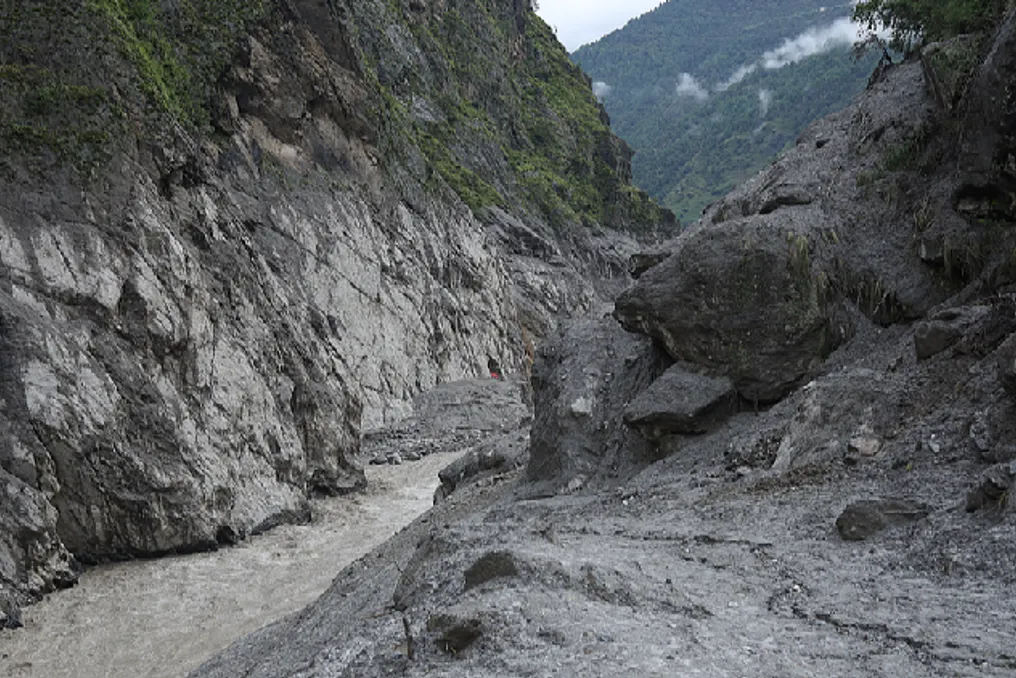
The recent devastating glacier collapse and subsequent mudflow at the China-Nepal border in August highlighted the critical need to strengthen cross-border cooperation in combating mountain hazards. Against this backdrop, the Global Mountain Chain Initiative with Intelligent Early Warning and Risk Management (M-CHAIN) was launched on October 18th at the Chengdu University of Technology.
Fan Xuanmei, chairman of the M-CHAIN initiative, discussed the importance of international collaboration in early warning and risk management for mountain hazards. Fan also serves as the Secretary of the Party Committee and Director of the State Key Laboratory of Geo-hazard Prevention and Geo-environment Protection at the Chengdu University of Technology.
The launch of M-CHAIN took place on October 18th at the Chengdu University of Technology. In July, this initiative was included in the third group of approved projects under the UN International Decade for Sustainable Development of Science (IDSSD, 2024–2033). This marked the first international mega-scientific initiative led by China in the field of geo-hazards to receive approval under IDSSD, and the only such initiative among the 22 approved projects in this third group.
More than 100 experts and scientists from over 20 countries and regions, as well as representatives from international organizations including UNESCO, ICIMOD, the International Association of Engineering Geology and Environment (IAEG), and the International Consortium on Landslides (ICL), participated in related events.
M-CHAIN is coordinated and led by the State Key Laboratory of Geo-hazard Prevention and Geo-environment Protection at the Chengdu University of Technology. The initiative, launched by Professor Fan Xuanmei, brings together research institutes and specialists from countries such as Italy, Nepal, the United Kingdom, the Netherlands, New Zealand, Switzerland, Canada, and Peru, and collaborates with international organizations like ICIMOD, IAEG, and ICL.
The initiative aims to address an increasingly pressing global problem. Driven by climate change and complex environmental conditions, mountain hazards are becoming more complex in formation and development, exerting impacts that can spread across river basins, regions, and national borders. Questions arise about how research can go beyond individual hazards to understand entire hazard chains, and how scientific advancements can be translated into coordinated disaster risk reduction opportunities. These questions have become central to global mountain hazard risk management.
Global climate change is increasingly transforming hazard occurrence processes in high-altitude areas, and its consequences extend far beyond the mountains themselves, affecting people, infrastructure, and development trajectories. Accelerated warming causes rapid cryosphere retreat, permafrost degradation, and glacial destabilization. Simultaneously, extreme precipitation events are increasing and intensifying, while expanding human activity in hazardous areas further increases exposure and vulnerability.
Under this cumulative pressure, landslides, mudflows, ice-rock avalanches, and glacial lake outburst floods are often interconnected components of developing hazard chains, rather than independent phenomena. Such cascading processes can occur immediately following a triggering event or continue for months, years, and even decades, altering landscapes and changing downstream risk patterns.
Thus, mountain hazards can no longer be adequately understood or managed as isolated events. Instead, they increasingly manifest as cascading hazard chains, where one process triggers or amplifies subsequent hazards, and the consequences spread across space, time, and administrative boundaries.
A simple definition of individual hazard locations is insufficient to reflect this complex dynamic. Effective disaster risk reduction requires a systemic understanding of hazard chains, including their formation conditions, evolution pathways, and risk propagation mechanisms.
M-CHAIN was developed to meet these scientific and managerial needs. The initiative, scheduled for the period 2026 to 2034, integrates expertise in geology, climatology, remote sensing, artificial intelligence, engineering disaster prevention, and public administration. It focuses on overarching scientific questions and critical technological challenges in managing cascading geo-hazards in major mountain systems worldwide. The goal of the initiative is to shift research from localized hazard identification to integrated understanding, and from experience-based judgments to data- and physics-based approaches.
Specifically, M-CHAIN will create an open and common global database of mountain hazard chains, integrating multi-source data from remote sensing, field studies, historical disaster records, and social vulnerability assessments. The initiative will conduct demonstration studies and pilot intelligent early warning projects in representative mountain systems, including the Himalayan-Qinghai-Tibet Plateau, the Alps, and the Andes, and develop methods for intelligent hazard detection, precise monitoring, early warning, and risk assessment in complex environmental conditions.
Furthermore, the initiative will promote the application of artificial intelligence and big data for identifying hazard chains, modeling their evolution, and analyzing risks, exploring approaches to monitoring, early warning, risk assessment, and coordinated management that can be replicated and scaled.
Mountain hazard chains can propagate down river valleys, and their consequences extend far beyond the areas where the hazards originated. In 2023, the outburst of Lake South Khola in Sikkim, India, led to floods that destroyed a major hydropower facility and affected areas hundreds of kilometers from the site. In 2025, a sudden glacial lake outburst upstream of the Girionga port area in Sichuan Autonomous Region, Southwest China, impacted downstream infrastructure in China and caused serious losses in Nepal.
In 2026, another cascading disaster occurred in the China-Nepal border region near the Girionga port: a high-altitude ice-rock avalanche from the Nepali side escalated into a high-speed mudflow, which reportedly devastated the port area and spread nearly 100 kilometers downstream, with reports of over 6,500 fatalities or missing persons. These cases illustrate why mere hazard locations, administrative jurisdictions, and disciplinary viewpoints are insufficient to address the growing risks associated with cascading mountain hazards.
Nevertheless, monitoring capabilities, data standards, information exchange mechanisms, and early warning procedures often vary from one region to another. Even if one area detects signs of an impending hazard, monitoring results may not lead to effective disaster prevention if the information is not transmitted in time or if local communities lack the capacity to assess risks and take appropriate response measures. Thus, managing cascading mountain hazards is not only a scientific issue but also a matter of interregional and cross-border governance.
M-CHAIN views cascading mountain hazards as a common global problem. Through demonstration studies and pilot intelligent early warning projects in representative mountain systems, it seeks to foster cooperation between countries and regions in monitoring, assessing, and managing. In areas subject to transboundary risks, including the China-Nepal border region, partners can work together according to local needs to prioritize hazards, analyze hazard chain scenarios, integrate multi-source monitoring data, and coordinate early warning. These efforts can help establish mechanisms for risk information sharing, joint assessments, and emergency response coordination.
International cooperation does not mean that all disasters can be prevented or that every event can be predicted precisely in advance. Its practical value lies in improving collective understanding of complex risks, strengthening information exchange and coordination among affected regions, and providing a more systematic scientific basis for transboundary disaster risk management. Hazard chains can cross national borders; cooperation on risk information and disaster prevention should not stop there.
High-risk mountain regions are widespread globally, and some still face limitations in monitoring resources, early warning technologies, and professional expertise. Research on cascading hazards requires not only scientific breakthroughs but also the transformation of research methods, technological achievements, and practical experience into disaster risk reduction capabilities that various countries and regions can understand, develop, and apply.
International scientific cooperation limited to academic exchange and scientific publications cannot fully solve these practical challenges. Joint research must be combined with technical exchange, talent development, and capacity building if scientific knowledge is to effectively serve local hazard identification, monitoring, early warning, and risk management.
M-CHAIN will utilize international learning platforms, such as iRALL School, to facilitate international exchange and the development of early-career researchers. Through courses, academic seminars, field training, and case studies, it will promote the exchange of knowledge and experience among researchers from different countries.
By involving early-career scientists in international cooperation and practical research, the initiative aims to strengthen their ability to understand cascading hazards, apply scientific methods, and participate in joint international research. In doing so, it will contribute to the co-production, dissemination, and application of scientific knowledge on disaster risk reduction.
Natural conditions, technological capabilities, and governance systems vary across regions. International cooperation should not impose a single model on all local conditions. Rather, through joint research and experience sharing, it should help develop risk reduction approaches tailored to the characteristics of different regions while allowing for the joint production, sharing, and application of scientific knowledge.
By moving from understanding hazard chains to strengthening interregional coordination and capacity building, M-CHAIN aims to transform international scientific cooperation into practical action for addressing global mountain hazards risks. In doing so, it aims to enhance mountain resilience.