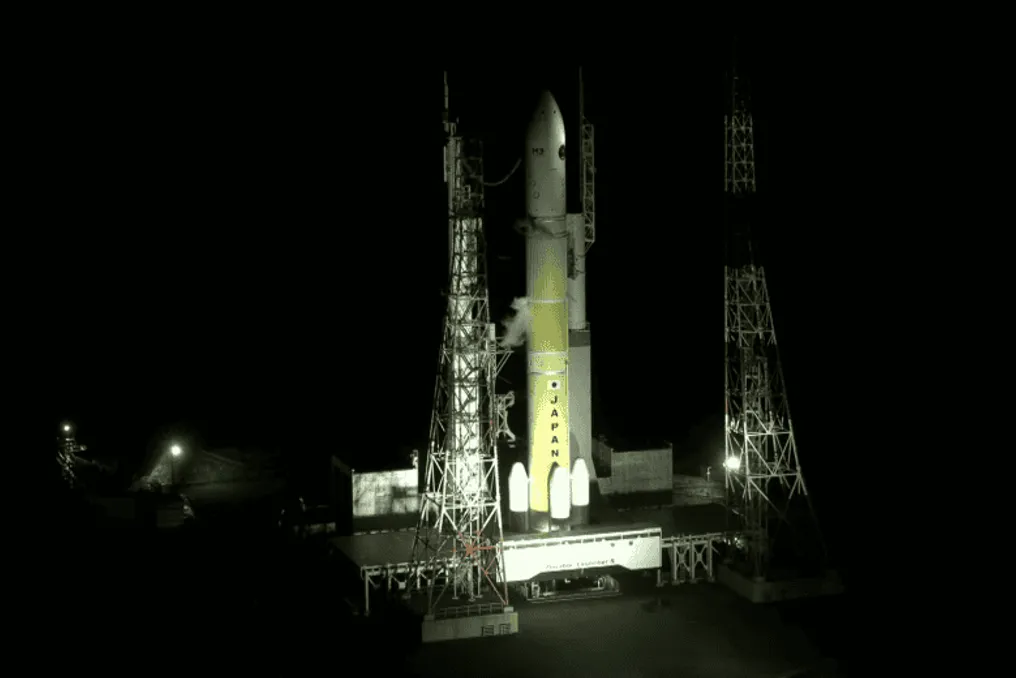
Japan began a space mission on Monday, the 19th, at 4:41 PM (Brasília time), with the launch of the MMX probe (Mars Moon Exploration). This mission aims to bring samples from one of Mars' moons back to Earth.
The MMX probe was launched aboard an H3 rocket from the Tanegashima Space Center in Japan. It is scheduled for a journey of about five years, with the purpose of investigating Phobos and Deimos, the two natural satellites of the red planet.
Under the leadership of the Japan Aerospace Exploration Agency (JAXA), the mission seeks to achieve an unprecedented feat: landing on Phobos, collecting material from its surface, and bringing it back to the planet. The goal is to obtain a minimum of ten grams of samples, which are expected to arrive on Earth in 2031.
This endeavor involves the participation of NASA and European space agencies, as well as various institutions and companies that provided essential scientific equipment and technologies for the mission.
One of the primary scientific focuses of MMX is to understand how Phobos and Deimos originated. There are two main theories to explain the genesis of these Martian moons. One suggests that the satellites resulted from material ejected into space after a large impact on the planet, where the fragments agglomerated to form the two moons.
The second hypothesis maintains that Phobos and Deimos are asteroids that approached Mars and were captured by the planet's gravitational force. The analysis of the collected samples will be crucial to differentiate between these possibilities. If the origin was an impact, the materials may contain traces of Mars mixed with debris from the impacting body. On the other hand, if they are captured asteroids, they may retain chemical characteristics of other areas of the Solar System.
The findings of this mission also have the potential to expand knowledge about the geological evolution of Mars and the formation of rocky planets. Additionally, MMX will investigate the viability of Phobos serving as a natural space station for future crewed missions to Mars.
MMX is part of a global effort aimed at better understanding the Martian environment and developing the necessary technologies for long-duration space exploration. JAXA plans to utilize accumulated experience from previous asteroid sample collection missions to conduct the operation on Phobos. NASA also supports the spacecraft, contributing scientific instruments, collection equipment, and communication systems.
If the mission is successful, it will enable the study in terrestrial laboratories of materials taken directly from a Martian moon. The detailed investigation of these materials may answer questions that remote observations have not yet been able to solve. The capsule containing the samples is expected to return in 2031, at which time scientists can begin analyzing the material gathered during the journey.