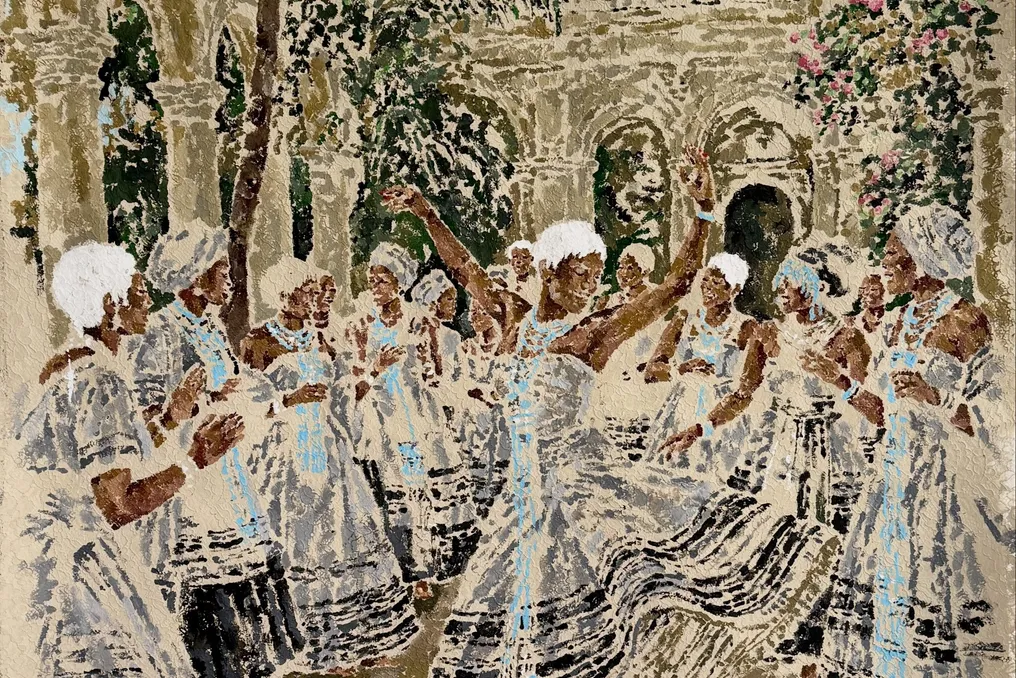
South African artist Bukakawuli Nobakada creates works of art using intricate lace surfaces, sculptural details, and images of uncompromising luxury to craft worlds where Black women are not just present, but feel completely at home.
For Nobakada, whose art explores what it means to see oneself in a world that rarely provided such space, the answer lies in depicting Black women in a future defined by beauty, freedom, and abundance.
Her paintings feature Black women relaxing by pools, strolling through lush gardens, and inhabiting luxurious interiors with an effortless sense of belonging. These scenes are not merely distant dreams, but imagined realities where Black women occupy their space on their own terms, surrounded by the luxury, ease, and opportunities that were too often denied to them.
Born in the Western Cape in 2000 and raised between the Philippines and the rural village of Lady Ferrer, Nobakada develops a unique visual language, drawing inspiration from personal history, domestic craft, and the politics of representation. She currently works in Johannesburg and London, exploring how everyday materials, rituals, and the aesthetics of Blackness can form the basis for something monumental.
Reimagining the Familiar
One of the most distinctive elements of Nobakada's work is her use of lace paper, which she prepares by hand and works with acrylic paint. Some pieces are further embellished with sculptural clay or gold accents, adding texture and volume to surfaces already rich in detail.
The choice of lace holds deep personal significance as it reminds her of the curtains in her grandmother's house. These curtains were maintained and mended by women in her family. What might be considered an ordinary household item becomes a starting point for examining gender, labor, craft, and the transmission of knowledge between generations of women.
In Nobakada's hands, this inherited material takes on an entirely different scale. It transforms into landscape, architecture, clothing, and skin. The domestic becomes monumental, and the traditions rooted in the home become part of a broader visual dialogue about Black identity and self-determination.
There is a quiet power in this transformation. By bringing material associated with domestic life into contemporary painting, Nobakada establishes a connection between the women of the past and the worlds she portrays today.
The Power of Being Seen
At the heart of Nobakada's work is what she calls performative visibility: the meticulous ways in which Black women style, dress, and present themselves to the world. The beauty in these paintings is not superficial; it represents a form of intellect, subjectivity, and self-determination.
Fashion
Adornments and hyperfemininity become modes of identity assertion, and luxury transcends being a mere marker of material wealth. It transforms into a psychological space where various future scenarios can be envisioned.
Her models are not depicted as visitors to these spaces nor waiting for permission to belong. They move through them with confidence and ease. Their presence challenges the conventional visual narratives that have too often restricted the portrayal of Black women in art, culture, and the mass consciousness.
The result is a work that is visually captivating yet carries a deeper message. Representation is not just about being noticed; it is also about expanding what is possible once one becomes visible.
Imagination of Abundance
There is a special freedom in imagining a life beyond what has been shown. Nobakada's paintings prompt viewers to consider what happens when beauty, comfort, and abundance become part of the visual lexicon through which Black women are represented.
Her work raises several questions that extend beyond the canvas: Who grows up seeing people like themselves surrounded by beauty and freedom? What changes when these images become more visible? And how can the act of imagining another world influence our understanding of our place in the existing world? These questions lend emotional weight to Nobakada's works. Her paintings are not just depictions of a luxurious lifestyle; they are exercises in possibility. They offer a world where Black women are free to define beauty for themselves, enjoy their surroundings, and envision lives not dictated by inherited limitations.
Her artistic practice finds its place through Nobakada's growing international recognition. In 2023, she received the ANNA Audience Award. In 2025, she presented her first solo museum exhibition in the United States at the Albany Museum of Art, which subsequently acquired two of her works.
These milestones mark an important moment for an artist whose practice merges personal memories, material experimentation, and thoughtful engagement with the representation of Black women. However, the significance of Nobakada's work lies not only in where it is exhibited or collected, but in the worlds it makes accessible to viewers. Through lace, paint, adornments, and meticulously constructed scenes of abundance, she develops a visual language that honors the women who shaped her while simultaneously creating space for new generations to represent themselves differently.
In Nobakada's world, Black women do not have to wait for an invitation to the future. They are already there, occupying it with beauty, confidence, and intention.